Paper 1 AQA A level Biology Questions & Answers 100% Correct
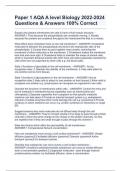
________________________________________ Explain why plasma membranes are said to have a fluid mosaic structure. - ANSWER1. Fluid because the phospholipids are constantly moving. 2. Mosaic because the proteins are scattered throughout the membrane-like tiles in a mosaic. What effect does cholesterol have on the cell membrane? - ANSWER1.Cholesterol molecules fit between the phospholipids and bind to the hydrophobic tails of the phospholipids. 2.Causes them to pack together more closely, restricting the movement of other molecules in the membrane. 3.Cholesterol makes the membrane less fluid and more rigid. 4.Cholesterol helps to maintain the shape of animal cells, which is important because animal cells don't have cell walls (especially important for cells which are not supported by other cells e.g. red blood cells). State 3 functions of glycolipids in the cell membrane. - ANSWER1. Act as recognition sites. 2. Maintain the stability of the membrane. 3. Help cells attach to one another and so form tissues. State 3 functions of glycoproteins in the cell membrane. - ANSWER1.Act as recognition sites.2.Help cells to attach to one another so form tissues.3.Allow cells to recognise one another e.g. lymphocytes can recognise an organisms's own cells. Describe the functions of membranes within cells. - ANSWER1.Control the entry and exit of materials in membrane-bound organelles such as mitochondria and chloroplasts.2.Separate organelles from cytoplasm so that specific metabolic reactions can take place.3.Provide an internal transport system e.g. endoplasmic reticulum.4.Isolate enzymes which could damage the cell e.g. lysosomes.5.Provide surfaces on which reactions can occur e.g. protein synthesis on ribosomes on rough ER. Suggest reasons why most molecules do not diffuse freely through the cell membrane. - ANSWER1.They're not lipid soluble.2.Too large to pass through protein channels.3.Have the same charge as the charge on the protein channels, so they are repelled even if they are small enough to pass through the channel.1 State two factors which affect the permeability of cell membranes - ANSWER.1.Temperature2.Solvent concentration How can substances move across a cell surface membrane? - ANSWER1.Simple diffusion (passive)2.Facilitated diffusion (passive)3.Osmosis (passive)4.Active transport (active)5.Co-transport (active) Describe how substances can move across a cell surface membrane. - ANSWER1.Small/non-polar/lipid-soluble substances can cross by simple diffusion down a concentration gradient.2.Large/polar molecules - pass through channel proteins/carrier proteins, by facilitated diffusion, down a concentration gradient.3.Water - moves by osmosis from an area of high water potential to an area of lower water potential.4.Active transport - moves substances against a concentration gradient, involves protein carriers and requires ATP.5.Glucose/amino acids can be co-transported across a cell membrane alongside sodium ions.* DON'T EVER SAY THAT A MOLECULE MOVES 'ACROSS' OR 'ALONG' A CONCENTRATION GRADIENT - MAKE SURE YOU SAY 'UP' OR 'DOWN' OR 'AGAINST' Define diffusion. - ANSWERThe net movement of molecules or ions from an area of higher concentration to an area of lower concentration until evenly distributed.Define os
Written for
- Institution
- Paper 1 AQA A level Biology
- Course
- Paper 1 AQA A level Biology
Document information
- Uploaded on
- June 6, 2024
- Number of pages
- 12
- Written in
- 2023/2024
- Type
- Exam (elaborations)
- Contains
- Questions & answers
Subjects
- explain w
-
paper 1 aqa a level biology questions
-
paper 1 aqa a level biology stuvia
-
what effect does cholesterol have on the cell memb

Also available in package deal