

100% satisfaction guarantee Immediately available after payment Both online and in PDF No strings attached 4.2 TrustPilot
logo-home
Exam (elaborations)

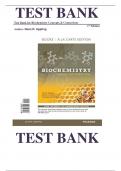
Test Bank for Biochemistry Concepts and Connections 1st Edition by Dean R. Appling, Spencer J. Anthony-Cahill & Christopher K. Mathews , ISBN: 9780321839923 |COMPLETE TEST BANK| Guide A+

Rating
-
Sold
-
Pages
102
Grade
A+
Uploaded on
06-06-2024
Written in
2023/2024

Biochemistry: Concepts and Connections (Appling et al.) Chapter 1 Biochemistry and the Language of Chemistry 1) The water content in the human body is approximately: A) 90%. B) 80%. C) 70%. D) 60%. E) 50%. Answer: C 2) The four most abundant chemical elements in living systems are: A) hydrogen, oxygen, sulfur and phosphorus. B) hydrogen, carbon, nitrogen and oxygen. C) sodium, potassium, carbon and oxygen. D) sodium, potassium, nitrogen and sulfur. E) carbon, nitrogen, oxygen and potassium. Answer: B Objective: 1.2 3) Nearly all proteins contain: A) cobalt. B) phosphorus. C) selenium. D) sulfur. E) none of the above. Answer: D Objective: 1.2 Global LO: G7 4) Which of the following statements is FALSE? A) Proteins can be structural components of cells. B) Proteins can transmit signals between cells. C) Proteins can transport molecules within cells and between cells. D) Proteins can be both hormones and hormone receptors. E) Proteins are the only biological polymer that can catalyze biochemical reactions. Answer: E Objective: 1.2 Global LO: G7 1 Copyright © 2016 Pearson Education, Inc. 5) Which of the following is NOT classed as a lipid? A) Cholesterol B) Palmitic acid C) Glycerol D) Phosphatidyl serine E) Triacylglycerol Answer: C Objective: 1.2 Global LO: G7 6) Amino acids and simple organic compounds like carbon dioxide and hydrogen cyanide cannot be produced without the use of enzymes. Answer: FALSE Objective: 1.2 Global LO: G7 7) Oxidation-reduction reactions, which are the basis of many biochemical reactions and pathways, cannot take place in the absence of oxygen. Answer: FALSE Objective: 1.2 Global LO: G7 8) Many biochemical reactions that form biopolymers from monomeric units involve the removal of water. Answer: TRUE Objective: 1.2 Global LO: G7 9) The principle component of a biological membrane is a triglyceride. Answer: FALSE Objective: 1.2 Global LO: G7 10) The chemical element ________ has a role in both transfer of energy as well as in the structure of nucleic acids. Answer: phosphorus Objective: 1.2 Global LO: G7 11) List the four major classes of biological macromolecules. Answer: lipids, carbohydrates, proteins, nucleic acids Objective: 1.2 Global LO: G7 2 Copyright © 2016 Pearson Education, Inc. 12) An amphipathic molecule provides the foundation for biological membranes because they have both ________ and ________ functional groups. Answer: hydrophobic, hydrophilic Objective: 1.2 Global LO: G7 13) Genomics is concerned with the entire ________, while ________ is focused on identifying all of the proteins of a cell. Answer: genome, proteomics Objective: 1.5 Global LO: G1 3 Copyright © 2016 Pearson Education, Inc. Biochemistry: Concepts and Connections (Appling et al.) Chapter 2 The Chemical Foundation of Life: Weak Interactions in an Aqueous Environment 1) Each of the following is a noncovalent interaction EXCEPT: A) a hydrogen bond. B) a carbon-hydrogen bond. C) the interaction between an amino and a carboxylate group. D) a van der Waals interaction. E) an interaction between —NH3+ and a water molecule. Answer: B Objective: 2.1 Global LO: G7 2) The most important noncovalent interaction in biochemistry is the ________ bond. Answer: hydrogen Objective: 2.1 Global LO: G7 3) Which of the following is FALSE when considering van der Waals interactions? A) The van der Waals radius represents the most stable distance between two interacting centers. B) Van der Waals radii can determine molecular surfaces. C) Molecules that interact by van der Waals forces do not interpenetrate. D) The total interaction energy is the sum of the attractive and repulsive forces. E) They are not important in determining the stability of three-dimensional structures of proteins. Answer: E Objective: 2.2 Global LO: G2 4) Which of the following in biological compounds are sufficiently electronegative to serve as strong donors in a hydrogen bond? A) Hydrogen and oxygen B) Oxygen and nitrogen C) Nitrogen and hydrogen D) Hydrogen and carbon E) Nitrogen and carbon Answer: B Objective: 2.2 Global LO: G7 5) Hydrogen bonds share features of both covalent and noncovalent bonds. Answer: TRUE Objective: 2.2 Global LO: G2 1 Copyright © 2016 Pearson Education, Inc. 6) Which of the following is TRUE of hydrophobic molecules? A) They have limited solubility in water. B) Water forms a cage-like structure around them. C) Dissolving in water decreases the entropy of the mixture. D) They self-associate by releasing some of the surrounding water molecules. E) All of the above Answer: E Objective: 2.3 Global LO: G2 7) Water is both a hydrogen bond donor and acceptor. Answer: TRUE Objective: 2.3 Global LO: G2 8) Amphipathic molecules are not able to interact via van der Waals forces. Answer: FALSE Objective: 2.3 Global LO: G2 9) Ionic compounds can be readily dissolved in water because the high dielectric constant of water screens and decreases the ________ force between the oppositely charged ions. Answer: electrostatic Objective: 2.3 Global LO: G7 10) The ________ describes the tendency for hydrophobic molecules to aggregate because of the exclusion of water with the consequent increase of entropy of the solvent. Answer: hydrophobic effect Objective: 2.3 Global LO: G7 11) Glycine cannot serve as a buffer because it has two ionizable groups. Answer: FALSE Objective: 2.4 Global LO: G7 12) The average charge on an amino acid below its pI will be positive. Answer: TRUE Objective: 2.4 Global LO: G2 13) Calculate the acid dissociation constant Ka of a 0.2 M solution of weak acid that is 0.1% ionized. Answer: 2 × 10⁻⁷ Objective: 2.4 Global LO: G4 2 Copyright © 2016 Pearson Education, Inc. 14) Calculate the pH of a 0.1 M phosphate buffer (pKa = 6.86) that contains equal amounts of acid and conjugate base. Answer: 6.86 Objective: 2.4 Global LO: G4 15) Calculate the pH of a 0.2 M acetate buffer (pKa = 4.77) that contains twice as much acid as conjugate base. Answer: 4.47 Objective: 2.4 Global LO: G4 16) The pKa of each amino acid residue in a protein will not be influenced by the adjacent residue. Answer: FALSE Objective: 2.5 Global LO: G2 17) Calculate the pH at the end of an enzyme-catalyzed reaction if it were carried out in a 0.1 M phosphate buffer, pH 6.86 and 0.005 M of acid was produced during the reaction? Answer: 6.77 Objective: 2.5 Global LO: G4 18) If hydroxide is added to an amino acid it will become increasingly ________ charged. Answer: negatively Objective: 2.6 Global LO: G7 19) Calculate the pH of a weak acid that is 0.2% ionized in a 0.2 M solution. Answer: 3.39 Objective: 2.6 Global LO: G4 20) The net charge on an amino acid at its isoelectric point (pI) is ________. Answer: zero Objective: 2.7 Global LO: G7 3 Copyright © 2016 Pearson Education, Inc. 21) Many proteins interact with DNA at physiological pH because: A) proteins are naturally attracted to DNA regardless of the pH. B) the negatively charged DNA is electrostatically attracted to positively charged regions on proteins. C) the positively charged DNA is electrostatically attracted to negatively charged regions on proteins. D) proteins and DNA interact using mainly hydrophobic interactions. E) both proteins and DNA are at their isoelectric points at physiological pH and tend to aggregate. Answer: B Objective: 2.8 Global LO: G2 22) Small ions in biological fluids: A) encourage strong electrostatic interactions between oppositely charged macroions at low ionic strengths. B) encourage strong electrostatic interactions between oppositely charged macroions at high ionic strengths. C) have no effect on the interactions between oppositely charged macroions. D) tend to cluster around macroions of the same charge. E) have large effects on pH. Answer: A Objective: 2.8 Global LO: G7 4 Copyright © 2016 Pearson Education, Inc. Biochemistry: Concepts and Connections (Appling et al.) Chapter 3 The Energetics of Life 1) Which of the following statements is FALSE? A) Organisms are open systems as they can exchange both energy and materials with their environments. B) In an open system energy can be converted from one form into another. C) Organisms are open systems as they can create energy from their environments. D) Energy can be transferred between a system and the surroundings. E) In biochemical processes, energy can neither be created or destroyed. Answer: C Objective: 3.1 Global LO: G7 2) Which of the following statements is FALSE? A) Entropy is a measure of disorder. B) The entropy of an isolated system will tend to increase to a maximum value. C) Biological systems are highly ordered so entropy changes are not relevant. D) Biological systems expend energy to overcome entropy. E) The entropy of a biological system can decrease. Answer: C Objective: 3.2 Global LO: G2 3) A biochemical reaction will proceed in the direction as written if: A) △G = zero. B) △G > 0. C) △G < 0. D) △H > 0. E) △H < 0. Answer: C Objective: 3.2 Global LO: G2 4) Life is an irreversible process, such that it never comes to equilibrium. Answer: TRUE Objective: 3.2 Global LO: G2 1 Copyright © 2016 Pearson Education, Inc. 5) The equilibrium constant of a reaction: A) is not related to the change in free energy of the reaction. B) is the same as the mass action ratio when the reaction is displaced from equilibrium. C) can change if the concentration of reactants and products are changed. D) is related to the change in free energy of the reaction. E) cannot be used to determine whether a reaction will proceed in the direction as written under non-standard conditions. Answer: D Objective: 3.3 Global LO: G7 6) The change in enthalpy (△H) for the complete oxidation of a fatty acid is different depending on whether it occurs via a biochemical pathway or combustion to CO2 and H2O. Answer: FALSE Objective: 3.3 Global LO: G7 7) A reaction at its lowest energy state for the system and with equal rates in the forward and reverse directions is said to be at ________. Answer: equilibrium Objective: 3.4 Global LO: G7 8) A reaction at equilibrium can be driven in one direction or the other by changing the ________ of reactants or products. Answer: concentration Objective: 3.4 Global LO: G7 9) A thermodynamically unfavorable reaction can become favorable if the mass action ratio is ________ than the equilibrium mass action ratio. Answer: less Objective: 3.4 Global LO: G7 10) Calculate the equilibrium constant for the enzymatic hydrolysis of 0.1 M glucose-6- phosphate to glucose and inorganic phosphate given that 0.05% of the original glucose-6- phosphate remained after reaching equilibrium and the activity of water is unity. Answer: 199.8 Objective: 3.4 Global LO: G4 2 Copyright © 2016 Pearson Education, Inc. 11) The △Go of a reaction: A) will change if the temperature of the reaction is changed. B) will change if the concentration of reactants and products are changed. C) is not related to the equilibrium constant. D) can be used to calculate whether a reaction is thermodynamically favorable under defined non-standard conditions. E) can predict whether a reaction will be thermodynamically favorable under standard conditions. Answer: D Objective: 3.5 Global LO: G7 12) Calculate the △G∘' for the reaction fructose-6-phosphate → glucose-6-phosphate given the equilibrium constant is 1.97 and the physiological relevant temperature is 37∘C. Answer: -1.75kJ/mol Objective: 3.5 Global LO: G4 13) A thermodynamically unfavorable reaction can become favorable when coupled to a highly endergonic reaction. Answer: FALSE Objective: 3.6 Global LO: G7 14) A reaction with a large negative free energy of hydrolysis can be coupled to the synthesis of ATP from ADP and Pi. Answer: TRUE Objective: 3.6 Global LO: G7 15) In a general redox reaction, the reductant becomes oxidized and the oxidant becomes reduced. Answer: TRUE Objective: 3.8 Global LO: G7 16) The standard reduction potential is a measure of the ability of a reductant to ________ an electron. Answer: lose Objective: 3.8 Global LO: G7 3 Copyright © 2016 Pearson Education, Inc. 17) The standard reduction potentials for the following reactions are given below. Pyruvate + 2H+ + 2e- → lactate E∘ = -0.190 V NAD+ + 2H+ + 2e- → NADH/H+ E∘ = -0.320V. Calculate △G∘ for the overall spontaneous reaction making use of the relationship between △E∘ and △G∘. Answer: -25kJ/mol Objective: 3.8 Global LO: G4 4 Copyright © 2016 Pearson Education, Inc. Biochemistry: Concepts and Connections (Appling et al.) Chapter 4 Nucleic Acids 1) The difference between a nucleoside and a nucleotide is: A) the presence of uracil. B) a phosphate group. C) a phosphodiester bond. D) a 2' —H group. E) methylated cytosine. Answer: B Objective: 4.1 Global LO: G7 2) Which statement is CORRECT? A) Both phosphodiester and glycosidic bonds in RNA and DNA are hydrolyzed in acid solution. B) Both RNA and DNA are hydrolyzed in mild alkaline solution. C) DNA is more unstable when dehydrated than when in solution D) RNA is not hydrolyzed in mild alkaline solution. E) Both A and B Answer: A Objective: 4.1 Global LO: G2 3) Nucleotides are all weak acids. Answer: FALSE Objective: 4.1 Global LO: G7 4) The nucleotide sequence of a polynucleotide chain is called the ________ structure. Answer: primary Objective: 4.3 Global LO: G7 5) Which of the following does NOT describe the secondary structure of DNA as proposed by Watson and Crick? A) The two strands of the double helix are stabilized by hydrogen-bonding between A and T and between G and C. B) The two strands of the double helix run in opposite directions. C) The distance between the 1' carbons of the deoxyribose units is the same between the A-T and the G-C base pair. D) The phosphate deoxyribose backbones of the helix are on the outside. E) The base pairs are stacked on one other with their planes at 180o to the helix axis. Answer: E Objective: 4.5 Global LO: G7 1 Copyright © 2016 Pearson Education, Inc. 6) An important observation that assisted in the elucidation of the secondary structure of DNA was that the mole percent adenine was almost always the same as the mole percent of thymine. Answer: TRUE Objective: 4.5 Global LO: G7 7) The mode of replication of DNA is BEST described as ________. Answer: semiconservative Objective: 4.6 Global LO: G6 8) Which of the following statements about nucleic acid secondary structure is FALSE? A) The width of the major and minor grooves is more equal in the A-from of DNA than in the B- form. B) Triple helices and G-quadruplexes can form at specific sequences in DNA. C) DNA can form cruciform structures at palindromic sequences. D) The A-form of DNA exists at high humidity, whereas the B-form exists at low humidity. E) Some nucleic acids can form a zig-zag structure or Z form. Answer: D Objective: 4.7 Global LO: G7 9) Supercoiled DNA has a lower mobility than relaxed DNA with the same number of base pairs when subjected to gel electrophoresis. Answer: FALSE Objective: 4.8 Global LO: G2 10) Single-stranded RNA molecules can have extensive regions of intramolecular base pairing leading to defined secondary and tertiary structure. Answer: TRUE Objective: 4.8 Global LO: G7 11) DNA in vivo is normally ________ supercoiled. Answer: negatively Objective: 4.8 Global LO: G7 12) Calculate the superhelix density of a circular DNA molecule with 210 base pairs and two negative supercoils, assuming that there are 10.5 bp per turn of the double helix. Answer: -0.1 Objective: 4.8 Global LO: G4 2 Copyright © 2016 Pearson Education, Inc. 13) Calculate the linking number in vivo for a plasmid that is 4200 bp in size if there is normally 1 negative supercoil in every 20 base pairs of a circular DNA. Assume there are 10.5 bp per turn of the double helix. Answer: 190 Objective: 4.8 Global LO: G4 14) Nucleic acids absorb light strongly in the ultraviolet region of the spectrum because they have ________ double-bond systems. Answer: conjugated Objective: 4.10 Global LO: G7 15) The melting temperature of DNA ________ with increasing G plus C content. Answer: increases Objective: 4.10 Global LO: G2 16) Expression of genetic information involves first ________ then ________. Answer: transcription, translation Objective: 4.11 Global LO: G7 17) Restriction endonucleases are useful in gene cloning because: A) they can cut DNA at specific sequences. B) they can join DNA molecules that have been cut at specific sequences. C) they all make cohesive ends when they cut DNA. D) they all make 5' phosphate extensions and recessed 3' OH groups that can be rejoined by DNA ligase. E) they can both cut and rejoin DNA molecules. Answer: A Objective: 4.12 Global LO: G7 18) Viral genomes cannot be used as vectors for making recombinant DNA molecules. Answer: FALSE Objective: 4.12 Global LO: G7 19) Dideoxynucleotide sequence analysis is a template-directed method that makes use of chain terminators that stop DNA synthesis because they lack a 2'OH group. Answer: FALSE Objective: 4.12 Global LO: G2 3 Copyright © 2016 Pearson Education, Inc. 20) Which of the following is a feature of X-diffraction? A) Radiation passing through a structure will be scattered only if the structure contains repeating units. B) Scattered radiation from repeating units in a structure will be weakened by interference. C) Scattered radiation from repeating units in a structure will be strengthened by interference. D) Short spacings in repeating structures will result in short spacings in diffraction patterns. E) The wavelength of radiation used to generate diffraction patterns must be slightly longer than the spacings between the repeating units of the structure. Answer: C Objective: 4.13 Global LO: G2 4 Copyright © 2016 Pearson Education, Inc. Biochemistry: Concepts and Connections (Appling et al.) Chapter 5 Introduction to Proteins: The Primary Level of Protein Structure 1) Which of the following amino acids would most likely be found on the surface of a protein? A) Aspartic acid B) Leucine C) Proline D) Valine E) Phenylalanine Answer: A Objective: 5.1 Global LO: G7 2) Protein biosynthesis uses only L-amino acids. Answer: TRUE Objective: 5.1 Global LO: G7 3) All amino acids have a chiral α-carbon EXCEPT ________. Answer: glycine Objective: 5.3 Global LO: G7 4) The side chain of ________ has a pKa in the physiological pH range and is therefore often involved in proton transfer during enzymatic catalysis. Answer: histidine Objective: 5.7 Global LO: G7 5) At physiological pH, the carboxylic acid group of an amino acid will be ________, while the amino group will be ________, yielding the zwitterion form. Answer: deprotonated, protonated Objective: 5.8 Global LO: G2 6) At pH=0, the net charge on a polypeptide will be negative. Answer: FALSE Objective: 5.10 Global LO: G7 1 Copyright © 2016 Pearson Education, Inc. 7) Which of the following modified amino acids is incorporated during translation rather than being modified post-translationally? A) Phosphoserine B) Selenocysteine C) γ-carboxyglutamate D) N-ε-acetyllysine E) 4-hydroxyproline Answer: B Objective: 5.11 Global LO: G7 8) An amide bond between the α-carboxylic acid group of one amino acid and the α-amino group on another is called a ________. Answer: peptide bond Objective: 5.13 Global LO: G7 9) The chemical ________ can cleave amide bonds on the C-terminal side of methionine residues. Answer: cyanogen bromide Objective: 5.13 Global LO: G9 10) Which of the following is FALSE when considering the standard genetic code? A) Three separate codons encode translation stop signals. B) There are 64 possible codons to represent 20 common amino acids. C) AUG serves as the translation start codon in most cases. D) Apart from methionine, the only other amino acid with a single codon is tryptophan. E) Each of the three stop codons can also encode rare modified amino acids. Answer: E Objective: 5.16 Global LO: G2 11) Which of the following statements about insulin is INCORRECT? A) In the active form it has two polypeptide chains joined by disulphide bonds. B) It is synthesized as a random coil single chain on membrane-bound ribosomes. C) The leader sequence is cleaved off after membrane transport. D) The disulphide bonds form after the final proteolytic cleavage to yield mature insulin. E) It is stored in the pancreas in an inactive form. Answer: D Objective: 5.17 Global LO: G2 12) Most proteins have blocked amino and carboxyl terminals. Answer: FALSE Objective: 5.17 Global LO: G7 2 Copyright © 2016 Pearson Education, Inc. 13) Conservative amino acid changes never affect stability or function of a protein. Answer: FALSE Objective: 5.18 Global LO: G2 14) When referring to the amino acid sequences of proteins, sequence homology is the same as sequence similarity. Answer: FALSE Objective: 5.18 Global LO: G2 15) Several homologous proteins can be aligned to provide a ________ sequence. Answer: consensus Objective: 5.19 Global LO: G2 16) Recombinant proteins containing a ________ can be purified using immobilized metal affinity chromatography and eluted by the addition of imidazole, a low pH buffer or a buffer containing EDTA. Answer: his-tag, or hexahistidine-tag Objective: 5.20 Global LO: G9 17) Applications of mass spectrometry include: A) determination of the mass of a protein. B) determining the primary structure of proteins. C) detection of post-translational modifications on proteins. D) A and B. E) A, B, and C. Answer: E Objective: 5.21 Global LO: G9 18) In size exclusion chromatography, the smallest proteins are eluted last. Answer: TRUE Objective: 5.21 Global LO: G9 19) ________ chromatography is used to separate proteins based on their surface charge. Answer: Ion exchange Objective: 5.21 Global LO: G9 3 Copyright © 2016 Pearson Education, Inc. Biochemistry: Concepts and Connections (Appling et al.) Chapter 6 The Three-Dimensional Structure of Proteins 1) In considering protein secondary structure which of the following is INCORRECT? A) An α helix repeats after 18 residues and has 3.6 residues per turn. B) A network of main-chain hydrogen bonds connect β strands in a β sheet. C) The most common structures are the α helix and the β sheet. D) The 310 helix is right-handed and often contains proline residues. E) The β strands can be in either parallel or antiparallel configuration. Answer: D Objective: 6.1 Global LO: G2 2) The amino acid side chain residues in an α helix point outwards away from the center of the helix. Answer: TRUE Objective: 6.1 Global LO: G2 3) ________ between amide protons and carbonyl oxygens is necessary to stabilize a regular folding of protein secondary structure. Answer: Hydrogen bonding Objective: 6.1 Global LO: G7 4) A ________ plot describes which structures in a polypeptide are sterically possible and which are not based on the angles of rotation about the backbone Namide —Cα and Cα-Ccarbonyl bonds. Answer: Ramachandran Objective: 6.3 Global LO: G9 5) Which of the following statements about α-keratins is FALSE? A) They include a major class of protein that comprises hair, fingernails and animal skin. B) Individual molecules are α-helical. C) There is a strip of contiguous hydrophobic surface making a shallow spiral around the helix. D) They include a small globular regions covalently linked to the surface. E) Pairs of α-helices twist about each other in a coiled-coil structure held together entirely by hydrophobic interactions. Answer: E Objective: 6.4 Global LO: G7 1 Copyright © 2016 Pearson Education, Inc. 6) The protein that makes up about a third of the total protein mass in animals is: A) β-keratin. B) collagen. C) hemoglobin. D) myoglobin. E) α-keratin. Answer: B Objective: 6.4 Global LO: G7 7) Fibroin is a β-sheet protein, with a high proportion of glycine. Answer: TRUE Objective: 6.4 Global LO: G7 8) Tropocollagen is a double helix of two left-handed polypeptide chains. Answer: FALSE Objective: 6.4 Global LO: G7 9) Scurvy results in weakness in collagen fibres because the enzymes that catalyze ________ of proline and lysine residues in collagen require Vitamin C. Answer: hydroxylation Objective: 6.4 Global LO: G7 10) Which of the following is CORRECT when considering the tertiary structure of globular proteins? A) β sheets are usually twisted or wrapped into barrel structures. B) Hydrophobic residues are normally on the inside and hydrophilic residues are on the outside. C) The amino acid proline never occurs in a region where the polypeptide chain bends or turns. D) All parts of the proteins can be classified as helix, β sheet or turns. E) None of the above. Answer: B Objective: 6.6 Global LO: G7 11) Proteins cannot self-assemble into a functional conformation after they have been denatured. Answer: FALSE Objective: 6.6 Global LO: G2 12) Protein folding is a random process, whereby a vast number of possible conformations are tested to find the desired most stable state. Answer: FALSE Objective: 6.7 Global LO: G2

Show more Read less
Institution
Biochemistry Concepts
Course
Biochemistry Concepts


Whoops! We can’t load your doc right now. Try again or contact support.

Written for

Institution
Biochemistry Concepts
Course
Biochemistry Concepts

Document information

Uploaded on
June 6, 2024
Number of pages
102
Written in
2023/2024
Type
Exam (elaborations)
Contains
Questions & answers

Content preview

TEST BANK
Test Bank for Biochemistry Concepts & Connections
1st Edition
Author: Dean R. Appling

KA
G
U
A


TEST BANK

,Dean R. Appling: Biochemistry Concepts & Connections

Chapter 1 Biochemistry and the Language of Chemistry

1) The water content in the human body is approximately:
A) 90%.
B) 80%.
C) 70%.
D) 60%.
E) 50%.
Answer: C

2) The four most abundant chemical elements in living systems are:
A) hydrogen, oxygen, sulfur and phosphorus.
B) hydrogen, carbon, nitrogen and oxygen.
C) sodium, potassium, carbon and oxygen.
D) sodium, potassium, nitrogen and sulfur.
E) carbon, nitrogen, oxygen and potassium.
KA
Answer: B
Objective: 1.2

3) Nearly all proteins contain:
A) cobalt.
G
B) phosphorus.
C) selenium.
D) sulfur.
U
E) none of the above.
Answer: D
Objective: 1.2
A
Global LO: G7

4) Which of the following statements is FALSE?
A) Proteins can be structural components of cells.
B) Proteins can transmit signals between cells.
C) Proteins can transport molecules within cells and between cells.
D) Proteins can be both hormones and hormone receptors.
E) Proteins are the only biological polymer that can catalyze biochemical reactions.
Answer: E
Objective: 1.2
Global LO: G7

,5) Which of the following is NOT classed as a lipid?
A) Cholesterol
B) Palmitic acid
C) Glycerol
D) Phosphatidyl serine
E) Triacylglycerol
Answer: C
Objective: 1.2
Global LO: G7

6) Amino acids and simple organic compounds like carbon dioxide and hydrogen cyanide cannot
be produced without the use of enzymes.
Answer: FALSE
Objective: 1.2
Global LO: G7

7) Oxidation-reduction reactions, which are the basis of many biochemical reactions and
pathways, cannot take place in the absence of oxygen.
KA
Answer: FALSE
Objective: 1.2
Global LO: G7

8) Many biochemical reactions that form biopolymers from monomeric units involve the
removal of water.
G
Answer: TRUE
Objective: 1.2
Global LO: G7
U

9) The principle component of a biological membrane is a triglyceride.
Answer: FALSE
A
Objective: 1.2
Global LO: G7

10) The chemical element has a role in both transfer of energy as well as in the
structure of nucleic acids.
Answer: phosphorus
Objective: 1.2
Global LO: G7

11) List the four major classes of biological macromolecules.
Answer: lipids, carbohydrates, proteins, nucleic acids
Objective: 1.2
Global LO: G7

, 12) An amphipathic molecule provides the foundation for biological membranes because they
have both and functional groups.
Answer: hydrophobic, hydrophilic
Objective: 1.2
Global LO: G7

13) Genomics is concerned with the entire , while is focused on identifying
all of the proteins of a cell.
Answer: genome, proteomics
Objective: 1.5
Global LO: G1
KA
G
U
A


Get to know the seller

Seller avatar
Reputation scores are based on the amount of documents a seller has sold for a fee and the reviews they have received for those documents. There are three levels: Bronze, Silver and Gold. The better the reputation, the more your can rely on the quality of the sellers work.
PROFDOC Chamberlain College Of Nursing
View profile
Follow You need to be logged in order to follow users or courses
Sold
337
Member since
1 year
Number of followers
19
Documents
1547
Last sold
5 hours ago
Welcome to PROFDOC – Your #1 Study Companion on Stuvia !!

Are you a student aiming for top grades without spending countless hours buried in textbooks? At Profdoc Digital Libraries, we’ve got your back! We specialize in high-quality, exam-focused study materials designed to help you understand faster, retain more, and score higher. Whether you're prepping for finals or just trying to keep up, our resources are crafted to support students like you who want results. Subjects We Cover: Business Law Psychology Nursing Biology Chemistry Mathematics Physics Accounting & Finance Etc..... What Makes Profdoc Digital Libraries Stand Out? Clear, structured notes that simplify even the hardest topics Past paper answers to help you prepare like a pro Case studies and real-world examples to deepen understanding Detailed diagrams to visualize complex ideas Time-saving summaries — perfect for revision or quick reference Trusted by hundreds of students across different courses and universities Whether you're cramming the night before or building your knowledge all semester long, our downloadable resources give you the confidence and clarity you need to study smarter, not harder. Browse our bestsellers and see why so many students choose Profdoc Digital Libraries to ace their exams !!!

Read more Read less
4.3

58 reviews

5
38
4
7
3
9
2
1
1
3

Recently viewed by you

Why students choose Stuvia

Created by fellow students, verified by reviews

Quality you can trust: written by students who passed their tests and reviewed by others who've used these notes.

Didn't get what you expected? Choose another document

No worries! You can instantly pick a different document that better fits what you're looking for.

Pay as you like, start learning right away

No subscription, no commitments. Pay the way you're used to via credit card and download your PDF document instantly.

Student with book image

“Bought, downloaded, and aced it. It really can be that simple.”

Alisha Student

Frequently asked questions
