ONS Chemotherapy Course Exam Questions and Answers 100% Pass
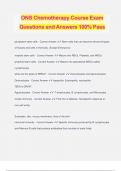
ONS Chemotherapy Course Exam Questions and Answers 100% Pass pluripotent stem cells - Correct Answer ️️ -Stem cells that can become almost all types of tissues and cells in the body. (Except Embryonic) myeloid stem cells - Correct Answer ️️ -Mature into RBCs, Platelets, and WBCs lymphoid stem cells - Correct Answer ️️ -Mature into specialized WBCs called Lymphocytes what are the types of WBCs? - Correct Answer ️️ -Granulocytes and Agranulocytes Granuolcytes - Correct Answer ️️ -basophils, Eosinophils, neutrophils "BEN is GRAN" Agranulocytes - Correct Answer ️️ -T lymphocytes, B Lymphocytes, and Monocytes Innate Immunity - Correct Answer ️️ -First line of defense. Nonspecific response to non-self entity. Examples: skin, mucus membrane, flora of the skin Humoral Immunity - Correct Answer ️️ -Specific immunity produced by B Lymphocytes and Memory B cells that produce antibodies that circulate in body fluids. B Cells will start dividing when it comes in contact with its antigen and will begin secreting antibodies The pathogen will be phagocytosed by presenting cells and presented to T cells to begin cell mediated immunity. After the threat some of the plasma cells will become memory cells and will go to the bone marrow where they will continue to secrete antibodies for years. Cell Mediated Immunity - Correct Answer ️️ -Type of immunity produced by T cells that attack infected or abnormal body cells. Can only be activated when fragments of an antigen are put on the surface of an antigen-presenting cell Proto-Oncogenes - Correct Answer ️️ -regulate normal cell growth and division. Mutated becomes Oncogene Tumor Suppressor Genes and example - Correct Answer ️️ -slow or stop cell growth and division P53- suicide gene, activated apoptosis when cell is damaged beyond repair. Often mutated in cancer cells What are the three goals of cancer treatment? - Correct Answer ️️ -Cure (prolonged absence of disease) Control (no further growth) Palliation (shrink tumor that is causing obstruction or other symptoms) neoadjuvant therapy - Correct Answer ️️ -a cancer treatment tha
Written for
- Institution
- ONS/oncc
- Course
- ONS/oncc
Document information
- Uploaded on
- June 5, 2024
- Number of pages
- 10
- Written in
- 2023/2024
- Type
- Exam (elaborations)
- Contains
- Questions & answers
Subjects
-
ons chemotherapy course exam questions and answers

Also available in package deal