Assignment 2: Do the right thing
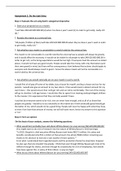
Step 1: Evaluate the act using Kant’s categorical imperative
1. State your proposed act as a maxim:
“I will take ZAR 620 000 000.00 (A) when I’ve done a year’s work (C) in order to get really, really rich
(E).”
2. Restate this maxim as a universal law:
“All people (7 billion of them) will take ZAR 620 000 000.00 when they’ve done a year’s work in order
to get really, really rich.”
3. Ask whether your maxim is conceivable in a world ruled by the universal law;
This maxim is not conceivable in a world ruled by the universal law as people will always be greedy,
and it would affect the economy. It would not be viable for all people to take ZAR 620 000 000.00 in
order to get rich, as the living expectations would be too high. If everyone took the amount as stated
above, it would not have any good results. People would take the money with only themselves (and
their own greed) in mind, but there will be consequences. Kant believed that actions should apply to
everyone and should always result in good – hence the above maxim will not be conceivable in a
world ruled by the universal law.
4. Ask whether you would rationally act on your maxim in such a world.
I would first of all pay off some of my debts, buy a house for myself, and buy a house and car for my
parents. I would also give an amount to my two sisters. I then would invest a decent amount for my
own future – this would ensure that I will get rich and can retire comfortably. The rest of the money
will go to charities / old age homes. I would also like to spend it on treating underprivileged children
to the movies / for experiences that they normally wouldn’t have.
I say that but everyone wants to be rich, one can never have enough, and as all of us know that
people are greedy. I would try to act rationally on this maxim but I think eventually greed would get
the better of me, which would not be a good thing. People will never be happy with what they have,
so even if we have that amount of money, we will still want more, hence my answer to this question
is “no”.
Step 2: Form an opinion
On the basis of your analysis, answer the following questions:
• What would Kant probably have said about Whitey Basson (or you) earning ZAR 620,000,000.00?
(You might want to do a bit of research into the nature of Whitey Basson's 2010 earnings).
“In 2010, Shoprite's chief executive Whitey Basson took home R627.5-million. His salary and
benefits constituted only R33.1-million of that amount; the almost R600-million remaining was
thanks to his decision to exercise a vast swathe of share options.”1
From what I understand Kant regarded assets and the protection thereof as important, however
he also says that one shouldn’t be greedy. I think that even though Whitey Basson got most of his
millions through his shares, and even though he created jobs for a lot of employees, Kant would
have been against this. A salary of R33 million+ is way too high!
• What do you think about Whitey Basson (or you) earning ZAR 620,000,000.00?
Step 1: Evaluate the act using Kant’s categorical imperative
1. State your proposed act as a maxim:
“I will take ZAR 620 000 000.00 (A) when I’ve done a year’s work (C) in order to get really, really rich
(E).”
2. Restate this maxim as a universal law:
“All people (7 billion of them) will take ZAR 620 000 000.00 when they’ve done a year’s work in order
to get really, really rich.”
3. Ask whether your maxim is conceivable in a world ruled by the universal law;
This maxim is not conceivable in a world ruled by the universal law as people will always be greedy,
and it would affect the economy. It would not be viable for all people to take ZAR 620 000 000.00 in
order to get rich, as the living expectations would be too high. If everyone took the amount as stated
above, it would not have any good results. People would take the money with only themselves (and
their own greed) in mind, but there will be consequences. Kant believed that actions should apply to
everyone and should always result in good – hence the above maxim will not be conceivable in a
world ruled by the universal law.
4. Ask whether you would rationally act on your maxim in such a world.
I would first of all pay off some of my debts, buy a house for myself, and buy a house and car for my
parents. I would also give an amount to my two sisters. I then would invest a decent amount for my
own future – this would ensure that I will get rich and can retire comfortably. The rest of the money
will go to charities / old age homes. I would also like to spend it on treating underprivileged children
to the movies / for experiences that they normally wouldn’t have.
I say that but everyone wants to be rich, one can never have enough, and as all of us know that
people are greedy. I would try to act rationally on this maxim but I think eventually greed would get
the better of me, which would not be a good thing. People will never be happy with what they have,
so even if we have that amount of money, we will still want more, hence my answer to this question
is “no”.
Step 2: Form an opinion
On the basis of your analysis, answer the following questions:
• What would Kant probably have said about Whitey Basson (or you) earning ZAR 620,000,000.00?
(You might want to do a bit of research into the nature of Whitey Basson's 2010 earnings).
“In 2010, Shoprite's chief executive Whitey Basson took home R627.5-million. His salary and
benefits constituted only R33.1-million of that amount; the almost R600-million remaining was
thanks to his decision to exercise a vast swathe of share options.”1
From what I understand Kant regarded assets and the protection thereof as important, however
he also says that one shouldn’t be greedy. I think that even though Whitey Basson got most of his
millions through his shares, and even though he created jobs for a lot of employees, Kant would
have been against this. A salary of R33 million+ is way too high!
• What do you think about Whitey Basson (or you) earning ZAR 620,000,000.00?