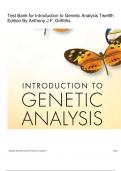
Test Bank for Introduction to Genetic Analysis Twelfth
Edition By Anthony J.F. Griffiths
Copyright Macmillan Learning. Powered by Cognero. Page 1
,Chapter 01: The Genetics Revolution
Multiple Choice
1. The early 1900s was an important period for genetics due to which of the following major events?
a. the rediscovery of Gregor Mendel's scientific findings
b. Watson and Crick solving the structure of DNA
c. Walter Sutton and Theodore Boveri hypothesizing that chromosomes are the hereditary elements
d. the rediscovery of Gregor Mendel's scientific findings and Walter Sutton and Theodore Boveri
hypothesizing that chromosomes are the hereditary elements
e. All of the answer options are correct.
ANSWER: e
2. A sample of normal double-stranded DNA was found to have a guanine content of 18%. What is the expected
proportion of adenine?
a. 9%
b. 32%
c. 36%
d. 68%
e. 82%
ANSWER: b
3. In one strand of DNA, the nucleotide sequence is 5'-ATGC-3'. The complementary sequence in the other
strand must be
a. 3'-ATGC-5'.
b. 3'-TACG-5'.
c. 5'-ATCG-3'.
d. 5'-CGTA-3'.
e. 5'-TACG-3'.
ANSWER: b
4. How many different DNA molecules that are eight-nucleotide-pairs long are theoretically possible?
a. 24
b. 32
c. 64
d. 256
e. 65,536
ANSWER: e
5. Which of the following is/are TRUE about genes?
a. Genes are located on chromosomes.
b. Genes come in variants known as alleles.
c. Genes usually encode protein products.
Copyright Macmillan Learning. Powered by Cognero. Page 2
, d. All of the answer options are correct.
e. None of the answer options is correct.
ANSWER: d
6. Wild cats (Felis silvestris) and common mice (Mus musculus) are diploid. In wild cats, 2n = 38, while in
common mice, 2n = 40. Based on this information, we can conclude that wild-cat cells have
a. less DNA than common-mouse cells.
b. smaller genomes than common-mouse cells.
c. fewer DNA molecules than common-mouse cells.
d. fewer genes than common-mouse cells.
e. fewer sets of chromosomes than common-mouse cells.
ANSWER: c
7. Which of the following is a component of DNA?
a. alanine
b. arginine
c. cysteine
d. guanine
e. tyrosine
ANSWER: d
8. Which of the following is/are TRUE of the DNA structure solved by Watson and Crick?
a. It is a double-helical structure.
b. Sugar–phosphate backbone is always toward the outside of the DNA.
c. There are two hydrogen bonds between A and T and three hydrogen bonds between C and G.
d. There are four types of nitrogenous bases.
e. All of the answer options are correct.
ANSWER: e
9. Which of the following is a CORRECT representation of the central dogma?
a. RNA → DNA → protein
b. protein → DNA → RNA
c. DNA → RNA → protein
d. DNA → protein → DNA
e. None of the answer options is correct.
ANSWER: c
10. You have come across a dog (named Cindy) that does not have a tail. Interestingly, all the puppies produced
by this dog don't have a tail. If the lack of tail is caused by a genetic mutation, where has this mutation most
likely taken place?
a. in Cindy's gametes
b. in the cells that should normally have given rise to Cindy's tail
c. in the cells that should normally have given rise to Cindy's and her puppies' tails
Copyright Macmillan Learning. Powered by Cognero. Page 3
, d. in all of Cindy's cells (including her gametes)
e. in a gamete of one of Cindy's parents
ANSWER: e
11. Which of the following features makes a species suitable as a model organism?
a. small organism
b. short generation time
c. small genome
d. produce large number of offspring
e. All of the answer options are correct.
ANSWER: e
12. Using molecular techniques, researchers have knocked out both copies of gene G in a series of genetically
identical mouse embryos. These mice develop normally, except for their forelimbs, which are missing several
small bones. What can be concluded from the results of this experiment?
a. Gene G encodes a protein that is a crucial component of the forelimbs' small bones in mice.
b. Gene G encodes a protein that is normally only present in the forelimb cells of developing mice.
c. Gene G is necessary for proper development of the forelimbs' small bones in mice.
d. Gene G is normally only present in the forelimb cells of developing mice.
e. Gene G is normally only transcribed in the forelimb cells of developing mice.
ANSWER: c
13. Who originated the one-gene–one-enzyme hypothesis?
a. Tatum and Beadle
b. Gregor Mendel
c. Watson and Crick
d. Franklin and Wilkins
e. Hershey and Chase
ANSWER: a
14. What are alleles?
a. gene variants
b. enzymes
c. regulatory elements
d. de novo mutations
e. quantitative trait loci
ANSWER: a
15. Which enzyme cuts DNA at a specific location?
a. polymerase
b. ligase
c. nuclease
d. allele
Copyright Macmillan Learning. Powered by Cognero. Page 4
Edition By Anthony J.F. Griffiths
Copyright Macmillan Learning. Powered by Cognero. Page 1
,Chapter 01: The Genetics Revolution
Multiple Choice
1. The early 1900s was an important period for genetics due to which of the following major events?
a. the rediscovery of Gregor Mendel's scientific findings
b. Watson and Crick solving the structure of DNA
c. Walter Sutton and Theodore Boveri hypothesizing that chromosomes are the hereditary elements
d. the rediscovery of Gregor Mendel's scientific findings and Walter Sutton and Theodore Boveri
hypothesizing that chromosomes are the hereditary elements
e. All of the answer options are correct.
ANSWER: e
2. A sample of normal double-stranded DNA was found to have a guanine content of 18%. What is the expected
proportion of adenine?
a. 9%
b. 32%
c. 36%
d. 68%
e. 82%
ANSWER: b
3. In one strand of DNA, the nucleotide sequence is 5'-ATGC-3'. The complementary sequence in the other
strand must be
a. 3'-ATGC-5'.
b. 3'-TACG-5'.
c. 5'-ATCG-3'.
d. 5'-CGTA-3'.
e. 5'-TACG-3'.
ANSWER: b
4. How many different DNA molecules that are eight-nucleotide-pairs long are theoretically possible?
a. 24
b. 32
c. 64
d. 256
e. 65,536
ANSWER: e
5. Which of the following is/are TRUE about genes?
a. Genes are located on chromosomes.
b. Genes come in variants known as alleles.
c. Genes usually encode protein products.
Copyright Macmillan Learning. Powered by Cognero. Page 2
, d. All of the answer options are correct.
e. None of the answer options is correct.
ANSWER: d
6. Wild cats (Felis silvestris) and common mice (Mus musculus) are diploid. In wild cats, 2n = 38, while in
common mice, 2n = 40. Based on this information, we can conclude that wild-cat cells have
a. less DNA than common-mouse cells.
b. smaller genomes than common-mouse cells.
c. fewer DNA molecules than common-mouse cells.
d. fewer genes than common-mouse cells.
e. fewer sets of chromosomes than common-mouse cells.
ANSWER: c
7. Which of the following is a component of DNA?
a. alanine
b. arginine
c. cysteine
d. guanine
e. tyrosine
ANSWER: d
8. Which of the following is/are TRUE of the DNA structure solved by Watson and Crick?
a. It is a double-helical structure.
b. Sugar–phosphate backbone is always toward the outside of the DNA.
c. There are two hydrogen bonds between A and T and three hydrogen bonds between C and G.
d. There are four types of nitrogenous bases.
e. All of the answer options are correct.
ANSWER: e
9. Which of the following is a CORRECT representation of the central dogma?
a. RNA → DNA → protein
b. protein → DNA → RNA
c. DNA → RNA → protein
d. DNA → protein → DNA
e. None of the answer options is correct.
ANSWER: c
10. You have come across a dog (named Cindy) that does not have a tail. Interestingly, all the puppies produced
by this dog don't have a tail. If the lack of tail is caused by a genetic mutation, where has this mutation most
likely taken place?
a. in Cindy's gametes
b. in the cells that should normally have given rise to Cindy's tail
c. in the cells that should normally have given rise to Cindy's and her puppies' tails
Copyright Macmillan Learning. Powered by Cognero. Page 3
, d. in all of Cindy's cells (including her gametes)
e. in a gamete of one of Cindy's parents
ANSWER: e
11. Which of the following features makes a species suitable as a model organism?
a. small organism
b. short generation time
c. small genome
d. produce large number of offspring
e. All of the answer options are correct.
ANSWER: e
12. Using molecular techniques, researchers have knocked out both copies of gene G in a series of genetically
identical mouse embryos. These mice develop normally, except for their forelimbs, which are missing several
small bones. What can be concluded from the results of this experiment?
a. Gene G encodes a protein that is a crucial component of the forelimbs' small bones in mice.
b. Gene G encodes a protein that is normally only present in the forelimb cells of developing mice.
c. Gene G is necessary for proper development of the forelimbs' small bones in mice.
d. Gene G is normally only present in the forelimb cells of developing mice.
e. Gene G is normally only transcribed in the forelimb cells of developing mice.
ANSWER: c
13. Who originated the one-gene–one-enzyme hypothesis?
a. Tatum and Beadle
b. Gregor Mendel
c. Watson and Crick
d. Franklin and Wilkins
e. Hershey and Chase
ANSWER: a
14. What are alleles?
a. gene variants
b. enzymes
c. regulatory elements
d. de novo mutations
e. quantitative trait loci
ANSWER: a
15. Which enzyme cuts DNA at a specific location?
a. polymerase
b. ligase
c. nuclease
d. allele
Copyright Macmillan Learning. Powered by Cognero. Page 4