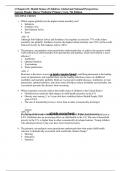
Burns pediatric questions and answers all 46 chapters.
CChapter 01: Health Status of Children: Global and National Perspectives Garzon Maaks: Burns’ Pediatric Primary Care, 7th Edition MULTIPLE CHOICE 1. Which region globally has the highest infant mortality rate? a. Indonesia b. Southern Asia c. Sub-Saharan Africa d. Syria ANS: B Although Sub-Saharan Africa and Southern Asia together account for 77% of the infant mortality rate globally, Southern Asia has the highest infant mortality rate (39%) in the world followed closely by Sub-Saharan Africa (38%). 2. The primary care pediatric nurse practitioner understands that, to achieve the greatest world- wide reduction in child mortality from pneumonia and diarrhea, which intervention is most effective? . a. Antibiotics b. Optimal nutrition c. Vaccinations d. Water purification ANS: C Rotavirus is the most commoan arrmhea/tgelosbatlly and Strep pneumonia is the leading cause of pneumonia, and together these are the leading infectious causes of childhood morbidity and mortality globally. Both are vaccine-preventable diseases. Antibiotics to treat pneumonia, optimal nutrition, and clean water all help to reduce morbidity and mortality, but vaccination prevents the diseases from occurring. 3. Which statement correctly reflects the health status of children in the United States? a. Globalism has relatively little impact on child health measures in the U.S. b. Obesity rates among 2- to 5-year-olds have stabilized below Health People 2020 goal of 9.4%. c. The rate of household poverty is lower than in other economically developed . nations. dO.beYdoorhmedaaly/thtceianresthhteavUe.Setrrefocoendtilnysheacvueritsyta. bilized at 8.9%. Globalism has an increasing effect on child health in the U.S. The rate of household poverty in the U.S. is higher than in other economically developed nations. Young children who attend preschool or day care have lower food insecurity. 4. The primary care pediatric nurse practitioner understands that what major child health outcome is dramatically associated with worldwide climate change? a. Housing b. Education c. Nutrition d. Pollution ANS: C There is growing evidence that climate change is having a dramatic effect on food crops that leads to food distribution issues and food insecurity among families. 5. When providing well child care for an infant in the first year of life, the primary care pediatric nurse practitioner demonstrates an understanding of current guidelines when taking what action? a. Focusing less on development and more on illness prevention and nutrition. b. Following guidelines established by the Bright Futures publication. c. Scheduling well-baby visits to coincide with key developmental milestones. d. Seeing the infant at ages 2, 4, 6, and 12 months when immunizations are due. ANS: C In the most recent AAP Recommendations for Preventive Pediatric Health Care, there is a greater emphasis on behavioral and developmental issues and a recommendation that well child care be based on child and family development rather than the periodicity of immunization schedules. Chapter 02: Unique Issues in Pediatrics Garzon Maaks: Burns’ Pediatric Primary Care, 7th Edition MULTIPLE CHOICE 1. What is the foundational basis of patient-and-family centered care (PFCC)? a. The family is to be considered when patient care is being planned b. The patient has ultimate control over health care decisions c. A family member acts as the patient’s surrogate decision makes d. The patient is the focus of the primary care provider’s attention ANS: B While all options are correct statements, the foundational basis of PFCC is the patient has ultimate control over health care decisions. 2. Which assessment question best demonstrates the primary care provider’s understanding of effectively dealing with the greatest challenge to providing dual patient care? a. To the parent: “Do you feel comfortable providing in-home care for your child?” b. To the child: “When would you like your physical therapy sessions to be scheduled?” c. To the parent: “What are your feelings about going to family therapy to help with this transition?” d. To the child: “When did you first notice the pain in your knees?” ANS: B One of the greatest challengeas ibs cemss,/atceknsotwledge, and include the child’s voice, which is often lost and/or overridden in health care. By directly asking the child their opinion or feelings, the PCP is providing for the child’s voice to be heard and acknowledged. None of the other options addresses that need. 3. Which intervention best demonstrates a pediatric nurse primary care pediatric nurse practitioner’s understanding of effective pain assessment? a. Providing instructions regarding the pain assessment tool to parents of all newly admitted children b. Assisting in the developmnet of a child-centered pain assessment scale c. Reviewing the documentation regarding the child’s pain assessment 30 minutes after analgesic medication was administered d. Explaining to both the child and the parents why pain medication will be delivered ANSin: trBavenously In the past, clinicians and researchers have relied on adult-developed and adult-centered tools and approaches, which have been “adapted” for use with children by adding pictures and/or simpler language. There is increasing realization that data from adapted, adult-centered models have has not adequately captured the voices and/or experiences of children. Engaging in the development of an assessment tool that is child focused is the best demonstration of understanding. All other options rely on adaptation of adult-centered tools or focus on standard pain management related interventions. 4. Which theorist is responsible for presenting an alternative theory to those established theories that focus on how the pediatric patient thinks? a. Piaget bc.. VSkyignontesrky d. Bandura ANS: B Vygotsky and Siegler both ricmpri/mtearysctare with a new understanding or alternative lens through which to view children and childhood regarding how they think and process information. The other options represent traditional theorists: Piaget does focus on how children think while Skinner and Bandura are concerned with how children’s learning and behavior is affected by experiences. 5. What is the strongest predictor of health regarding the pediatric patient? a. The early identification of existing health problems b. Health literacy of the parent(s) and/or caregiver(s) c. Assess to specialized healthcare professionals d. Past experience with same of similar health issues ANS: B The health literacy possessed by parents/caregivers is one of the strongest predictors of the health of a pediatric patient. While the other options enhance good health outcomes, they are all influenced by appropriate health literacy. Chapter 03: Genetic and Genomics: The basics of child health Garzon Maaks: Burns’ Pediatric Primary Care, 7th Edition MULTIPLE CHOICE 1. What is true about haploid cells? a. Each contains 23 paired chromosomes. b. Each one contains 23 chromosomes. c. Replication produces two identical cells. d. They replicate via the process of mitosis. ANS: B Haploid cells each contain only 23 chromosomes, while diploid cells contain 23 paired chromosomes. Diploid cells replicate via the process of mitosis, producing two identical daughter cells. 2. What does the following genetic notation symbol mean 47,XX,6q-? a. Male with deletion of chromosome 6 b. Female with deletion of chromosome 6 c. Male with deletion on the long arm of chromosome 6 d. Female with deletion on the long arm of chromosome 6 ANS: D “XX” is a female. “q” indicates the long arm of a chromosome. “-” indicates a deletion. None of the remaining options accurately describe the notation “q”. 3. A child has a recessive genetic disorder that is homozygous for that mutation. What is most likely about this child’s parents? a. Neither parent has a copy of that gene mutation. b. Only the mother has a copy of that gene mutation. c. Only the father has a copy of that gene mutation. d. Each parent has one copy of that gene mutation. ANS: D When a child has a recessive genetic mutation that is homozygous, the child has two copies of the mutation, each donated by the parents. Since it is recessive, parents may be carriers of the gene, having only one copy, and pass the disorder to the child when the child inherits two copies. Both parents have to donate this mutation to the child. 4. Which type of mutation is responsible for many single-gene genetic disorders? a. Copy number variations b. Nucleotide repeat expansions c. Point mutations d. Single nucleotide polymorphisms (SNP) ANS: C Point mutations are single base pair changes capable of changing the function of a gene or gene product. Copy number variations involve larger areas of chromosomes beyond point mutations and provide the genetic basis for many psycho-behavioral diseases. Nucleotide repeat expansions occur beyond single point changes; genetic changes occur when the number of repeats increases beyond the tolerated limit. SNPs are alterations that contribute to multifactorial disorders. 5. Cystic fibrosis is a recessive disease requiring the presence of a gene mutation on both alleles inherited from the parents. Which type of genetic disorder is this? a. Chromosome b. Mitochondrial c. Monogenetic d. Multifactorial ANS: C Monogenetic disorders amtion/taeffesctts a single gene; recessive diseases are one type of monogenetic disorder. Chromosome disorders occur with changes in the number or structure of an entire chromosome or large segments of it. Mitochondrial disorders are rare and are related to mutations in the genetic material found in the mitochondria and not the chromosomes. Multifactorial disorders are caused by mutations that may have inherited and environmental causes. 6. The primary care pediatric nurse practitioner is counseling a couple about genetic risks and learns that one parent has neurofibromatosis, an autosomal dominant disorder, and the other parent does not. What will the nurse practitioner include when discussing this disorder and its transmission? a. Children must inherit a gene from both parents to develop the disease. b. Each child born to this couple will have a 50% risk of having the disease. c. This type of disorder characteristically skips generations. d. Unaffected offspring may still pass on the disease to their offspring. ANS: B With this type of disorder, the gene mutation is passed on from only one parent, who has a single copy of the gene. The unaffected partner does not carry the genes. Each pregnancy carries a 50% risk from the probability that the affected parent will either donate an affected gene or not. Only one gene is necessary to produce disease. This type of disorder usually does not skip generations. Unaffected offspring will not have the gene and cannot pass on the disease to their offspring. 7. A family medical history conducted during a well baby exam for a newborn girl reveals that hemophilia A, an X-linked recessive disorder, is present in males in three previous generations in the mother’s family, whose father had the disease. What will the primary care pediatric nurse practitioner tell the parents about the risk of this disease in their children? a. All of their sons will be affected by the disease. b. Any sons they have will not be affected by the disease. c. Daughters have a 50% chance of being carriers of the disease. d. Their daughter has a 25% chance of having the disease. ANS: C . If a father is affected by an X-linked recessive disease, all of his daughters will be carriers and will have a 50% chance of having sons who are affected. Daughters have a 50% chance of being a carrier, but are not affected, since they receive normal X chromosomes from their father. 8. What is an important responsibility of the primary care pediatric nurse practitioner to help determine genetic risk factors in families? a. Assessing physical characteristics of genetic disorders b. Knowing which genetic screening tests to perform c. Making appropriate referrals to pediatric geneticists d. Obtaining a three-generation pedigree for each family ANS: D In primary care practice, taking the time to collect a child’s family health history and pedigree can be just as important as information from a laboratory test and gives useful information about possible genetic disorders present in a family. The other skills are necessary if there is concern that a genetic disorder exists. 9. Which diagnostic study may be ordered when the provider wishes to detect the presence of additional genetic material obtestbankmse?.com a. Chromosomal microarray b. FISH c. Karyotype d. Molecular testing ANS: B Fluorescence in-situ hybridization (FISH) is used to locate and detect a specific area of a particular chromosome, including subtle missing, additional, or rearranged chromosomal material. Chromosomal microarray is used to detect micro-deletions or duplications in any of the chromosomes but not specific gene mutations. Karyotype testing is used to identify and evaluate the size, shape, and number of chromosomes. Molecular testing is used to detect specific single gene mutations. 10. Which type of testing will the primary care pediatric nurse practitioner recommend for a couple concerned about the potential for having children with cystic fibrosis? a. Biochemical testing b. Carrier testing c. FISH testing d. Karyotype testing ANS: B Carrier testing is used to detect the presence of a carrier state by detecting whether each has one copy of a gene mutation known to cause a specific disorder caused when two copies are present. Biochemical testing is used to study the amount, activity level, or structure of panrodteinnzsymes that result from gene mutations. FISH testing is used to locate and detect a specific area of a particular chromosome, including subtle missing, additional, or rearranged chromosomal material. Karyotype testing is used to identify and evaluate the size, shape, and number of chromosomes. Chapter 04: Environment and Child Health Garzon Maaks: Burns’ Pediatric Primary Care, 7th Edition MULTIPLE CHOICE 1. What has been the result of passage of the Toxic Substances Control Act (TSCA) of 1976? a. A mandate for corporations to disclose known toxic chemicals b. A requirement that all manufactured chemicals undergo toxicity testing c. Authorization of the EPA to require testing and reporting of some chemicals d. Development of a mechanism to report reactions to toxic chemicals ANS: C The TSCA authorized the EPA to require testing and reporting of some chemicals. However, of the more than 84,000 chemicals registered for use in the U.S., only about 200 have been tested and only 5 have been banned. Corporations have resisted disclosure of chemical properties and this law does not require this. 2. Many European nations use the “precautionary principle” to help regulate potentially toxic chemicals. What does this m. a. Chemicals must be proven to be safe before being introduced into the environment. Corporations may be exempt from testing if their costs in doing so are too high. Regulators must demonstrate risk to the public before banning a chemical. d. Without a strong risk, corporations need not release data about their products. ANS: A The precautionary principle satipbuliartebs .thcatocmhem/itcealssmtust be proven safe before they are released. U.S. corporations argue that costs of testing and the need to release confidential information inhibit their ability to manufacture chemicals and produce a profit. The EPA in the U.S. must first demonstrate risk before banning a product, which is the opposite of the precautionary principle. . Chapter 05: Child and Family Health Assessment Garzon Maaks: Burns’ Pediatric Primary Care, 7th Edition MULTIPLE CHOICE 1. The primary care pediatric nurse practitioner is obtaining a medical history about a child. To integrate both nursing and medical aspects of primary care, which will be included in the medical history? . a. Complementary medicatinos, alternative health practices, and chief complaint b. Developmental delays, nutritional status, and linear growth patterns c. Medication currently taking, allergy information, and family medical history d. Speech and language development, beliefs about health, and previous illnesses ANS: D An assessment model that rmsing/taendsmtedical aspects of primary care uses three domains: developmental problems (speech and language development), functional health problems (beliefs about health), and diseases (chief complaint). The other examples all use domains associated with the traditional medical model and do not contain nursing aspects associated with functional health problems. 2. When meeting with a new family, the primary care pediatric nurse practitioner develops a database that identifies familybmteemsbetrbs aa rsmliving in the household, relationships with others outside the household, and significant behavioral and emotional problems. Which tool will the nurse practitioner use to record this information? a. CRAFFT b. Ecomap c. Genogram d. Pedigree ANS: C The genogram is an approach to developing a family database to provide a graphic representation of family structure, roles, and problems of recurring significance in a family. The CRAFFT tool is used to assess substance abuse in adolescents. The ecomap is used to identify relationships in the family and community that are supportive or harmful. The pedigree is used to identify potential genetic disorders. . 3. nAucrsheilpdriasctiintitohneecrl(iPniNcPf)ornoevteasluthataitotnheofcahnilda’ssthlmasat vaicstitown apslafno.rTahperep-rkiminadreyrgcarteenpepdhiyatsriiccal and observes that the child is extremely anxious. What will the nurse practitioner do initially? a. Ask the child’s parent why the child is so anxious. b. Perform a physical assessment to rule out shortness of breath. c. Reassure the child that there is nothing to be afraid of. d. Review the purpose of this visit and any anticipated procedures. ANS: D The PNP should remember that young children are learning “scripts” for health care visits and may be stressed when recalling previous visits, especially if those involved immunizations.
Connected book
Written for
- Institution
- Burns pediatric primary care 7th edition
- Course
- Burns pediatric primary care 7th edition
Document information
- Uploaded on
- June 5, 2024
- Number of pages
- 171
- Written in
- 2023/2024
- Type
- Exam (elaborations)
- Contains
- Questions & answers
Subjects
-
pediatric primary care 7th edition

Also available in package deal