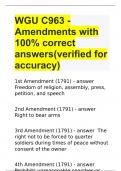
WGU C963 - Amendments with 100% correct answers(verified for accuracy)
1st Amendment (1791) Freedom of religion, assembly, press, petition, and speech 2nd Amendment (1791) Right to bear arms Previous Play Next Rewind 10 seconds Move forward 10 seconds Unmute 0:02 / 0:15 Full screen Brainpower Read More 3rd Amendment (1791) The right not to be forced to quarter soldiers during times of peace without consent of the owner 4th Amendment (1791) Prohibits unreasonable searches or seizures and sets out requirements for search warrants based on probable cause. 5th Amendment (1791) Right to due process, no self-incrimination, eminent domain, double jeopardy, and grand jury 6th Amendment (1791) Right to trial by jury, a speedy trial, and right to a lawyer 7th Amendment (1791) Right to a jury in civil cases over $20 8th Amendment (1791) Right to no cruel and/or unusual punishments, no unfair bail, fines, or fees 9th Amendment (1791) Protects rights not enumerated in the Constitution 10th Amendment (1791) The powers not delegated to the United States by the Constitution, nor prohibited by it to the States, are reserved to the States respectively, or to the people. 11th Amendment (1795) Prohibits citizens of one state or foreign country from suing another state, except with permission from that state's judicial system. 12th Amendment (1804) Electoral college must have two separate elections for the president and vice president. 13th Amendment (1865) Abolishes slavery and involuntary servitude, except as punishment for a crime. 14th Amendment (1868) Declares that all persons born in the U.S. are citizens and are guaranteed equal protection of the laws 15th Amendment (1870) Prohibits the denial of the right to vote based on race, color, or previous condition of servitude 16th Amendment (1913) Allows the federal government to collect income tax 17th Amendment (1913) Establishes the direct election of United States Senators by popular vote 18th Amendment (1919) Prohibited the manufacturing or sale of alcohol within the United States (Repealed Dec 5, 1933 with 21st amendment) 19th Amendment (1920) Prohibits the denial of the right to vote based on sex 20th Amendment (1933) Changes the date on which the terms of the president, vice president, and members of Congress end and begin (to January 20 and January 3 respectively) 21st Amendment (1933) Repeals the 18th Amendment and makes it a federal offense to transport or import intoxicating liquors into US states and territories that prohibit it 22nd Amendment (1951) Limits the number of times that a person can be elected president: a person cannot be elected president more than twice 23rd Amendment (1961) Grants the District of Columbia electors in the Electoral College 24th Amendment (1964) Prohibits the revocation of voting rights due to non-payment of a poll tax or any other tax 25th Amendment (1967) Address succession to the Presidency and establishes procedures for both filling a vacancy in the office, as well as to Presidential disabilities 26th Amendment (1971) Prohibits the denial the right of US citizens, eighteen years or older, to vote on account of age
Written for
- Institution
- Wgu c963
- Course
- Wgu c963
Document information
- Uploaded on
- June 5, 2024
- Number of pages
- 6
- Written in
- 2023/2024
- Type
- Exam (elaborations)
- Contains
- Questions & answers
Subjects

Also available in package deal