ASBOG EXAM WITH CORRECT ANSWERS 2024
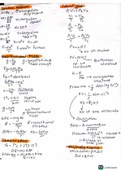
Aquifer - ANSWER-water bearing geological formation that can store and transit usable amounts of water. high porosity, and permeability aquitard - ANSWER-somewhat restricts water movement aquiclude - ANSWER-layer that completely prevents water movement unconfined aquifer - ANSWER-top is water table, recharged by local rainfall, generally freshwater, cheap to drill wells, easily contaminated, potentiometric surface=water table confined aquifer - ANSWER-top is a confining layer, can be artesian wells, potentiometric surface is generally above the physical top, in or above confining layer, recharged by distant water b - ANSWER-saturated thickness s (drawdown) - ANSWER-change in potentiometric surface in response to pumping a well porosity (phi) - ANSWER-amount of empty space in a solid object (n=Vvoid/Vtotal) porosity equations - ANSWER-Vv/Vt, Vt-Vs/Vt, 1- Vs/Vt, 1- drybulkdensity/particledensity porosity depends on - ANSWER-packing, grain shape, grain size, grain size distribution, structure, density, moisture content, effective porosity, permeability, specific yeild specific gravity - ANSWER-density of substance/density of water bulk density - ANSWER-overall density of rock including water in it. always less than density of rock because water density is less gravimetric moisture content (w) - ANSWER-weight h20/ weight solids volumetric water content (theta) - ANSWER-volume h20/vol total saturation (S) - ANSWER-volume water/volume voids effective porosity - ANSWER-porosity available for fluid flow. always less than total porosity permeability - ANSWER-measures the transmission property of the media and interconnection of the pores specific yeild (Sy) - ANSWER-volume fraction of water that drains from a saturated rock under influence of gravity specific retention (Sr) - ANSWER-volume fraction of water retained in a rock after influence of gravity Specific storage (Ss) - ANSWER-=(rho)g × (α + neff β) α - ANSWER-compressibility of aquifer β - ANSWER-compressibility of water Storativity (confined) - ANSWER-Ss x b storativity (unconfined) - ANSWER-(Ss x b) +Sy hydrostatic equilibrium - ANSWER-achieved when the force of gravity on the fluid volume is balanced by the fluid pressure on a given cross section total head - ANSWER-=z + P/(rho g), or z + psi Darcy's Law - ANSWER-Q= -Kia Q - ANSWER-volumetric discharge --> volume of water moving through a given cross section of an aquifer q - ANSWER-specific discharge --> average groundwater speed through a porous medium v - ANSWER-mean porewater velocity--> actual speed the groundwater molecules travel at through pore space. v>q specific discharge equation - ANSWER-q=Q/Area = -Ki = =K ∆h/∆L hydraulic conductivity - ANSWER-permeability of water in a porous medium. emperical parameter; depends on medium and fluid hydraulic conductivity equation - ANSWER-K = k (rho g/ μ) where μ=viscosity of fluid Hazen formula - ANSWER-K=C(d10)² ; for measuring conductivity Transmissivity - ANSWER-represents how easily water moves through a whole aquifer Transmissivity equation - ANSWER-T=Kb ; Q=-Tiw hysteresis - ANSWER-the hydraulic properties (K) depends and differs if its wetting or drying. wetting will be on the bottom of the graph (closer to zero) No flow boundary - ANSWER-zero flux=no water flow crosses boundary; really compact material; groundwater divides, or symmetry lines; flow is parallel, equipotentials are perp constant head boundary - ANSWER-total head at boundary doesnt change; think of a lake; flow is perp to boundary, equipotentials are parallel streamtube - ANSWER-region between 2 flowlines flow in streamtube equation, one streamtube - ANSWER-Qi = -K (∆H/∆L) ×wi×b flow in streamtube, entire flownet - ANSWER-Q= -K∆Hmb/n Dupuit assumption - ANSWER-when the slope of water table is negligibly small, assume equipotentials are vertical, flowlines are horizontal. workes with shallow unconfined flow heterogeneity - ANSWER-hydraulic conductivity is not the same in different spots of the aquifer 3 types of heterogeneity - ANSWER-random(finescales), structured(river deltas), layered(sed basin) horizontal hydraulic conductivity - ANSWER-arithmetic mean: Keff= sum of (kib)/sum of b vertical hydraulic conductivity - ANSWER-harmonic mean: Keff = sum of b/ sum of (b/Ki) snells law - ANSWER-k1/k2 = tan(α1)/tan(α2) lines closer together on contour maps - ANSWER-lower K lines further apart on contour maps - ANSWER-higher K anisotropy - ANSWER-hydraulic conductivity is different in different directions anisotropy causes - ANSWER-layering at a scales less than interested in; preferential orientation of effective porosity types of wells - ANSWER-dug, driven, bored(used as storage), drilled drawdown over time - ANSWER-increases effect of lower transmissivity on drawdown - ANSWER-narrower, deeper cone of depression effect of lower storativity/specific yeild on drawdown - ANSWER-shifts whole cone deeper. confined usually have bigger cones bc Ss << Sy safe yield myth - ANSWER-safe yield of aquifer = recharge rate pumping near no flow boundaries - ANSWER-drawdown is greater pumping near constant head boundaries - ANSWER-drawdown is less Thiem Equation use - ANSWER-steady state, confined and unconfined thiem equation - ANSWER-T= Q/(2π(h1-h2)) × ln(r1/r2) confined K = Q/(π (b1²-b2²)) × ln(r1/r2) unconfined Theis solution use - ANSWER-transient, confined, drawdown vs times theis solution - ANSWER-s= Q/4π × W(u) cooper jacob solution - ANSWER-transient, confined, drawdown vs times jacob solution - ANSWER-transient confined, drawdown vs distance neuman solution - ANSWER-transient, unconfined Slug tests - ANSWER-single well test, transient types of slug tests - ANSWER-hvorslev test, cooper lasjdflasjd, bouwer and rice method, van der kamp hvorslev test - ANSWER-length of peizometer is longer than 8x radius of well screen K= r² ln(Le/R) / 2Le(t37) bouwer and rice method - ANSWER-valid when distance from water table to borehole is smaller than saturated thickness. long ass equation Van Der Kamp - ANSWER-used for underdamped response. most likely to happen in gravel
Written for
- Institution
- ASBOG
- Course
- ASBOG
Document information
- Uploaded on
- June 4, 2024
- Number of pages
- 9
- Written in
- 2023/2024
- Type
- Exam (elaborations)
- Contains
- Questions & answers
Subjects
-
asbog exam with correct answers 2024