Affective Disorders
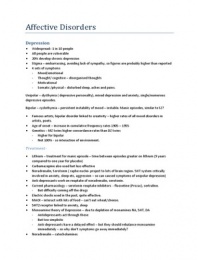
Depression
Widespread– 1 in 10 people
All people are vulnerable
20% develop chronic depression
Stigma – embarrassing, avoiding lack of sympathy, so figures are probably higher than reported
4 sets of symptoms
- Mood/emotional
- Thought/ cognitive – disorganised thoughts
- Motivational
- Somatic /physical – disturbed sleep, aches and pains.
Unipolar – dysthymia ( depressive personality), mixed depression and anxiety, single/numerous
depressive episodes.
Bipolar – cyclothymia – persistent instability of mood – instable. Manic episodes, similar to SZ?
Famous artists, bipolar disorder linked to creativity – higher rates of all mood disorders in
artists, poets.
Age of onset – increase in cumulative frequency rates 1905 – 1955
Genetics – MZ twins higher concordance rates than DZ twins
- Higher for bipolar
- Not 100% - so interaction of environment.
Treatment-
Lithium – treatment for manic episode – time between episodes greater on lithium (9 years
compared to one year for placebo)
Carbamazepine also used but less effective
Noradrenalin, Serotonin ( raphe nuclei- project to lots of brain region. 5HT system critically
involved in anxiety, sleep etc, aggression – so can caused symptoms of unipolar depression)
Anti-depressants work on reuptake of noradrenalin, serotonin.
Current pharmacology – serotonin reuptake inhibitors - fluoxetine (Prozac), sertraline.
- But difficulty coming off the drugs
Electric shocks used in the past, quite effective.
MAOI – interact with lots of food – can’t eat wheat/cheese.
5HT2 receptor linked to anxiety, sleep
Monoamine theory of Depression – due to depletion of monamines NA, 5HT, DA
- Antidepressants act through these
- But too simplistic
- Anti-depressants have a delayed effect – but they should rebalance monoamine
immediately – so why don’t symptoms go away immediately?
Noradrenalin – catecholamines
Depression
Widespread– 1 in 10 people
All people are vulnerable
20% develop chronic depression
Stigma – embarrassing, avoiding lack of sympathy, so figures are probably higher than reported
4 sets of symptoms
- Mood/emotional
- Thought/ cognitive – disorganised thoughts
- Motivational
- Somatic /physical – disturbed sleep, aches and pains.
Unipolar – dysthymia ( depressive personality), mixed depression and anxiety, single/numerous
depressive episodes.
Bipolar – cyclothymia – persistent instability of mood – instable. Manic episodes, similar to SZ?
Famous artists, bipolar disorder linked to creativity – higher rates of all mood disorders in
artists, poets.
Age of onset – increase in cumulative frequency rates 1905 – 1955
Genetics – MZ twins higher concordance rates than DZ twins
- Higher for bipolar
- Not 100% - so interaction of environment.
Treatment-
Lithium – treatment for manic episode – time between episodes greater on lithium (9 years
compared to one year for placebo)
Carbamazepine also used but less effective
Noradrenalin, Serotonin ( raphe nuclei- project to lots of brain region. 5HT system critically
involved in anxiety, sleep etc, aggression – so can caused symptoms of unipolar depression)
Anti-depressants work on reuptake of noradrenalin, serotonin.
Current pharmacology – serotonin reuptake inhibitors - fluoxetine (Prozac), sertraline.
- But difficulty coming off the drugs
Electric shocks used in the past, quite effective.
MAOI – interact with lots of food – can’t eat wheat/cheese.
5HT2 receptor linked to anxiety, sleep
Monoamine theory of Depression – due to depletion of monamines NA, 5HT, DA
- Antidepressants act through these
- But too simplistic
- Anti-depressants have a delayed effect – but they should rebalance monoamine
immediately – so why don’t symptoms go away immediately?
Noradrenalin – catecholamines