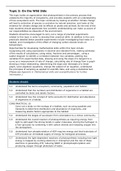
Topic 5: On the Wild Side
This topic builds an appreciation that photosynthesis is the primary process that
underpins the majority of ecosystems, and provides students with an understanding
of how ecosystems work. The topic continues by looking at whether climate change
will lead to extinction of species or evolution by natural selection, and looks at the
evidence for climate change and its effects on plants and animals. By the end of the
topic students should appreciate how scientific understanding can make us aware of
our responsibilities as stewards of the environment.
Students should be encouraged to carry out a range of practical experiments
related to this topic in order to develop their practical skills. In addition to the core
practicals detailed below possible experiments include investigating food webs in a
habitat, and investigation of the effect of changing carbon dioxide levels on
temperature.
Opportunities for developing mathematical skills within this topic include
recognising and using expressions in decimal and standard form, making estimates
of the results of calculations, using ratios, fractions and percentages , using a
scatter diagram to identify a correlation between two variables, plotting two
variables from experimental data, drawing and using the slope of a tangent to a
curve as a measurement of rate of change, calculating rate of change from a graph
showing a linear relationship, determining the slope and intercepts of a linear
graph, solve algebraic equations, change the subject of an equation, understand
the principles of sampling as applied to scientific data, and using a statistical test.
(Please see Appendix 6: Mathematical skills and exemplifications for further
information.)
Students should:
5.1 Understand the terms ecosystem, community, population and habitat.
5.2 Understand that the numbers and distribution of organisms in a habitat are
controlled by biotic and abiotic factors.
5.3 Understand how the concept of niche accounts for distribution and abundance
of organisms in a habitat.
CORE PRACTICAL 10:
Carry out a study on the ecology of a habitat, such as using quadrats and
transects to determine distribution and abundance of organisms, and
measuring abiotic factors appropriate to the habitat.
5.4 Understand the stages of succession from colonisation to a climax community.
5.5 Understand the overall reaction of photosynthesis as requiring energy from
light to split apart the strong bonds in water molecules, storing the hydrogen in
a fuel (glucose) by combining it with carbon dioxide and releasing oxygen into
the atmosphere.
5.6 Understand how phosphorylation of ADP requires energy and that hydrolysis of
ATP provides an immediate supply of energy for biological processes.
5.7 Understand the light-dependent reactions of photosynthesis including how light
energy is trapped by exciting electrons in chlorophyll and the role of these
electrons in generating ATP, reducing NADP in photophosphorylation and
producing oxygen through photolysis of water.
Pearson Edexcel Level 3 Advanced GCE in Biology A (Salters-Nuffield) 17
Specification – Issue 3 – July 2016 © Pearson Education Limited 2016
,Students should:
5.8 i) Understand the light-independent reactions as reduction of carbon dioxide
using the products of the light-dependent reactions (carbon fixation in the
Calvin cycle, the role of GP, GALP, RuBP and RUBISCO).
ii) Know that the products are simple sugars that are used by plants, animals
and other organisms in respiration and the synthesis of new biological
molecules (polysaccharides, amino acids, lipids and nucleic acids).
CORE PRACTICAL 11:
Investigate photosynthesis using isolated chloroplasts (the Hill reaction).
5.9 Understand the structure of chloroplasts in relation to their role in
photosynthesis.
5.10 i) Be able to calculate net primary productivity.
ii) Understand the relationship between gross primary productivity, net primary
productivity and plant respiration.
5.11 Know how to calculate the efficiency of biomass and energy transfers between
trophic levels.
5.12 Understand the different types of evidence for climate change and its causes
(including records of carbon dioxide levels, temperature records, pollen in peat
bogs and dendrochronology), recognising correlations and causal relationships.
5.13 Understand the causes of anthropogenic climate change, including the role of
greenhouse gases (carbon dioxide and methane) in the greenhouse effect.
5.14 i) Understand that data can be extrapolated to make predictions and that these
are used in models of future climate change.
ii) Understand that models for climate change have limitations.
5.15 Understand the effects of climate change (changing rainfall patterns and
changes in seasonal cycles) on plants and animals (distribution of species,
development and life cycles).
5.16 Understand the effect of temperature on the rate of enzyme activity and its
impact on plants, animals and microorganisms.
5.17 Understand how evolution (a change in the allele frequency) can come about
through gene mutation and natural selection.
5.18 Understand the role of the scientific community (scientific journals, the peer
review process, scientific conferences) in validating new evidence, including
proteomics and genomics, that supports the accepted scientific theory of
evolution.
5.19 Understand how isolation reduces gene flow between populations, leading to
Students should:
allopatric or sympatric speciation.
CORE PRACTICAL 12:
Investigate the effect of temperature on the initial rate of an enzyme-catalysed
reaction, to include Q10.
CORE PRACTICAL 13:
Investigate the effects of temperature on the development of organisms (such
as seedling growth rate, brine shrimp hatch rates).
5.20 Understand the way in which scientific conclusions about controversial issues,
such as what actions should be taken to reduce climate change or the degree
to which humans are affecting climate change, can sometimes depend on who
18 is reaching the conclusions. Pearson Edexcel Level 3 Advanced GCE in Biology A (Salters-Nuffield)
Specification – Issue 3 – July 2016 © Pearson Education Limited 2016
5.21 Understand how knowledge of the carbon cycle can be applied to methods to
reduce atmospheric levels of carbon dioxide.
5.22 Understand how reforestation and the use of sustainable resources, including
biofuels, are examples of the effective management of the conflict between
human needs and conservation.
, Topic Five Biology
5.1 – Key Words
5.2 - Distribution and Abundance of Organisms in a Habitat is Controlled by Abiotic or Biotic Factors
• The distribution and abundance (population) of organisms in a habitat is controlled by both
o biotic (living) factors like:
▪ Competition - for food, light, water, space
• Can be interspecific – between species
• Can be intraspecific – within species
▪ Grazing, Predation, Disease, Parasitism
▪ Mutualism – where both partners benefit
o abiotic (non-living factors) like
▪ Solar energy input – light, latitude, season
▪ Climate – Temperature, rainfall, wind exposure
▪ Topography – altitude (slopes)
▪ Oxygen concentration
▪ Edaphic – geology has effect on plant distribution
▪ Pollution – of air water or land
▪ Catastrophes – volcanos, earthquakes, floods
• Biotic factors are density dependent – effects related to size of the populations for area available
o Larger density = larger competition for food, space, water
• Anthropogenic factors – arises from human activity (is either biotic or abiotic)
o For e.g. Deforestation, grazing, fertilizers affect ecosystems to make them unnatural
5.3 - Species Distribution and Abundance of an Organism due to their Niche
• Ecological niche - role a species has in its environment and how it meets its needs for food and shelter, how
it survives, and how it reproduces. So abiotic and biotic interaction with the environment also matter.
• If different species share the same ecological niche
1. They will compete
2. The better adapted species will outcompete the other and exclude it from the habitat
3. Two species can share the same habitat but each species MUST occupy a Different Niche
• Primary productivity - Rate at which energy is turned to organic matter in an ecosystem
o Producers are autotrophs s organisms make own organic compounds
o Some producers are chemosynthetic autotrophs
This topic builds an appreciation that photosynthesis is the primary process that
underpins the majority of ecosystems, and provides students with an understanding
of how ecosystems work. The topic continues by looking at whether climate change
will lead to extinction of species or evolution by natural selection, and looks at the
evidence for climate change and its effects on plants and animals. By the end of the
topic students should appreciate how scientific understanding can make us aware of
our responsibilities as stewards of the environment.
Students should be encouraged to carry out a range of practical experiments
related to this topic in order to develop their practical skills. In addition to the core
practicals detailed below possible experiments include investigating food webs in a
habitat, and investigation of the effect of changing carbon dioxide levels on
temperature.
Opportunities for developing mathematical skills within this topic include
recognising and using expressions in decimal and standard form, making estimates
of the results of calculations, using ratios, fractions and percentages , using a
scatter diagram to identify a correlation between two variables, plotting two
variables from experimental data, drawing and using the slope of a tangent to a
curve as a measurement of rate of change, calculating rate of change from a graph
showing a linear relationship, determining the slope and intercepts of a linear
graph, solve algebraic equations, change the subject of an equation, understand
the principles of sampling as applied to scientific data, and using a statistical test.
(Please see Appendix 6: Mathematical skills and exemplifications for further
information.)
Students should:
5.1 Understand the terms ecosystem, community, population and habitat.
5.2 Understand that the numbers and distribution of organisms in a habitat are
controlled by biotic and abiotic factors.
5.3 Understand how the concept of niche accounts for distribution and abundance
of organisms in a habitat.
CORE PRACTICAL 10:
Carry out a study on the ecology of a habitat, such as using quadrats and
transects to determine distribution and abundance of organisms, and
measuring abiotic factors appropriate to the habitat.
5.4 Understand the stages of succession from colonisation to a climax community.
5.5 Understand the overall reaction of photosynthesis as requiring energy from
light to split apart the strong bonds in water molecules, storing the hydrogen in
a fuel (glucose) by combining it with carbon dioxide and releasing oxygen into
the atmosphere.
5.6 Understand how phosphorylation of ADP requires energy and that hydrolysis of
ATP provides an immediate supply of energy for biological processes.
5.7 Understand the light-dependent reactions of photosynthesis including how light
energy is trapped by exciting electrons in chlorophyll and the role of these
electrons in generating ATP, reducing NADP in photophosphorylation and
producing oxygen through photolysis of water.
Pearson Edexcel Level 3 Advanced GCE in Biology A (Salters-Nuffield) 17
Specification – Issue 3 – July 2016 © Pearson Education Limited 2016
,Students should:
5.8 i) Understand the light-independent reactions as reduction of carbon dioxide
using the products of the light-dependent reactions (carbon fixation in the
Calvin cycle, the role of GP, GALP, RuBP and RUBISCO).
ii) Know that the products are simple sugars that are used by plants, animals
and other organisms in respiration and the synthesis of new biological
molecules (polysaccharides, amino acids, lipids and nucleic acids).
CORE PRACTICAL 11:
Investigate photosynthesis using isolated chloroplasts (the Hill reaction).
5.9 Understand the structure of chloroplasts in relation to their role in
photosynthesis.
5.10 i) Be able to calculate net primary productivity.
ii) Understand the relationship between gross primary productivity, net primary
productivity and plant respiration.
5.11 Know how to calculate the efficiency of biomass and energy transfers between
trophic levels.
5.12 Understand the different types of evidence for climate change and its causes
(including records of carbon dioxide levels, temperature records, pollen in peat
bogs and dendrochronology), recognising correlations and causal relationships.
5.13 Understand the causes of anthropogenic climate change, including the role of
greenhouse gases (carbon dioxide and methane) in the greenhouse effect.
5.14 i) Understand that data can be extrapolated to make predictions and that these
are used in models of future climate change.
ii) Understand that models for climate change have limitations.
5.15 Understand the effects of climate change (changing rainfall patterns and
changes in seasonal cycles) on plants and animals (distribution of species,
development and life cycles).
5.16 Understand the effect of temperature on the rate of enzyme activity and its
impact on plants, animals and microorganisms.
5.17 Understand how evolution (a change in the allele frequency) can come about
through gene mutation and natural selection.
5.18 Understand the role of the scientific community (scientific journals, the peer
review process, scientific conferences) in validating new evidence, including
proteomics and genomics, that supports the accepted scientific theory of
evolution.
5.19 Understand how isolation reduces gene flow between populations, leading to
Students should:
allopatric or sympatric speciation.
CORE PRACTICAL 12:
Investigate the effect of temperature on the initial rate of an enzyme-catalysed
reaction, to include Q10.
CORE PRACTICAL 13:
Investigate the effects of temperature on the development of organisms (such
as seedling growth rate, brine shrimp hatch rates).
5.20 Understand the way in which scientific conclusions about controversial issues,
such as what actions should be taken to reduce climate change or the degree
to which humans are affecting climate change, can sometimes depend on who
18 is reaching the conclusions. Pearson Edexcel Level 3 Advanced GCE in Biology A (Salters-Nuffield)
Specification – Issue 3 – July 2016 © Pearson Education Limited 2016
5.21 Understand how knowledge of the carbon cycle can be applied to methods to
reduce atmospheric levels of carbon dioxide.
5.22 Understand how reforestation and the use of sustainable resources, including
biofuels, are examples of the effective management of the conflict between
human needs and conservation.
, Topic Five Biology
5.1 – Key Words
5.2 - Distribution and Abundance of Organisms in a Habitat is Controlled by Abiotic or Biotic Factors
• The distribution and abundance (population) of organisms in a habitat is controlled by both
o biotic (living) factors like:
▪ Competition - for food, light, water, space
• Can be interspecific – between species
• Can be intraspecific – within species
▪ Grazing, Predation, Disease, Parasitism
▪ Mutualism – where both partners benefit
o abiotic (non-living factors) like
▪ Solar energy input – light, latitude, season
▪ Climate – Temperature, rainfall, wind exposure
▪ Topography – altitude (slopes)
▪ Oxygen concentration
▪ Edaphic – geology has effect on plant distribution
▪ Pollution – of air water or land
▪ Catastrophes – volcanos, earthquakes, floods
• Biotic factors are density dependent – effects related to size of the populations for area available
o Larger density = larger competition for food, space, water
• Anthropogenic factors – arises from human activity (is either biotic or abiotic)
o For e.g. Deforestation, grazing, fertilizers affect ecosystems to make them unnatural
5.3 - Species Distribution and Abundance of an Organism due to their Niche
• Ecological niche - role a species has in its environment and how it meets its needs for food and shelter, how
it survives, and how it reproduces. So abiotic and biotic interaction with the environment also matter.
• If different species share the same ecological niche
1. They will compete
2. The better adapted species will outcompete the other and exclude it from the habitat
3. Two species can share the same habitat but each species MUST occupy a Different Niche
• Primary productivity - Rate at which energy is turned to organic matter in an ecosystem
o Producers are autotrophs s organisms make own organic compounds
o Some producers are chemosynthetic autotrophs