AS Computing
Unit 1.1 - Hardware and Communications
Background Information
The first computer was built in 1937 and could only do algebra. It was built at Iowa University by a
professor, Clifford Berry, to help his students with complex partial differential equations.
Central Processing Unit
The central processing unit is the so-called ‘brain’ of the computer. It controls everything that the
computer does by performing millions, sometimes billions of calculations per second. The CPU has
an aluminium cap on it which dissipates heat and protects the chipset itself. It also has around 1000
pins on the board which connect it to a motherboard. Different sections of the pins on the board
control different things such as memory etc. These pins are also used to spread out the current so
that individual pins don’t disintegrate.
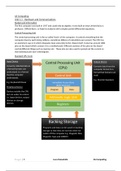
Standard CPU Cycle
Input Device Output Device
Central Processing Unit
Converts collected data in Converts data from the
a format humans can (CPU) computer format to a
understand, to a format format that humans can
that the computer Control Unit read.
understands.
E.g. Monitor/Speakers
E.g. Keyboard/Mouse Immediate Access Store
(RAM Memory)
Peripheral Device
Program Data
Devices outside the CPU
but are under its control
i.e. input devices, output Arithmetic Logic Unit
devices or storage
devices. Registers
Backing Storage
Programs and data can be saved on backing
storage so that they are not lost when we
switch off the computer E.g. Magnetic Disk,
Magnetic Tape and CDROM
Page |1 Luca Passariello AS Computing
Unit 1.1 - Hardware and Communications
Background Information
The first computer was built in 1937 and could only do algebra. It was built at Iowa University by a
professor, Clifford Berry, to help his students with complex partial differential equations.
Central Processing Unit
The central processing unit is the so-called ‘brain’ of the computer. It controls everything that the
computer does by performing millions, sometimes billions of calculations per second. The CPU has
an aluminium cap on it which dissipates heat and protects the chipset itself. It also has around 1000
pins on the board which connect it to a motherboard. Different sections of the pins on the board
control different things such as memory etc. These pins are also used to spread out the current so
that individual pins don’t disintegrate.
Standard CPU Cycle
Input Device Output Device
Central Processing Unit
Converts collected data in Converts data from the
a format humans can (CPU) computer format to a
understand, to a format format that humans can
that the computer Control Unit read.
understands.
E.g. Monitor/Speakers
E.g. Keyboard/Mouse Immediate Access Store
(RAM Memory)
Peripheral Device
Program Data
Devices outside the CPU
but are under its control
i.e. input devices, output Arithmetic Logic Unit
devices or storage
devices. Registers
Backing Storage
Programs and data can be saved on backing
storage so that they are not lost when we
switch off the computer E.g. Magnetic Disk,
Magnetic Tape and CDROM
Page |1 Luca Passariello AS Computing