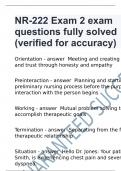
NR-222 Exam 2 exam questions fully solved (verified for accuracy)
Orientation Meeting and creating rapport and trust through honesty and empathy Preinteraction Planning and starting the preliminary nursing process before the purposeful interaction with the person begins Working Mutual problem solving to accomplish therapeutic goals Termination Separating from the formal therapeutic relationship Situation Hello Dr. Jones: Your patient, Mr. Smith, is experiencing chest pain and severe dyspnea. Background He was admitted to 6 South this morning following total knee replacement (TKR) and his pulse is 140 and weak, respiration are 50 and labored, with BP 108/56. He is extremely anxious and appears bluish with clammy skin. 02 sat is 76%. Assessment My assessment indicates that the patient is experiencing a pulmonary embolism or cardiac event status post TKR. Recommendation Recommend starting 02 at 10 L/min, stat EKG, stat medical consult, and further orders. Offering Self Making oneself available to clients in an unconditional manner. Example: "I'll just sit with you for a while, whether or not you would like to talk." Focusing Selecting a single topic or concept that the client has expressed to explore further. Example: "Let's talk more about your job." Broad Openings Allows the client to take the initiative in talking and emphasizes his or her importance and control in the process. Example: "What would you like to talk about today?" Reflecting Referring questions or statements back to the client. Example: "What do you think you should do about it?" Restating The content or main idea of what the client said is repeated by the nurse, allowing the client to continue or correct perceptions. Example: "You are concerned that this promotion may be beyond your capabilities?" Voicing Doubt Expresses uncertainty about whether what the client has said represents reality. Example: "Tell me more about how you see these things happening today. I need to have a better understanding of your perceptions." Presenting Reality The nurse defines reality or his or her perceptions in the face of the client misconception of the environment. Example: "I don't see anyone else in the room." Asking for Clarification Seeking the meaning of what has been said for mutual understanding. Example: "Did I understand you correctly? That you feel you may be fired because of your hospitalization?" Seeking Validation Similar to seeking clarification, the nurse confirms that there is a mutual understanding of what the client has said. Example: "Tell me if I understand what you have said." Summarizing Identifying key concepts for conclusion to the conversation or development of an action plan. Example: "Today we have talked about a plan for you to manage feelings of anger." Using Silence Demonstrates acceptance and allows the client an opportunity to reflect on what has been said or to introduce additional content. Example: Body language needs to be attentive without dominating. Opportunities for reflecting on the conversation are necessary. An uncomfortable period is therapeutic to encourage the other person to expand on his or her thoughts. Making Observations Allowing the client to recognize his or her behaviors and to compare the nurse's perceptions with the client's understanding. Example: "You seem upset about something." Offering General Leads Allows the client the opportunity to continue with a topic. Example: "What happened next?" Giving personal opinions "If I was you, I'd put your mother in a nursing home." Autonomic Responses "Older adults are always confused." Sympathy "I'm so sorry about your mastectomy; it must be terrible to lose a breast." Disapproval "You should/t even think about assisted suicide; it's not right." Passive responses "Things are bad, and there is nothing I can do about it." Arguing "How can you say you didn't sleep a wink when I heard you snoring all night long?" Aggressive responses "Things are bad, and it's all your fault." Defensive responses "No one here would intentionally lie to you." Asking for explanation "Why are you so anxious?" False reassurance "Don't worry, everything will be alright." Changing the subject "Let's not talk about your problems with the insurance company. It's for your walk." Asking personal questions "Why don't you and John get married?" Cultural Differences As the American-born nurse interacts with her Asian-born patient, she maintains positive eye contact. The patient, however, avoids looking back directly and feels uncomfortable around the nurse. Trans-theoretical model of change The nurse conducts nutritional education about carbohydrate intake with his newly diagnosed diabetic patient who often seemed impatient. Within an hour, the nurse notices that the patient is eating large piece of chocolate cake a family member brought from home. Healthy Literacy The nurse outlines the primary prevention needs for flu immunization by explaining how an attenuated virus activates WBCs to create antibodies. The individual chooses not to be immunized. metacommunication communication that comes from relationship building and understanding others on the team well Referent Motivates one person to communicate with another. Example: A patient's request for help prompted by his difficulty breathing Sender The person who encodes and delivers a message Receiver The person who is given a message and decodes it Message The contents of the communication Channels Means of sending a receiving messages through auditory, visual, and tactile senses Feedback The message a receiver sends to the sender that indicates whether or not the receiver understood the initial message Interpersonal Variables Factors that influence communication. Examples: education/developmental level, sociocultural background, values, and beliefs, emotions, gender, ect. When working with an older adult who is hearing-impaired, the use of which techniques would improve communication? (Select all that apply.) 1. Check for needed adaptive equipment. 2. Exaggerate lip movements to help the patient lip read. 3. Give the patient time to respond to questions. 4. Keep communication short and to the point. 5. Communicate only through written information. 1,3,4 Nurses must communicate effectively with the health care team for which of the following reasons? (Select all that apply.) 1. Improve the nurse's status with the health team members 2. Reduce the risk of errors to the patient 3. Provide optimum level of patient care 4. Improve patient outcomes 5. Prevent issues that need to be reported to outside agencies 2,3,4
Written for
- Institution
- NR 222-
- Course
- NR 222-
Document information
- Uploaded on
- June 1, 2024
- Number of pages
- 61
- Written in
- 2023/2024
- Type
- Exam (elaborations)
- Contains
- Questions & answers
Subjects
-
nr 222 exam 2 exam questions

Also available in package deal