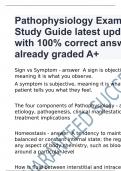
Pathophysiology Exam 1 Study Guide latest update with 100% correct answers already graded A+
Sign vs Symptom A sign is objective, meaning it is what you observe. A symptom is subjective, meaning it is what the patient tells you what they feel. The four components of Pathophysiology etiology, pathogenesis, clinical manifestations, treatment implications Homeostasis A tendency to maintain a balanced or constant internal state; the regulation of any aspect of body chemistry, such as blood glucose, around a particular level How is fluid between interstitial and intracellular compartments distributed? Fluid is distributed by osmosis Main complication of sodium imbalance Neurological symptoms such as confusion, seizures, coma, headache Main complication of calcium imbalance Heart and muscle problems How fluid is lost or excreted from the body § Gastrointestinal losses § Excessive diaphoresis § Prolonged hyperventilation § Hemorrhage § Nephrosis § Diabetes mellitus § Diabetes insipidus § Burns § Open wounds § Ascites § Effusions § Excessive use of diuretics § Osmotic diuresis How do we lose fluid from extracellular compartment Sweating, excessive crying, hyperventilation, vomiting What is a potential and fatal complication from hyponatremia Seizures and comas Priority assessment for a patient with potassium imbalance The heart; EKG Symptoms of dehydration thirst, headache, fatigue, loss of appetite, dry eyes, dry mouth, dark-colored urine Manifestations of fluid excess edema, hypertension, weight gain, bounding pulse, increased heart rate Cause of edema The capillary hydrostatic pressure increases to cause edema in the interstitial compartment Extracellular fluid has higher concentration of which electrolytes/substances Sodium and chloride The energy currency of a cell and role the mitochondrion plays in this currency The energy currency of a cell is the ATP, or Adenosine Triphosphate. The mitochondria acts as the power plant of the cell, making ATP for the cell. Three electrolytes that are stored in and impact bone and the relationship they have to each other The three electrolytes that are stored in and impact bone are calcium, phosphorus, and magnesium. Calcium has an inverse relationship with phosphorus and a synergistic relationship with magnesium. RAAS System The system regulates blood pressure by vasoconstriction to increase blood pressure Acute vs. Chronic Acute - Symptom has been present for less than three months. Chronic - Symptom has been present for more than three months. Epidemiology - Levels of prevention Levels of Prevention Primary: Do not have the disease and you are trying to prevent it (e.g., vaccines handwashing, PPE, wearing masks) Secondary: Disease detection (e.g., Pap smears and regular physicals) Tertiary: Trying to prevent problems from the disease (e.g., rehabilitation, physical therapy) Major Cell Components Nucleus, Ribosomes, Mitochondria Fluid Compartments Intracellular fluid: Fluid inside the cells Extracellular fluid: fluid outside the cells Interstitial fluid: between the cell Intravascular fluid: inside the blood vessels Transcellular fluid: third space (e.g., joints, everywhere else) Hypotension Manifestation of dehydration; low blood pressure Fluid balance control Thirst mechanism: triggered by decreased blood volume; patient can be bleeding out; dry mouth, thirst feeling Antidiuretic hormone (ADH): Promotes reabsorption of water in the kidneys; Hold on to water when dehydrated; No urination when dehydrated, which is caused by ADH; Regulates fluid Aldosterone: Hormone made in adrenal cortex; Increases reabsorption of sodium and water in the kidneys; Regulates or increases blood pressure; Blood pressure drops when dehydrated Atrial Natriuretic Peptide: Stimulated renal vasodilation and suppresses aldosterone, increasing urinary output; Hormone released when patient is very hydrated; Blood vessels in kidneys open up; Blood pressure is high when there is too much fluid, making the heart work harder Oliguria Not enough urine What happens during the alarm phase of Hans Selye's General Adaptation Syndrome? The alarm phase is the initial reaction, where the sympathetic nervous system is stimulated, releasing epinephrine (adrenaline) and cortisol. This is known as the fight or fight response. What clinical findings would the patient in the fight or flight stage present with? Increased heart rate, increased respiration, pupil dilation, increased blood flow to the muscles, increased muscle strength, increased alertness, increased glucose availability, decreased inflammation. Signs of inflammation redness, heat, swelling, pain, loss of function What is active immunity? the immunity that results from the production of antibodies by the immune system in response to the presence of an antigen. Type 1 hypersensitivity mediator and its effect on the body IgE mediated Can cause allergic rhinitis, asthma, anaphylaxis What do histamines do? increase the flow of blood and fluids to the affected area; increases the permeability of the capillaries to white blood cells and other proteins, allowing them to engage foreign invaders in the infected tissues. A lab test that can measure inflammation C - Reactive Protein (CRP) and Plasma Viscosity PV Blood Test. What is metastasis? Cancer cells leaving a tumor and invading other parts of the body What is cachexia? weakness and wasting of the body due to severe chronic illness
Written for
- Institution
- NUR2063 Pathophysiology
- Course
- NUR2063 Pathophysiology
Document information
- Uploaded on
- June 1, 2024
- Number of pages
- 21
- Written in
- 2023/2024
- Type
- Exam (elaborations)
- Contains
- Questions & answers
Subjects
-
pathophysiology exam 1 study guide latest update

Also available in package deal