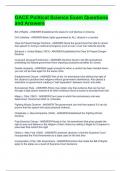
TX GOV 1.1 - INTRODUCTION TO
POLITICAL SCIENCE EXAM QUESTIONS
AND ANSWERS
What is politics? - ANSWER-Who gets what, when, and how; constrained used of
power; working with others to achieve your goals.
What is political science? - ANSWER-Political science is a social science discipline that
deals with systems of government and the analysis of political activity and political
behavior. As a social science, political science focuses on group power - the how and
why of decision making; therefore, political science is the study of power, how it's
created, exercised, justified, and challenged.
Political science draws upon: - ANSWER-many fields - economics, law, sociology,
history, anthropology, public administration, public policy, national politics, international
relations, comparative politics, psychology, political organization, and political theory
How is historical context related to policy? - ANSWER-Historical context is critical to
understanding politics. It allows us to take a look at:
How the event or policy evolved
What else was happening that influenced the event or policy
Who was involved, and what their views were
Why we got this result and not another
The two aspects of political science are: - ANSWER-Facts (the what is), and theory
(what ought to be).
Government vs PolySci - ANSWER-A government is the system by which a nation,
state or community is controlled. Government is by the people, for the people.
Big "S" state vs little "S" state - ANSWER-The big "S" refers to a specific sovereign
entity such as the State of Texas, Germany, Mexico etc. Each is a entity with borders
and a government and is recognized as a distinct unit. The small "s" state refers to the
organization of people (society a polity) into a governed unit.
Theories of the origin of the state: - ANSWER-Evolutionary (social, agricultural, security)
-> Force (conquering/getting conquered) -> Divine (religious) -> Social Contract (giving
up small rights for bigger and better rights; cooperation)
What is a state? - ANSWER-A defined territory over which/A central impersonal
bureaucracy that :
>Maintains an army/police which protects/controls the territory (monopoly on violence)
POLITICAL SCIENCE EXAM QUESTIONS
AND ANSWERS
What is politics? - ANSWER-Who gets what, when, and how; constrained used of
power; working with others to achieve your goals.
What is political science? - ANSWER-Political science is a social science discipline that
deals with systems of government and the analysis of political activity and political
behavior. As a social science, political science focuses on group power - the how and
why of decision making; therefore, political science is the study of power, how it's
created, exercised, justified, and challenged.
Political science draws upon: - ANSWER-many fields - economics, law, sociology,
history, anthropology, public administration, public policy, national politics, international
relations, comparative politics, psychology, political organization, and political theory
How is historical context related to policy? - ANSWER-Historical context is critical to
understanding politics. It allows us to take a look at:
How the event or policy evolved
What else was happening that influenced the event or policy
Who was involved, and what their views were
Why we got this result and not another
The two aspects of political science are: - ANSWER-Facts (the what is), and theory
(what ought to be).
Government vs PolySci - ANSWER-A government is the system by which a nation,
state or community is controlled. Government is by the people, for the people.
Big "S" state vs little "S" state - ANSWER-The big "S" refers to a specific sovereign
entity such as the State of Texas, Germany, Mexico etc. Each is a entity with borders
and a government and is recognized as a distinct unit. The small "s" state refers to the
organization of people (society a polity) into a governed unit.
Theories of the origin of the state: - ANSWER-Evolutionary (social, agricultural, security)
-> Force (conquering/getting conquered) -> Divine (religious) -> Social Contract (giving
up small rights for bigger and better rights; cooperation)
What is a state? - ANSWER-A defined territory over which/A central impersonal
bureaucracy that :
>Maintains an army/police which protects/controls the territory (monopoly on violence)