Meta Ethics
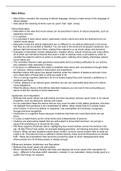
• Meta Ethics considers the meaning of ethical language, aiming to make sense of the language of
ethical debate.
• Asks about the meaning of terms such as ‘good’ ‘bad’ ‘right’ ‘wrong’.
Ethical Naturalism
• Naturalism is the view that moral values can be described in terms of natural properties, such as
happiness and love.
• It is cognitive.
• It is grounded in facts about nature, particularly human nature and what are deemed to be our
'natural moral values.’
• Naturalism holds that ethical statements are no different to non-ethical statements in the sense
that they too can be verified or falsified. You can look to the world and at people's behaviour and
deduce right and wrong from them, making them natural to us as moral values and decisions.
• Examples of naturalism include utilitarianism, situation ethics, natural moral law and virtue ethics,
all of which are normative theories that exist in order to express rules or principles by which to
consider the extent to which an action is morally good, outlining more clearly what these natural
moral values are.
• The normative theories make goodness measurable which provides justification for our actions,
this underpins what naturalism is about.
• If we focus on utilitarianism, this seeks to establish facts about pain and pleasure through Hedo-
nic Calculus, linking morality to observation and experience.
• Bentham claims that nature has placed mankind under the masters of pleasure and pain more-
over observation of these tells us what we ought to do.
• This is a strong cognitive statement, he is not simply saying they point towards a preference or
emotional pull-factor.
• Further, pleasure is an intrinsic good, therefore we can use observable facts about it to derive
moral obligations.
• What the above shows is that ethical naturalism believes you can look to the surrounding evi-
dence to test the veracity of moral statements.
Intuitionism (non-naturalism)
• Believes that moral values are self-evident and that naturalism reduces 'good' down to its natural
properties, such as pleasures, desires and needs.
• As non-naturalism takes the stance that we may never be able to fully define goodness, this does
not highlight that goodness is too complicated to define, rather simply that it's a simple notion
which means it cannot be defined or explained, only exemplified and intuitively recognised,
through previous recognition.
• Intuitionism is a cognitive theory because it believes that there are moral facts which we can
know.
• It is also a realist theory as the moral truths exist independently of persons.
• Intuitions are stand-alone beliefs that are self-evident to those that hold them; we just get a
sense that something is or should be the case.
• WD Ross supports intuitionist claims, highlighting how moral intuition comes into decision mak-
ing. He lists Prima Facie duties, for example keeping promises, not harming innocents, returning
favours. When we face situations where these conflict, common sense-intuition tells us what we
ought to do. Provided we have a sufficient mental maturity, these prevent themselves as intuited
truth. These are propositions that cannot be proved but need no proof. Disagreements arise
where people are not thinking clearly or deeply enough.
Differences between Intuitionism and Naturalism
• Believes that moral values are self-evident.
• Moore rejected the idea of stating with facts and slipping into moral values (the naturalistic fal-
lacy). - different to the ideas within naturalism, instead, in non-naturalism, being morally good is a
quality that things can possess.
• Meta Ethics considers the meaning of ethical language, aiming to make sense of the language of
ethical debate.
• Asks about the meaning of terms such as ‘good’ ‘bad’ ‘right’ ‘wrong’.
Ethical Naturalism
• Naturalism is the view that moral values can be described in terms of natural properties, such as
happiness and love.
• It is cognitive.
• It is grounded in facts about nature, particularly human nature and what are deemed to be our
'natural moral values.’
• Naturalism holds that ethical statements are no different to non-ethical statements in the sense
that they too can be verified or falsified. You can look to the world and at people's behaviour and
deduce right and wrong from them, making them natural to us as moral values and decisions.
• Examples of naturalism include utilitarianism, situation ethics, natural moral law and virtue ethics,
all of which are normative theories that exist in order to express rules or principles by which to
consider the extent to which an action is morally good, outlining more clearly what these natural
moral values are.
• The normative theories make goodness measurable which provides justification for our actions,
this underpins what naturalism is about.
• If we focus on utilitarianism, this seeks to establish facts about pain and pleasure through Hedo-
nic Calculus, linking morality to observation and experience.
• Bentham claims that nature has placed mankind under the masters of pleasure and pain more-
over observation of these tells us what we ought to do.
• This is a strong cognitive statement, he is not simply saying they point towards a preference or
emotional pull-factor.
• Further, pleasure is an intrinsic good, therefore we can use observable facts about it to derive
moral obligations.
• What the above shows is that ethical naturalism believes you can look to the surrounding evi-
dence to test the veracity of moral statements.
Intuitionism (non-naturalism)
• Believes that moral values are self-evident and that naturalism reduces 'good' down to its natural
properties, such as pleasures, desires and needs.
• As non-naturalism takes the stance that we may never be able to fully define goodness, this does
not highlight that goodness is too complicated to define, rather simply that it's a simple notion
which means it cannot be defined or explained, only exemplified and intuitively recognised,
through previous recognition.
• Intuitionism is a cognitive theory because it believes that there are moral facts which we can
know.
• It is also a realist theory as the moral truths exist independently of persons.
• Intuitions are stand-alone beliefs that are self-evident to those that hold them; we just get a
sense that something is or should be the case.
• WD Ross supports intuitionist claims, highlighting how moral intuition comes into decision mak-
ing. He lists Prima Facie duties, for example keeping promises, not harming innocents, returning
favours. When we face situations where these conflict, common sense-intuition tells us what we
ought to do. Provided we have a sufficient mental maturity, these prevent themselves as intuited
truth. These are propositions that cannot be proved but need no proof. Disagreements arise
where people are not thinking clearly or deeply enough.
Differences between Intuitionism and Naturalism
• Believes that moral values are self-evident.
• Moore rejected the idea of stating with facts and slipping into moral values (the naturalistic fal-
lacy). - different to the ideas within naturalism, instead, in non-naturalism, being morally good is a
quality that things can possess.