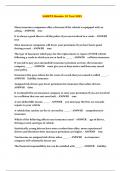
RBT Exam Assessment Practice Questions with 100% correct answers
A multiple stimulus with replacement is best described by which of the following options below? A) Many stimuli are presented simultaneously, but only one choice is allowed at a time. After an item is chosen, it is returned to the array on subsequent trials. B) Stimuli are presented in pairs, and one choice is allowed at a time. All stimuli are matched together at least once. C) The individual freely engages with any items (in a typically richly seeded) environment, and engagement time with each activity is recorded. D) Many stimuli are presented simultaneously, but only one choice is allowed at a time. After an item is chosen, it is removed from the array. A Which of the following is an objective, concise, clear and complete response definition? A) Aggression B) Mean language C) Inappropriate language D) Striking the body parts of others with an open or closed fist D Which of the following is an objective, concise, clear and complete response definition? A) Brings the tip of his forefinger into contact with his nose within 3 - 5 seconds of the SD. B) Runs quickly, but not too quickly, with a good gait C) Does it D) Completes the activity A Food, sex, water, breathable air and any other stimuli that are necessary for life (homeostasis) are what types of _________ reinforcement? A) Ontogenetic B) Conditioned C) Unconditioned D) Operant C Which of the following is an objective, concise, clear and complete response definition? A) Behaves appropriately B) Crying with or without tears for longer than 5 seconds C) Does math problems the right way D) Intends to harm others B Which of the following is a preference assessment where the individual is systematically exposed to many stimuli in sets of two - this arrangement allows for each item to be presented an equal number of times, which enables us to create a "preference hierarchy" (i.e., how much each item is preferred / non-preferred). A) MSWO B) Paired Choice C) Free Operant D) MS (Multiple Stimulus) B What type of design is employed by a functional analysis to verify the maintaining variables of a given behavior? A) Momentary Baseline Sampling Design B) Alternating Treatments Design C) Multiple Probe Assessment Design D) Multiple Baseline Design B A free operant preference assessment is... A) The individual freely engages with any items (in a typically richly seeded) environment, and engagement time with each activity is recorded. B) Many stimuli are presented simultaneously, but only one choice is allowed at a time. After an item is chosen, it is returned to the array on subsequent trials. C) Stimuli are presented in pairs, and one choice is allowed at a time. All stimuli are matched together at least once. D) Many stimuli are presented simultaneously, but only one choice is allowed at a time. After an item is chosen, it is removed from the array. A Which of the following is the name for the type of preference assessment where the individual is allowed to freely roam a room seeded with potentially preferred stimuli while the analyst records the duration of engagement with each item in the room, hoping to gather an understanding of what items, if any, the individual spends their time with when allowed to freely interact with them, and potentially create a hierarchy out of the amount of time they allocate their responding? A) MSWO B) Free Operant C) MS D) Paired Choice B A paired stimulus preference assessment is best described by which of the following? A) Many stimuli are presented simultaneously, but only one choice is allowed at a time. After an item is chosen, it is removed from the array. B) Many stimuli are presented simultaneously, but only one choice is allowed at a time. After an item is chosen, it is returned to the array on subsequent trials. C) Stimuli are presented in pairs, and one choice is allowed at a time. All stimuli are matched together at least once. D) The individual freely engages with any items (in a typically richly seeded) environment, and engagement time with each activity is recorded. C Which of the following is the name for the type of preference assessment where the individual is offerred an array of likely preferred items (typically 5 - 7). As each item is selected, it is removed from subsequent presentations A) MSWO B) Paired Choice C) MS D) Free Operant A Which of the following is the name for the type of preference assessment described below? This stimulus preference assessment has a participant select one item at a time from an array of potentially preferred stimuli. Each time they select an item from the array, they can select that item again on the next trial. This continues while the analyst records the number of times each item is chosen, generating a list of most highly preferred stimuli. A) MSWO B) Paired Choice C) Free Operant D) MS D A _____________ (fill in the blank) is a type of assessment that allows analysts to determine the "why" (or reinforcers) for a specific behavior by arranging test conditions which manipulate antecedents & consequences in an alternating design to evoke (and reinforce) problem behavior. After the assessment, the test conditions are compared with the goal of discriminating what test condition evoked the most problem behavior (and is, therefore, likely a functional reinforcer for that problem behavior). A) Functional analysis B) Myers-Briggs Analysis C) Multiple Stimulus without Replacement D) Rorschach Test A The ABLLS-R (Assessment of Basic Language & Learning Skills) is a popular assessment for individuals with special needs, especially ASD. The ABLLS-R is arranged with skills organized into related groups, such as motor, labeling, social skills, etc. creating an easy to follow curriculum for that child. Each skill is broken down into instructional targets with objective criteria for mastery, with specific response criteria for each objective. This is an example of what type(s) of assessment? A) Respondent-assessment, empirically validated B) Trials to Criterion C) Norm-referenced, developmentally-based D) Curriculum-based, Criteron-referenced D A __________ (fill in the blank) is a type of assessment where stimuli are presented to an individual in a systematic fashion with the overall goal of determining what, if any, of the stimuli are preferred by that individual - these "preferred" stimuli may be then used as reinforcers. A) Functional Analysis B) Multiple Exemplar Assessment C) Preference Assessment D) ABC Recording C A multiple stimulus without replacement is described best by which of the following? A) The individual freely engages with any items (in a typically richly seeded) environment, and engagement time with each activity is recorded. B) Many stimuli are presented simultaneously, but only one choice is allowed at a time. After an item is chosen, it is removed from the array. C) Stimuli are presented in pairs, and one choice is allowed at a time. All stimuli are matched together at least once. D) Many stimuli are presented simultaneously, but only one choice is allowed at a time. After an item is chosen, it is returned to the array on subsequent trials. B Developed by Iwata et al. in 1994, this procedure assists with identifying the likely maintaining variables and is often used during an initial assessment to identify the likely "cause" of a problem behavior? A) Asking the parents and other caregivers is usually good enough B) Function Test C) Norm-Referenced Testing D) Functional Analysis D What is a curriculum-based assessment? A) An assessment that is specifically designed to generate a bell curve with a standard normal distribution of performance. B) An assessment that measures the development of a child's performance with emphasis on their ability to form friendships, relationships, and appropriate interactions in group contexts. C) An assessment that maps the child's performance against the performance of typically developing children from the same age group. D) This test measures performance against a fixed set of standards or goals, usually grouped by class, e.g., "motor," "language," etc. D Which of the following types of assessments identifies the maintaining reinforcer for a given behavior? A) Functional Analysis B) Direct observation and approximation based off what "looks" to be the root cause C) Alternating Treatments Design D) Multiple Schedule Litmus Test A
Written for
- Institution
- PEARSON RBT
- Course
- PEARSON RBT
Document information
- Uploaded on
- May 31, 2024
- Number of pages
- 15
- Written in
- 2023/2024
- Type
- Exam (elaborations)
- Contains
- Questions & answers
Subjects
-
rbt exam assessment practice questions