4.4 Variation and evolution
Types of variation
● Variation in phenotypes may be due to;
○ Having different genotypes
○ Having the same genotype but different epigenetic modifications
○ Being exposed to different environments
● Heritable variation (can be passed onto offspring) arises from;
○ Gene mutations
○ Crossing over during prophase I of meiosis
○ Independent assortment during metaphase I & II of meiosis
○ Random mating i.e. that any organism can mate with another
○ Random fusion of gametes
○ Environmental factors leading to epigenetic modifications
■ Can lead to non-heritable variation e.g. diet
● Two types of variation
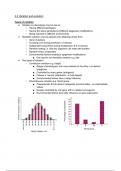
○ Continuous variation e.g. height
■ Range of phenotypes, from one extreme to the other / no distinct
categories
■ Controlled by many genes (polygenic)
■ Follows a ‘normal’ distribution - is ‘bell shaped’
■ Environmental factors have a large influence
○ Discontinuous variation e.g. blood group
■ Characteristic fit into distinct categories (nominal data) - no intermediate
values
■ Usually controlled by one gene with 2+ alleles (monogenic)
■ Environmental factors have little influence on gene expression
, T-test
● Significant value between the mean values of two continuous data sets
● Mean - a measure of central tendency
● Standard deviation - measure of variation either side of the mean
● t-value must exceed the critical value for results to be significant
○ p=0.05
○ Degrees of freedom as the number of observations-2
Causes of variation
Environmental factors
● Environmental influences affect genotype expression ⇾ different phenotypes
● E.g. industrial melanism in the peppered moth (Biston betularia)
○ In polluted habitats where trees are covered in soot, dark form is most common
○ In unpolluted habitats where lichens are found, speckled form is more common
○ Colour provides camouflage, giving a selective advantage
■ More likely to survive, reproduce transfer advantageous alleles to
offspring, numbers within population increase
● Biotic & abiotic factors
● Density dependent & density independent factors
Competition
● Intraspecific competition
○ Members of the same species compete for the same resources in an ecosystem
● Interspecific competition
Types of variation
● Variation in phenotypes may be due to;
○ Having different genotypes
○ Having the same genotype but different epigenetic modifications
○ Being exposed to different environments
● Heritable variation (can be passed onto offspring) arises from;
○ Gene mutations
○ Crossing over during prophase I of meiosis
○ Independent assortment during metaphase I & II of meiosis
○ Random mating i.e. that any organism can mate with another
○ Random fusion of gametes
○ Environmental factors leading to epigenetic modifications
■ Can lead to non-heritable variation e.g. diet
● Two types of variation
○ Continuous variation e.g. height
■ Range of phenotypes, from one extreme to the other / no distinct
categories
■ Controlled by many genes (polygenic)
■ Follows a ‘normal’ distribution - is ‘bell shaped’
■ Environmental factors have a large influence
○ Discontinuous variation e.g. blood group
■ Characteristic fit into distinct categories (nominal data) - no intermediate
values
■ Usually controlled by one gene with 2+ alleles (monogenic)
■ Environmental factors have little influence on gene expression
, T-test
● Significant value between the mean values of two continuous data sets
● Mean - a measure of central tendency
● Standard deviation - measure of variation either side of the mean
● t-value must exceed the critical value for results to be significant
○ p=0.05
○ Degrees of freedom as the number of observations-2
Causes of variation
Environmental factors
● Environmental influences affect genotype expression ⇾ different phenotypes
● E.g. industrial melanism in the peppered moth (Biston betularia)
○ In polluted habitats where trees are covered in soot, dark form is most common
○ In unpolluted habitats where lichens are found, speckled form is more common
○ Colour provides camouflage, giving a selective advantage
■ More likely to survive, reproduce transfer advantageous alleles to
offspring, numbers within population increase
● Biotic & abiotic factors
● Density dependent & density independent factors
Competition
● Intraspecific competition
○ Members of the same species compete for the same resources in an ecosystem
● Interspecific competition