4.2 sexual reproduction in plants
Flower structure
● Angiosperms = flowering plants
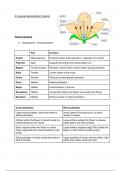
Part Function
Anther Male (stamen) Produces pollen (male gametes) + deposits it to insects
Filament Male Supports the anther and carries pollen to it
Stigma Female (carpel) Receptor surface which collects pollen during pollination
Style Female Carries pollen to the ovary
Ovary Female Produces ovules (female gametes)
Petal Neither Attracts pollinators
Sepal Neither Protects flower in the bud
Receptacle Neither Connect the stalk to the flower and support the flower
Nectaries Neither Produce nectar to attract pollinators
Insect pollinated Wind pollinated
Large colourful petals, scent and nectar to Small, green & inconspicuous, no scent,
attract pollinators usually no petals
Anthers within the flower to transfer pollen to Large anthers outside the flower to release
insects feeding on the nectar pollen grains into wind currents
Sticky stigmas within the flower to collect Large feathery stigmas (large SA) outside the
pollen deposited from insects feeding on the flower to catch airborne pollen grains
nectar
Small quantities of sticky sculptured pollen to Large quantities of small, smooth-walled, light
stick to insects pollen to be easily carried by wind
, Development of gametes
Male gamete development
● Anthers consist of four pollen sacs arranged in two pairs
● Within the pollen sac
○ Diploid pollen mother cells (formed by mitosis, 2n) divide by meiosis to produce a
tetrad (4 haploid (n) and immature pollen grains)
■ Tapetum (surrounding nutritive layer) provides nutrients to developing
pollen grains
■ Pollen cell wall is tough and resistant to desiccation
○ The haploid nucleus within the pollen grain undergoes mitosis to produce a
mature pollen grain inc;
■ A generative nucleus which undergoes further mitotic division producing
two male nuclei
■ And a pollen tube nucleus
○ As the outer layers of the anther mature and dry, the outer walls curl exposing the
pollen grains i.e. dehiscence
Female gamete development
● Within the ovary
○ Megaspore mother cell (2n) undergoes meiosis producing 4 haploid cells
■ 3 cells degenerate
■ One develops into the embryo sac -
produces 8 haploid cells following three
mitotic divisions
● 2 cells fuse to produce a diploid polar nucleus
● 6 haploid cells inc;
○ 3 antipodals - play no further role
○ 2 synergids - degenerate after fertilisation
○ 1 oosphere
● All contained within the embryo sac which is
surrounded by integuments
Flower structure
● Angiosperms = flowering plants
Part Function
Anther Male (stamen) Produces pollen (male gametes) + deposits it to insects
Filament Male Supports the anther and carries pollen to it
Stigma Female (carpel) Receptor surface which collects pollen during pollination
Style Female Carries pollen to the ovary
Ovary Female Produces ovules (female gametes)
Petal Neither Attracts pollinators
Sepal Neither Protects flower in the bud
Receptacle Neither Connect the stalk to the flower and support the flower
Nectaries Neither Produce nectar to attract pollinators
Insect pollinated Wind pollinated
Large colourful petals, scent and nectar to Small, green & inconspicuous, no scent,
attract pollinators usually no petals
Anthers within the flower to transfer pollen to Large anthers outside the flower to release
insects feeding on the nectar pollen grains into wind currents
Sticky stigmas within the flower to collect Large feathery stigmas (large SA) outside the
pollen deposited from insects feeding on the flower to catch airborne pollen grains
nectar
Small quantities of sticky sculptured pollen to Large quantities of small, smooth-walled, light
stick to insects pollen to be easily carried by wind
, Development of gametes
Male gamete development
● Anthers consist of four pollen sacs arranged in two pairs
● Within the pollen sac
○ Diploid pollen mother cells (formed by mitosis, 2n) divide by meiosis to produce a
tetrad (4 haploid (n) and immature pollen grains)
■ Tapetum (surrounding nutritive layer) provides nutrients to developing
pollen grains
■ Pollen cell wall is tough and resistant to desiccation
○ The haploid nucleus within the pollen grain undergoes mitosis to produce a
mature pollen grain inc;
■ A generative nucleus which undergoes further mitotic division producing
two male nuclei
■ And a pollen tube nucleus
○ As the outer layers of the anther mature and dry, the outer walls curl exposing the
pollen grains i.e. dehiscence
Female gamete development
● Within the ovary
○ Megaspore mother cell (2n) undergoes meiosis producing 4 haploid cells
■ 3 cells degenerate
■ One develops into the embryo sac -
produces 8 haploid cells following three
mitotic divisions
● 2 cells fuse to produce a diploid polar nucleus
● 6 haploid cells inc;
○ 3 antipodals - play no further role
○ 2 synergids - degenerate after fertilisation
○ 1 oosphere
● All contained within the embryo sac which is
surrounded by integuments