3.4 Microbiology
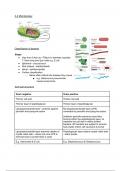
Classification of bacteria
Shape
● Vary from 0.4μm to >700μm in diameter, typically
7-10μm long and 2μm wide e.g. E.coli
● Spherical - coccus/cocci
● Rod shaped - bacillus/bacilli
● Spiral - spirillum/spirilla
● Further classification
○ Name often reflects the disease they cause
■ e.g. Diplococcus pneumoniae
causes pneumonia
Cell wall structure
Gram negative Gram positive
Thinner cell wall Thicker cell wall
Thinner layer of peptidoglycan Thicker layer of peptidoglycan
Lipopolysaccharide layer - protects against No lipopolysaccharide layer (LPS) -
penicillin and lysozyme action vulnerable to penicillin and lysozyme action
Antibiotic penicillin prevents cross-links
forming within the peptidoglycan layer, so
weakens the cell wall in newly divided
bacteria. GP bacteria are subject to osmotic
lysis (water enters cell causing it to burst)
Lipopolysaccharide layer prevents uptake of Peptidoglycan layer retains crystal violet stain
crystal violet stain - stains red once LPS is - stains purple
removed and a counter-stain is used
E.g. Salmonella & E.coli E.g. Staphylococcus & Streptococcus
, ● Gram stain technique - method of identifying bacterial species (+/-) based on their cell
wall structure
1. Transfer a small sample of bacteria to a glass microscope slide using an
inoculating loop
2. Pass the slide through a bunsen flame a few times to fix bacteria to the slide
(also kills them)
3. Add a few drops of crystal violet stain and leave for 30 seconds
4. Rinse excess with water
5. Add Gram’s iodine for 1 minute to fix stain
6. Bacteria that stain purple are Gram-positive
7. To stain remaining bacteria;
a. Wash with alcohol for 30 seconds to dissolve lipids in lipopolysaccharide
layer, and expose inner peptidoglycan layer
b. Re-stain using another stain e.g. safranin which stains unstained bacteria
red
Culturing bacteria
● A growth medium e.g. nutrient agar has the following;
○ Nutrients
■ Source of carbon for respiration e.g. glucose
■ Nitrogen source for synthesis of nucleotides and proteins
■ Sulphur, phosphorus, vitamins & mineral salts
○ Water
○ Suitable temperature
■ 25-45℃ for most bacteria
■ 37℃ is the optimum temperature for
mammalian pathogens
■ Thermophiles (e.g. Thermus
aquaticus which evolved in hot
springs) survive at 90℃
■ To calculate optimum range draw a
line across the top of each peak
○ Suitable pH
■ Optimum for most bacteria is slightly
Classification of bacteria
Shape
● Vary from 0.4μm to >700μm in diameter, typically
7-10μm long and 2μm wide e.g. E.coli
● Spherical - coccus/cocci
● Rod shaped - bacillus/bacilli
● Spiral - spirillum/spirilla
● Further classification
○ Name often reflects the disease they cause
■ e.g. Diplococcus pneumoniae
causes pneumonia
Cell wall structure
Gram negative Gram positive
Thinner cell wall Thicker cell wall
Thinner layer of peptidoglycan Thicker layer of peptidoglycan
Lipopolysaccharide layer - protects against No lipopolysaccharide layer (LPS) -
penicillin and lysozyme action vulnerable to penicillin and lysozyme action
Antibiotic penicillin prevents cross-links
forming within the peptidoglycan layer, so
weakens the cell wall in newly divided
bacteria. GP bacteria are subject to osmotic
lysis (water enters cell causing it to burst)
Lipopolysaccharide layer prevents uptake of Peptidoglycan layer retains crystal violet stain
crystal violet stain - stains red once LPS is - stains purple
removed and a counter-stain is used
E.g. Salmonella & E.coli E.g. Staphylococcus & Streptococcus
, ● Gram stain technique - method of identifying bacterial species (+/-) based on their cell
wall structure
1. Transfer a small sample of bacteria to a glass microscope slide using an
inoculating loop
2. Pass the slide through a bunsen flame a few times to fix bacteria to the slide
(also kills them)
3. Add a few drops of crystal violet stain and leave for 30 seconds
4. Rinse excess with water
5. Add Gram’s iodine for 1 minute to fix stain
6. Bacteria that stain purple are Gram-positive
7. To stain remaining bacteria;
a. Wash with alcohol for 30 seconds to dissolve lipids in lipopolysaccharide
layer, and expose inner peptidoglycan layer
b. Re-stain using another stain e.g. safranin which stains unstained bacteria
red
Culturing bacteria
● A growth medium e.g. nutrient agar has the following;
○ Nutrients
■ Source of carbon for respiration e.g. glucose
■ Nitrogen source for synthesis of nucleotides and proteins
■ Sulphur, phosphorus, vitamins & mineral salts
○ Water
○ Suitable temperature
■ 25-45℃ for most bacteria
■ 37℃ is the optimum temperature for
mammalian pathogens
■ Thermophiles (e.g. Thermus
aquaticus which evolved in hot
springs) survive at 90℃
■ To calculate optimum range draw a
line across the top of each peak
○ Suitable pH
■ Optimum for most bacteria is slightly