3.3 Respiration
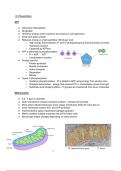
ATP
● Adenosine triphosphate
● Nucleotide
● Universal energy carrier (used for all reactions in all organisms)
● Small and water soluble
● Releases energy in small quantities (30.6kj per mol)
○ High energy bond between 2nd and 3rd phosphate group (terminal bond) is broken
○ Hydrolysis reaction
○ Catalysed by ATPase
● ATP is reformed by phosphorylation
○ Pi + ADP ⇾ ATP
○ Condensation reaction
● Energy used for;
○ Protein synthesis
○ Muscle contraction
○ Active transport
○ Respiration
○ Mitosis
● Types of phosphorylation
○ Oxidative phosphorylation - Pi is added to ADP using energy from electron loss
○ Photophosphorylation - energy that powers ETC in chloroplasts comes from light
○ Substrate level phosphorylation - Pi groups are transferred from donor molecules
Mitochondria
● 0.5 - 1.0μm in diameter
● Outer membrane contains transport proteins - transport of pyruvate
● More active mitochondria have more cristae (membrane folds) for more SA:vol
● Inner membrane contain ETC and ATP synthase
● Intermembrane space maximises hydrogen gradient
● Matrix contains suitable enzymes and pH for krebs cycle
● Microscope shape changes depending on cross-section
, Overview of respiration
Aerobic respiration
● Complete breakdown of glucose
● Releases relatively large amount of energy (32-38 ATP by oxidative phosphorylation)
● O2 is the final electron acceptor
Anaerobic respiration
● In muscles
○ Glucose ⇾ lactic acid
○ C6H12O6 ⇾ 2C3H6O3
● In yeast
○ Glucose ⇾ ethanol + carbon dioxide
○ C6H12O6 ⇾ 2C2H5OH + 2CO2
● Incomplete breakdown of glucose
● Releases relatively little energy as ATP by substrate level phosphorylation
● Occurs in absence of oxygen e.g. vigorous exercise
Aerobic respiration
Glycolysis
● Cytoplasm
● Does not require O2
● Net gain +2 ATP
1. Phosphorylation of glucose
a. Glucose is phosphorylated (6C + 2x Pi) ⇾
hexose bisphosphate
i. 2 ATP are hydrolysed to obtain
phosphates - 2 ATP ⇾ 2ADP + 2Pi
2. Splitting of phosphorylated glucose
a. Hexose bisphosphate more reactive
(lowers Ea for reaction) splits to 2x TP (3C)
3. Oxidation of 2x TP to form 2x Pyruvate
a. Dehydrogenation (removal of H atoms
catalysed by dehydrogenase enzymes)
i. 2 NAD + 2 H ⇾ 2 reduced NAD
ATP
● Adenosine triphosphate
● Nucleotide
● Universal energy carrier (used for all reactions in all organisms)
● Small and water soluble
● Releases energy in small quantities (30.6kj per mol)
○ High energy bond between 2nd and 3rd phosphate group (terminal bond) is broken
○ Hydrolysis reaction
○ Catalysed by ATPase
● ATP is reformed by phosphorylation
○ Pi + ADP ⇾ ATP
○ Condensation reaction
● Energy used for;
○ Protein synthesis
○ Muscle contraction
○ Active transport
○ Respiration
○ Mitosis
● Types of phosphorylation
○ Oxidative phosphorylation - Pi is added to ADP using energy from electron loss
○ Photophosphorylation - energy that powers ETC in chloroplasts comes from light
○ Substrate level phosphorylation - Pi groups are transferred from donor molecules
Mitochondria
● 0.5 - 1.0μm in diameter
● Outer membrane contains transport proteins - transport of pyruvate
● More active mitochondria have more cristae (membrane folds) for more SA:vol
● Inner membrane contain ETC and ATP synthase
● Intermembrane space maximises hydrogen gradient
● Matrix contains suitable enzymes and pH for krebs cycle
● Microscope shape changes depending on cross-section
, Overview of respiration
Aerobic respiration
● Complete breakdown of glucose
● Releases relatively large amount of energy (32-38 ATP by oxidative phosphorylation)
● O2 is the final electron acceptor
Anaerobic respiration
● In muscles
○ Glucose ⇾ lactic acid
○ C6H12O6 ⇾ 2C3H6O3
● In yeast
○ Glucose ⇾ ethanol + carbon dioxide
○ C6H12O6 ⇾ 2C2H5OH + 2CO2
● Incomplete breakdown of glucose
● Releases relatively little energy as ATP by substrate level phosphorylation
● Occurs in absence of oxygen e.g. vigorous exercise
Aerobic respiration
Glycolysis
● Cytoplasm
● Does not require O2
● Net gain +2 ATP
1. Phosphorylation of glucose
a. Glucose is phosphorylated (6C + 2x Pi) ⇾
hexose bisphosphate
i. 2 ATP are hydrolysed to obtain
phosphates - 2 ATP ⇾ 2ADP + 2Pi
2. Splitting of phosphorylated glucose
a. Hexose bisphosphate more reactive
(lowers Ea for reaction) splits to 2x TP (3C)
3. Oxidation of 2x TP to form 2x Pyruvate
a. Dehydrogenation (removal of H atoms
catalysed by dehydrogenase enzymes)
i. 2 NAD + 2 H ⇾ 2 reduced NAD