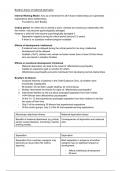
Bowlby’s theory of maternal deprivation
Internal Working Model: Acts as a framework for all th future relationships as it generates
expectations about relationships
- Founded by John Bowlby
Critical period- An infant who is denied a warm, intimate and continuous relationship with
the mother, may become psychologically damaged.
However a child will only become psychologically damaged if:
- Separation happens during the critical period (around 2.5 years)
- If there is no substitute mother/caregiver available
Effects of development: Intellectual
- If maternal care is delayed during the critical period for too long, intellectual
development will be delayed.
- Goldfarb (1947): children who remain as foster homes have a lower IQ than those
who are placed in adoption families.
Effects on emotional development: Emotional
- Maternal deprivation can lead to the onset of “affectionless psychopathy
- Inability to experience guilt or emotion for others
- Affectionless psychopathy prevents individuals from developing normal relationships.
Bowlby’s 44 thieves
- Analysed histories of patients in the Child Guidance Clinic, all children were
emotionally maladjusted.
- 88 studied: 44 had been caught stealing, 44 control group
1. Bowlby interviewed the thieves for signs of “affectionless psychopathy”.
2. Interviewed families to find out about prolonged separation from their mother.
- 14/44 thieves were affectionless psychopaths
- Of this 14, 12 had experienced prolonged separation from their mothers in the first
two years of their lives
- Only 5 of the remaining 30 thieves had experienced separations.
- Of the control groups, only 2 of the 44 had experienced long separations.
Monotropic attachment theory Maternal deprivation theory
Benefits of maternal attachment (e.g critical Consequences of deprivation and maternal
period, social releasers, monotropy, internal care.
working model).
Separation Deprivation
Separation from a primary caregiver only Brief separation in presence of another
becomes an issue when the child is caregiver has no significant impact on
deprived. development.
- Affects intellectual development
- IQ level
Internal Working Model: Acts as a framework for all th future relationships as it generates
expectations about relationships
- Founded by John Bowlby
Critical period- An infant who is denied a warm, intimate and continuous relationship with
the mother, may become psychologically damaged.
However a child will only become psychologically damaged if:
- Separation happens during the critical period (around 2.5 years)
- If there is no substitute mother/caregiver available
Effects of development: Intellectual
- If maternal care is delayed during the critical period for too long, intellectual
development will be delayed.
- Goldfarb (1947): children who remain as foster homes have a lower IQ than those
who are placed in adoption families.
Effects on emotional development: Emotional
- Maternal deprivation can lead to the onset of “affectionless psychopathy
- Inability to experience guilt or emotion for others
- Affectionless psychopathy prevents individuals from developing normal relationships.
Bowlby’s 44 thieves
- Analysed histories of patients in the Child Guidance Clinic, all children were
emotionally maladjusted.
- 88 studied: 44 had been caught stealing, 44 control group
1. Bowlby interviewed the thieves for signs of “affectionless psychopathy”.
2. Interviewed families to find out about prolonged separation from their mother.
- 14/44 thieves were affectionless psychopaths
- Of this 14, 12 had experienced prolonged separation from their mothers in the first
two years of their lives
- Only 5 of the remaining 30 thieves had experienced separations.
- Of the control groups, only 2 of the 44 had experienced long separations.
Monotropic attachment theory Maternal deprivation theory
Benefits of maternal attachment (e.g critical Consequences of deprivation and maternal
period, social releasers, monotropy, internal care.
working model).
Separation Deprivation
Separation from a primary caregiver only Brief separation in presence of another
becomes an issue when the child is caregiver has no significant impact on
deprived. development.
- Affects intellectual development
- IQ level