Psychology- Cultural variations in attachment
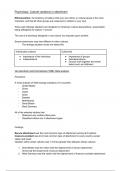
Ethnocentrism- the tendency to believe that your own ethnic or cultural group is the most
important, and that all other groups are measured in relation to your own.
Tools used (strange situation) are designed on American cultural assumptions. (assumption
being willingness to explore = secure).
The use of a technique designed in one culture, but imposed upon another.
Secure behaviours may look different in other cultures.
- The strange situation would not detect this
Individualist cultures Collectivist
● Importance of the individual ● Importance of groups
● Independence ● Interdependence
● Groups work together and share
tasks (such as childcare)
Van Ijzendoorn and Kroonerberg (1988)- Meta analysis
Procedure:
A meta analysis of 2000 strange situations in 8 countries:
- United States
- China
- Japan
- Israel
- Sweden
- Netherlands
- Great Britain
- West Germany
All of the selected studies had:
- Observed only mother-infant pairs
- Classified infants into 3 attachment types
Findings:
Secure attachment was the most common type of attachment across all 8 nations
Insecure-avoidant was 2nd most common type of attachment in every country except
Japan and Israel
Variation within (inter) cultures was 1.5 times greater than between (intra) cultures.
1. Great Britain was the nation with the highest level of secure attachment
China had the lowest level of secure attachment
2. West Germany was the nation had the highest level of Insecure avoidant attachment
Ethnocentrism- the tendency to believe that your own ethnic or cultural group is the most
important, and that all other groups are measured in relation to your own.
Tools used (strange situation) are designed on American cultural assumptions. (assumption
being willingness to explore = secure).
The use of a technique designed in one culture, but imposed upon another.
Secure behaviours may look different in other cultures.
- The strange situation would not detect this
Individualist cultures Collectivist
● Importance of the individual ● Importance of groups
● Independence ● Interdependence
● Groups work together and share
tasks (such as childcare)
Van Ijzendoorn and Kroonerberg (1988)- Meta analysis
Procedure:
A meta analysis of 2000 strange situations in 8 countries:
- United States
- China
- Japan
- Israel
- Sweden
- Netherlands
- Great Britain
- West Germany
All of the selected studies had:
- Observed only mother-infant pairs
- Classified infants into 3 attachment types
Findings:
Secure attachment was the most common type of attachment across all 8 nations
Insecure-avoidant was 2nd most common type of attachment in every country except
Japan and Israel
Variation within (inter) cultures was 1.5 times greater than between (intra) cultures.
1. Great Britain was the nation with the highest level of secure attachment
China had the lowest level of secure attachment
2. West Germany was the nation had the highest level of Insecure avoidant attachment