Topic: Psychology- Self Report Techniques
Key points/ Notes/Diagrams:
Main Ideas/
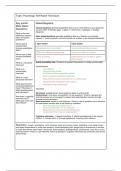
Closed questions generate quantitative data (e.g “to what extent do you agree that
Questions: you are tired?” 5 strongly agree, 4 agree, 3 i don't know, 2 disagree, 1 strongly
disagree)
What is the main
difference between Open ended questions generate qualitative data (e.g “describe your earliest
open and closed memory”). These questions cannot be sorted into a graph or be analysed statistically.
questions?
Which type of Open ended Close ended
questionnaire
involves quantitative Responses are in more detail Involves ticking/circling answers
data?
Difficult to collate/summarise data Results are easier to compare
Which type of data
involves qualitative Time consuming Respondents can’t be able to explain
data? their answers.
What is a structured Social desirability bias- People lie to present themselves in a better, positive light.
interview?
Questionnaires
What is an - Cost effective
unstructured - Large amounts of data
interview? - Completion without researcher present
- Easy to analyse quantitative responses
What is a semi-
structured interview? - Respondents may lie to themselves in a positive light
- Response bias (clicking the same option)
What does the term - Participants may rush through
social desirability bias
mean? How does it Interviews
affect questionnaires
and interviews? Structured- predetermined, fixed questions asked in a fixed order.
Unstructured- more like a conversation, no set questions. There is a general aim
How does a cognitive and interviewees are encouraged to expand and elaborate their answers through
interview occur? prompts by the interviewer.
What type of job uses Semi-structured- similar to a job interview. There is a list of questions set in advance
this method? but interviewers are also free to ask follow up questions.
- More thorough than questionnaires
- Structured interviews can be replicated
- Respondents may lie (social desirability bias)
- Unstructured interviews are incomparable
Cognitive interviews- 1. Report everything, 2. Mental reinstatement of the original
context, 3. Change order, 4. Change perspective. (used by police officers)
Summary: closed- quantitative, more numerica, short and concise. Open- qualitative, more detail, longer
and allows respondents to justify their answers. Social desirability bias- people lying to themselves in surveys
to make themselves seem better. Structured- fixed questions, predetermined, unstructured- more like a convo,
semi-structured- similar to a job interview, follow up questions. Cognitive interviews are commonly used by the
police forces.
Key points/ Notes/Diagrams:
Main Ideas/
Closed questions generate quantitative data (e.g “to what extent do you agree that
Questions: you are tired?” 5 strongly agree, 4 agree, 3 i don't know, 2 disagree, 1 strongly
disagree)
What is the main
difference between Open ended questions generate qualitative data (e.g “describe your earliest
open and closed memory”). These questions cannot be sorted into a graph or be analysed statistically.
questions?
Which type of Open ended Close ended
questionnaire
involves quantitative Responses are in more detail Involves ticking/circling answers
data?
Difficult to collate/summarise data Results are easier to compare
Which type of data
involves qualitative Time consuming Respondents can’t be able to explain
data? their answers.
What is a structured Social desirability bias- People lie to present themselves in a better, positive light.
interview?
Questionnaires
What is an - Cost effective
unstructured - Large amounts of data
interview? - Completion without researcher present
- Easy to analyse quantitative responses
What is a semi-
structured interview? - Respondents may lie to themselves in a positive light
- Response bias (clicking the same option)
What does the term - Participants may rush through
social desirability bias
mean? How does it Interviews
affect questionnaires
and interviews? Structured- predetermined, fixed questions asked in a fixed order.
Unstructured- more like a conversation, no set questions. There is a general aim
How does a cognitive and interviewees are encouraged to expand and elaborate their answers through
interview occur? prompts by the interviewer.
What type of job uses Semi-structured- similar to a job interview. There is a list of questions set in advance
this method? but interviewers are also free to ask follow up questions.
- More thorough than questionnaires
- Structured interviews can be replicated
- Respondents may lie (social desirability bias)
- Unstructured interviews are incomparable
Cognitive interviews- 1. Report everything, 2. Mental reinstatement of the original
context, 3. Change order, 4. Change perspective. (used by police officers)
Summary: closed- quantitative, more numerica, short and concise. Open- qualitative, more detail, longer
and allows respondents to justify their answers. Social desirability bias- people lying to themselves in surveys
to make themselves seem better. Structured- fixed questions, predetermined, unstructured- more like a convo,
semi-structured- similar to a job interview, follow up questions. Cognitive interviews are commonly used by the
police forces.