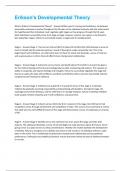
Erikson's Developmental Theory Questions With Correct Answers.
What is Erikson's Developmental Theory? - Answer-Widely used in nursing and healthcare. He believed personality continues to evolve throughout the life span as the individual interacts with the social world. He hypothesized that individuals must negotiate eight stages as they progress through the life span. Most individuals successfully move from stage to stage; however a person can regress or be forced to face tasks/later stages. Failure to successfully master a stage leads to maladjustment. Stage 1 - Answer-Stage 1: Trust versus mistrust (birth to about 18 months) the child develops a sense of trust in himself and the external world as a result of having his needs consistently met. This is the beginning of self-confidence. An infant who does not have his needs met develops a sense of mistrust and suspiciousness in others that will affect future interpersonal relationships Stage 2 - Answer-Stage 2: Autonomy versus shame and doubt (about 18 months to 3 years) the goal is for the child to develop self-control and independence while maintaining self-esteem. This requires an ability to cooperate and express feelings and thoughts. Failure to successfully negotiate this stage will lead to an adult who lacks self-confidence and feels controlled by others and who may exhibit extreme compliance (self-restraint) or defiance. Stage 3 - Answer-Stage 3: Initiative versus guilt (3 to 5 years) the focus of this stage is to develop initiative by gradually assuming responsibility and developing self-discipline. During this stage, the superego (conscience) develops, and the child learns to manage impulses. Failure to develop initiative leads to guilt, limited creativity, lack of self-confidence, and pessimism. Stage 4 - Answer-Stage 4: Industry versus inferiority (6 to 11 years) in this stage, the child learns that recognition comes through achievement and completion of tasks. This success occurs primarily in school. The adult who has not fulfilled the tasks of this stage will demonstrate a sense of inadequacy in all areas of life. Stage 5 - Answer-Stage 5: Identity versus role confusion (11 to 21 years) this stage coincides with puberty. The adolescent develops a sense of self and begins to make decisions about the future. Social groups serve as a place to test out ideas and behaviors. Healthy role models facilitate the development of identity. Failure to recognize one's abilities and sense of self, results in an individual without a solid place in the world. This is manifested by dysfunction interpersonal relationships and occupational performance. Delinquent and rebellious behavior may be prominent when the task of identity formation is not met.Stage 6 - Answer-Stage 6: Intimacy versus isolation (21 to 40 years) Erikson defined intimacy as "the capacity to commit himself to concrete affiliations and partnerships and to develop the ethical strength to abide by such commitments". Isolation is the avoidance of intimacy. The task at this stage is to develop a commitment to work and relationships. Failure to do so will result in impersonal relationships and difficulty with maintaining a job. Stage 7 - Answer-Stage 7: Generativity versus stagnation (40 to 65 years) the goal of this stage is to be creative and productive. Often this is accomplished through work or relationships, such as raising healthy, functional children or contributing to society by developing a distinguished career, for example in nursing. The person who fails to achieve Generativity may manifest stagnation in the form of superficial relationships and self-absorption. Simply having children does not guarantee Generativity. Stage 8 - Answer-Stage 8: Ego integrity versus despair (over 65 years) the task of this stage is the acceptance of one's life, worth and eventual death. Ego integrity reflects a satisfaction with life and an understanding of one's place in the life cycle. A sense of loss, discomfort with life and aging, and a fear of death are seen in despair
Written for
- Institution
- Erikson\'s Developmental Theory
- Course
- Erikson\'s Developmental Theory
Document information
- Uploaded on
- May 29, 2024
- Number of pages
- 2
- Written in
- 2023/2024
- Type
- Exam (elaborations)
- Contains
- Questions & answers
Subjects
-
eriksons developmental theory

Also available in package deal