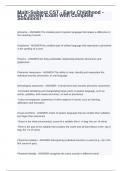
Multi-Subject CST - Early Childhood - ELA review Exam With Complete Solutions!
phoneme - ANSWER-The smallest part of spoken language that makes a difference in the meaning of words.
Grapheme - ANSWER-the smallest part of written language that represents a phoneme in the spelling of a word
Phonics - ANSWER-the fairly predictable relationship between phonemes and graphemes
Phonemic Awareness - ANSWER-The ability to hear, identify,and manipulate the individual sounds, phonemes, in oral language.
phonological awareness - ANSWER--A broad term that includes phonemic awareness
-It includes identifying and manipulating larger parts of spoken language, such as words, syllables, and onsets and rimes, as well as phonemes
-It also encompasses awareness of other aspects of sound, such as rhyming, alliteration and intonation
Onset and Rime - ANSWER--Parts of spoken language that are smaller than syllables but larger than phonemes
-Onset is the initial consonant(s) sound of a syllable (the b- of bag; the sw- of swim)
-Rime is the part of the syllable that contains the vowel and all that follows it (the -ag of bag; the -im of swim)
Phoneme Isolation - ANSWER-Recognizing individual sounds in a word (e.g., /p/ is the first sound in pan).
Phoneme Identity - ANSWER-recognize the same sounds in different words phoneme categorization - ANSWER-recognize a word with a sound that does not match
the sounds in other words
phoneme blending - ANSWER-combining phonemes to make a word
phoneme segmentation - ANSWER-break a word into its separate sounds, saying each sound
phoneme deletion - ANSWER-recognize the word that remains when a phoneme is removed from another word
phoneme addition - ANSWER-make a new word by adding a phoneme to an existing word
phoneme substitution - ANSWER-substitute one phoneme for another to make a new word
Phonemic Awareness Instruction is most effective when... - ANSWER-Children are taught to manipulate phonemes by using the letters of the alphabet. AND
When it focuses on only one or two types of phoneme manipulation
Systematic Phonics Instruction is more effective than - ANSWER-Non-Systematic or No
phonic instruction including: Literature based programs, basal reading programs and sight word programs
2 Best ways of improving fluency are - ANSWER-Repeated and Monitored Oral Reading
AND
Students hearing models of fluent reading
phoneme - ANSWER-The smallest part of spoken language that makes a difference in the meaning of words.
Grapheme - ANSWER-the smallest part of written language that represents a phoneme in the spelling of a word
Phonics - ANSWER-the fairly predictable relationship between phonemes and graphemes
Phonemic Awareness - ANSWER-The ability to hear, identify,and manipulate the individual sounds, phonemes, in oral language.
phonological awareness - ANSWER--A broad term that includes phonemic awareness
-It includes identifying and manipulating larger parts of spoken language, such as words, syllables, and onsets and rimes, as well as phonemes
-It also encompasses awareness of other aspects of sound, such as rhyming, alliteration and intonation
Onset and Rime - ANSWER--Parts of spoken language that are smaller than syllables but larger than phonemes
-Onset is the initial consonant(s) sound of a syllable (the b- of bag; the sw- of swim)
-Rime is the part of the syllable that contains the vowel and all that follows it (the -ag of bag; the -im of swim)
Phoneme Isolation - ANSWER-Recognizing individual sounds in a word (e.g., /p/ is the first sound in pan).
Phoneme Identity - ANSWER-recognize the same sounds in different words phoneme categorization - ANSWER-recognize a word with a sound that does not match
the sounds in other words
phoneme blending - ANSWER-combining phonemes to make a word
phoneme segmentation - ANSWER-break a word into its separate sounds, saying each sound
phoneme deletion - ANSWER-recognize the word that remains when a phoneme is removed from another word
phoneme addition - ANSWER-make a new word by adding a phoneme to an existing word
phoneme substitution - ANSWER-substitute one phoneme for another to make a new word
Phonemic Awareness Instruction is most effective when... - ANSWER-Children are taught to manipulate phonemes by using the letters of the alphabet. AND
When it focuses on only one or two types of phoneme manipulation
Systematic Phonics Instruction is more effective than - ANSWER-Non-Systematic or No
phonic instruction including: Literature based programs, basal reading programs and sight word programs
2 Best ways of improving fluency are - ANSWER-Repeated and Monitored Oral Reading
AND
Students hearing models of fluent reading