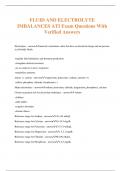
FLUID AND ELECTROLYTE IMBALANCES ATI Exam Questions With Verified Answers
FLUID AND ELECTROLYTE IMBALANCES ATI Exam Questions With Verified Answers Electrolytes - answerminerals (sometimes salts) that have an electrical charge and are present in all bodily fluids. -regulate fluid imbalance and hormone production -strengthen skeletal structures -act as catalysts in nerve responses -metabolize nutrients anions vs. cations - answer-magnesium, potassium, sodium, calcium (+) -sulfate, phosphate, chloride, bicarbonate (-) Major electrolytes - answersodium, potassium, chloride, magnesium, phosphorus, calcium Clients at greatest risk for electrolyte imbalance - answer-infants -children -older adults -cognitive disorders -chronic illness Reference range for Sodium - answer136-145 mEq/L Reference range for Calcium - answer9.0-10.5 mg/dL Reference range for Potassium - answer3.5-5.0 mEq/L Reference range for Magnesium - answer1.3-2.1 mg/dL Reference range for Chloride - answer98-106 mEq/L Reference range for Phosphorus - answer3-4.5 mg/dL Sodium (Na+) - answermajor electrolyte found in ECF and is present in most bodily fluids/secretions. -essential for acid/base fluid balance -active/passive transport -irritability and conduction of nerve/muscle tissue Hyponatremia - answerBlood sodium level less than 136 mEq/L -results from excess water in plasma or loss of sodium rich fluids. -delays and slows depolarization of membranes -water moves from ECF to ICF which causes cells in the body to swell Risk factors of hyponatremia - answer-deficit ECF volume -excessive GI losses: vomiting, NG suctioning, diarrhea, enemas -renal losses: diuretics, kidney disease, adrenal insufficiency, excessive sweating -skin losses: burns, wound drainage, peripheral edema, ascites -excessive water intake, SIADH -heart failure/cirrhosis/nephrotic syndrome -excessive administration of dextrose -inadequate sodium intake (NPO status) -use of hypotonic irrigating solutions -hyperglycemia -greater risk for older adults due to increased chronic illnesses (diuretics, insufficient intake) Expected findings in hyponatremia - answerphysical: vary with a normal/decreased ECF volume VS: hypothermia, tachycardia, rapid thready pulse, hypotension, orthostatic hypotension musculoskeletal: headache, confusion, lethargy, muscle weakness/respiratory compromise, fatigue, decreased deep tendon reflexes
Written for
- Institution
- Fluid and Electrolytes
- Course
- Fluid and Electrolytes
Document information
- Uploaded on
- May 28, 2024
- Number of pages
- 14
- Written in
- 2023/2024
- Type
- Exam (elaborations)
- Contains
- Questions & answers
Subjects
-
fluid and electrolyte imbalances ati exam question

Also available in package deal