EXSS 181 Exam 2 Questions With 100% Correct Answers
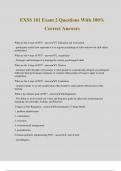
EXSS 181 Exam 2 Questions With 100% Correct Answers What are the 4 steps of PST? - answer1. Education and Assessment - participants realize how important it is to acquire psychological skills and how the skill affects performance What are the 4 steps of PST? - answer2. Acquisition - Strategies and techniques for learning the various psychological skills What are the 4 steps of PST? - answer3. Practice - automate skills through over learning; to teach people to systematically integrate psychological skills into their performance situations; to simulate skills people will want to apply in actual competition What are the 4 steps of PST? - answer4. Evaluation - should evaluate to see any modifications that should be made and the effectiveness of the training What is the ultimate goal of PST? - answerSelf-Regulation - The ability to work toward one's short and long term goals by effectively monitoring and managing one's thoughts, feelings, and behaviors 5 Stages of Self-Regulation - answerKirschenbaum's 5-Stage Model: 1. problem identification 2. commitment 3. execution 4. environmental management 5. generalization Common problems implementing PST? - answer- lack of time - unwillingness Deep Breathing - answer- method of arousal/anxiety control - easy, effective - decreases muscle tension - best use in competition: break in action PMR (Progressive Muscle Relaxation) - answer- method of arousal/anxiety control - objective is to teach/train contrast between tension and relaxation - full program is 30 min but can do abbreviated program - helps relax on-site in competition - Major Premises: 1. tension and relaxation can't occur at the same time 2. relaxation of body contributes to relaxation of mind Autogenic Training - answer- method of arousal/anxiety control - longer time to learn, extensive practice - focuses on warmth and heaviness rather than tension and relaxation - aims to produce 6 sensations: - heaviness in extremities - warmth in extremities - regulation of heart rate - regulation of breathing - abdominal warmth - cool forehead Biofeedback - answer- visual and/or auditory feedback of muscle activity, skin temperature, brain wave, heart rate Common coping strategies of elite athletes? - answer- thought stopping - narrowing focus - rational thinking and self-talk - positive focus - social support - PST - time management On-site coping/relaxation techniques? - answer- smile in response to tension - enjoy the situation - slow down - stay focused in the present - be prepared Techniques that can increase athlete arousal? - answer- increase breathing rate - act energized - self-talk - energizing music - energizing imagery - pre competitive workout Imagery - answer- creating or recreating an experience on the mind - recall from memory pieces stored and shape them into useful information - imagery = recall + construction - visual - auditory - tactile - olfactory 2 characteristics of skilled/effective imagery? - answer- vividness - controllability Internal vs. External Imagery - answer- Internal: seeing things in a 1st person view - External: seeing things from a 3rd person view Common Uses of Imagery - answer- improve concentration - enhance motivation - build confidence - control emotional response
Written for
- Institution
- EXSS 181
- Course
- EXSS 181
Document information
- Uploaded on
- May 28, 2024
- Number of pages
- 11
- Written in
- 2023/2024
- Type
- Exam (elaborations)
- Contains
- Questions & answers
Subjects
-
exss 181 exam 2 questions with 100 correct answer

Also available in package deal