

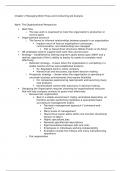
Managing Work Flows and Conducting Job Analysis
Chapter 2 on Managing Work Flows and Conducting Job Analysis explores essential aspects of organizational design and job management crucial for optimizing productivity and employee satisfaction. Work Flow and Organizational Structure: Work flow refers to how tasks are organized to achieve organizational goals. Organizational structures like flat, hierarchical, and boundaryless impact communication, decision-making, and flexibility within companies. Each structure suits different business environments: hierarchical for stability, flat for agility, and boundaryless for external collaborations. Business Process Reengineering (BPR): BPR involves radical redesigning of processes to enhance efficiency and effectiveness. It focuses on eliminating unnecessary steps and roles to streamline operations and respond faster to market demands. Teams in Organizations: Teams play a pivotal role, especially in flat and boundaryless organizations. Types include self-managed teams, problem-solving teams, special-purpose teams, and virtual teams. Each type enhances collaboration and innovation across functional boundaries. Motivation Theories in Job Design: Various theories like Herzberg's Two-Factor Theory, Work Adjustment Theory, Goal-Setting Theory, and Job Characteristics Theory explain how job design influences motivation, satisfaction, and performance. They emphasize factors such as autonomy, feedback, and meaningfulness of tasks. Job Design Approaches: Job design methods include work simplification, job enlargement, job rotation, job enrichment, and team-based design. Each method aims to enhance job satisfaction, productivity, and flexibility by adjusting task complexity and autonomy. Job Analysis and Description: Job analysis involves systematically gathering information about job roles and responsibilities. It informs recruitment, training, performance appraisal, and compensation decisions. Job descriptions summarize these findings, outlining duties, responsibilities, and required skills (KSAs). Emerging Trends: Flexible Work Arrangements: Flexible schedules, including contingent workers (temporary, part-time, contract, and outsourcing roles), are increasingly prevalent. They cater to organizational needs for agility and cost-effectiveness while accommodating diverse employee preferences. HRIS Application: Human Resource Information Systems (HRIS) facilitate data collection, storage, and analysis for HR decision-making. These systems integrate hardware and software to streamline HR processes and support strategic organizational goals.
Document information
- Uploaded on
- May 27, 2024
- Number of pages
- 9
- Written in
- 2023/2024
- Type
- Class notes
- Professor(s)
- Professor hurt
- Contains
- Week 2


