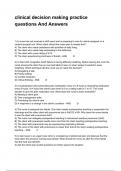
clinical decision making practice questions And Answers
1) A nurse has just received a shift report and is preparing to care for clients assigned on a medical-surgical unit. Which client should the nurse plan to assess first? A) The client who needs assistance with activities of daily living B) The client who needs help ambulating to the bathroom C) The client with a pain rating of 3/10 D) The client experiencing shortness of breath - ANS D 2) A client with congestive heart failure is having difficulty breathing. Before leaving the room the nurse ensures the client has an over-bed table to lean on when awake if needed to ease breathing. Which technique did the nurse use to make this decision? A) Delegating a task B) Priority-setting C) Conflict resolution D) Critical thinking - ANS D 3) A postoperative client prescribed pain medication every 4 to 6 hours is requesting medication every 6 hours. At 4 hours the client's pain level is 8 on a rating scale of 1 to 10. The nurse decides to give the pain medication now. What does this nurse's action exemplify? A) Meeting a client goal B) Time management skills C) Prioritizing the client's care D) A response to a change in the client's condition - ANS D 4) The nurse is assigned two clients. One client needs postoperative teaching in preparation for discharge and the other client with pneumonia has a PaCO2 of 85. Why does the nurse decide to see the client with pneumonia first? A) The nurse can delegate postoperative teaching to unlicensed assistive personnel (UAP). B) The client with pneumonia needs more care than the client needing postoperative teaching. C) The client with pneumonia may be experiencing respiratory distress. D) The room of the client with pneumonia is closer than that of the client needing postoperative teaching. - ANS C 5) A client seen in an urgent care clinic is complaining of abdominal pain and believes that the food eaten the previous evening was tainted. What should the nurse do after the client states that the food was tainted? A) Ask the client open-ended questions to further assess the situation. B) Tell the client the physician does not need to assess the client. C) Call an ambulance before assessing the client any further. D) Advise the client to take an antacid. - ANS A 6) A client with aspiration pneumonia is diaphoretic, pale, and taking gasping breaths. What should the nurse do first? A) Notify the physician. B) Complete a thorough cardiopulmonary assessment. C) Administer 10 L of oxygen per face mask. D) Reposition the client to help with breathing. - ANS B 7) The home health nurse is visiting a client who is 2 weeks postoperative from a coronary artery bypass surgery. The client has lost 10 pounds, is continuing to experience pain, and is not eating. What should be the nurse's next action? A) Examine the current interventions for pain relief. B) Refer the client to social services. C) Contact Meals on Wheels so that the client will eat. D) Revise the goals in the current plan of care. - ANS A 8) The nurse is caring for a female client with decreased energy who needs to get up to prevent the development of pressure ulcers. The client is unable to ambulate and wants to be alone. What should the nurse do? A) Notify the physician of the client's noncompliance. B) Leave the client alone until ready to get out of bed. C) Gain knowledge about the client from family to gain compliance. D) Proceed to get help to get the client out of bed. - ANS C
Written for
- Institution
- NURS 2106
- Course
- NURS 2106
Document information
- Uploaded on
- May 25, 2024
- Number of pages
- 8
- Written in
- 2023/2024
- Type
- Exam (elaborations)
- Contains
- Questions & answers
Subjects
-
clinical decision making practice questions and an

Also available in package deal