Mahnoor Tariq Charter of Fundamental Rights
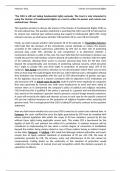
‘The CJEU is still not taking fundamental rights seriously. The Court is only interested in
using the Charter of Fundamental Rights as a tool to widen its powers and control over
national laws.’ Discuss.
This question pertains to discuss the impact of the Charter of Fundamental Rights (CFR) on
EU and national law. The question statement is asserting that CJEU uses CFR to fully exercise
its control over national laws without paying due regard to fundamental rights (FR). Using
relevant case law, we shall assess whether CJEU protects FR or uses CFR to its benefit.
Firstly, we shall evaluate whether CJEU protects FR of EU nationals. In Maximillan Schrems,
CJEU held that the decision of the Commission cannot eliminate or reduce the powers
accorded to the national supervisory authorities by CFR due to their role of protecting
personal data under CFR, whereby its sole competence is to determine whether a
Commission decision is valid. In this case, the court held that the Commission’s decision was
invalid because the Safe Harbour scheme allowed US authorities to interfere with the rights
of EU nationals, allowing them access to process personal data from EU MS that went
beyond the proportionality and necessity of protecting national security, which breaches
Art.7 (right to private life) and Art.8 (right to protection of personal data) CFR of EU
nationals. Test Aschat concerned a directive on sex discrimination where there was no time
limit on how long MS could derogate from EU law. CJEU held that such a derogation without
time limitation was incompatible with A21 and 23 CFR (discrimination of gender and age).
An EU legislator must act in a manner consistent with its objectives as EU institutions are
also bound by CFR. In joined cases IX and MJ, both IX and MJ were employed at companies
that were governed by German law; both wore headscarves to work and were asked to
remove them as it contravened the company’s policy of political and religious neutrality.
CJEU held that this is justified if the policy is pursued in a general and non-discriminatory
way, based on the employer’s genuine need to present a neutral image towards customers.
A court will reconcile the rights and interests at issue in each case for the specific context of
MS and any national measures on the protection of religious freedom when assessing this
genuine need. This is enough proof that CJEU is taking FR seriously, contrary to the question
statement.
Now we shall review whether the court uses CFR to exercise its control over national laws. In
Fransson, the court clarified that since the rights guaranteed by CFR must be complied with
where national legislation falls within the scope of EU law, situations covered by EU law
without those rights being applicable cannot exist. This makes CFR a benchmark for the
legality of both EU and national law within EU’s jurisdiction. A national measure will be
considered as implementing EU law when a certain degree of connection is established
beyond the matters being closely related or one of those matters having an indirect impact
on the other (Siragusa). In Melloni, CJEU ruled that although national authorities and courts
remain free to apply national standards of protection of FR per A53 CFR, the level of
protection provided by CFR, the primacy, unity, and effectiveness of EU law cannot be
compromised. Casting doubt on the uniformity of this standard of protection would
undermine the principles of mutual trust and recognition which this decision purports to
uphold for its efficacy.
‘The CJEU is still not taking fundamental rights seriously. The Court is only interested in
using the Charter of Fundamental Rights as a tool to widen its powers and control over
national laws.’ Discuss.
This question pertains to discuss the impact of the Charter of Fundamental Rights (CFR) on
EU and national law. The question statement is asserting that CJEU uses CFR to fully exercise
its control over national laws without paying due regard to fundamental rights (FR). Using
relevant case law, we shall assess whether CJEU protects FR or uses CFR to its benefit.
Firstly, we shall evaluate whether CJEU protects FR of EU nationals. In Maximillan Schrems,
CJEU held that the decision of the Commission cannot eliminate or reduce the powers
accorded to the national supervisory authorities by CFR due to their role of protecting
personal data under CFR, whereby its sole competence is to determine whether a
Commission decision is valid. In this case, the court held that the Commission’s decision was
invalid because the Safe Harbour scheme allowed US authorities to interfere with the rights
of EU nationals, allowing them access to process personal data from EU MS that went
beyond the proportionality and necessity of protecting national security, which breaches
Art.7 (right to private life) and Art.8 (right to protection of personal data) CFR of EU
nationals. Test Aschat concerned a directive on sex discrimination where there was no time
limit on how long MS could derogate from EU law. CJEU held that such a derogation without
time limitation was incompatible with A21 and 23 CFR (discrimination of gender and age).
An EU legislator must act in a manner consistent with its objectives as EU institutions are
also bound by CFR. In joined cases IX and MJ, both IX and MJ were employed at companies
that were governed by German law; both wore headscarves to work and were asked to
remove them as it contravened the company’s policy of political and religious neutrality.
CJEU held that this is justified if the policy is pursued in a general and non-discriminatory
way, based on the employer’s genuine need to present a neutral image towards customers.
A court will reconcile the rights and interests at issue in each case for the specific context of
MS and any national measures on the protection of religious freedom when assessing this
genuine need. This is enough proof that CJEU is taking FR seriously, contrary to the question
statement.
Now we shall review whether the court uses CFR to exercise its control over national laws. In
Fransson, the court clarified that since the rights guaranteed by CFR must be complied with
where national legislation falls within the scope of EU law, situations covered by EU law
without those rights being applicable cannot exist. This makes CFR a benchmark for the
legality of both EU and national law within EU’s jurisdiction. A national measure will be
considered as implementing EU law when a certain degree of connection is established
beyond the matters being closely related or one of those matters having an indirect impact
on the other (Siragusa). In Melloni, CJEU ruled that although national authorities and courts
remain free to apply national standards of protection of FR per A53 CFR, the level of
protection provided by CFR, the primacy, unity, and effectiveness of EU law cannot be
compromised. Casting doubt on the uniformity of this standard of protection would
undermine the principles of mutual trust and recognition which this decision purports to
uphold for its efficacy.