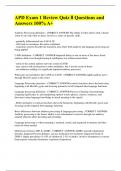
APD Exam 1 Review Quiz II Questions and Answers 100% A+
APD Exam 1 Review Quiz II Questions and Answers 100% A+ Auditory Processing definition - CORRECT ANSWER-The ability to fully utilize what is heard (what we do with what we hear). Involves a series of specific skills. - gradually differentiated into CAP & LP - still tends to encompass the entire continuum - sometimes used to describe the transition area where both auditory and language processing are being applied CAPD definition - CORRECT ANSWER-Impaired ability in one or more of the above listed auditory skills even though hearing & intelligence are within normal limits - refers to the central auditory nervous system (CANS) - may coexist with dysfunction in other modalities, but is not the result of them! - can influence reading (via significant impaired auditory processes) What parts are included in the CANS for CAPD - CORRECT ANSWER-eighth auditory nerve through Heschl's gyrus in the cortex Language Processing structures - CORRECT ANSWER-cortical structures above the brain stem, beginning with Heschl's gyrus and focusing primarily on left temporal lobe language functions Language processing definition - CORRECT ANSWER-Process of hearing, discriminating, assigning significance to, and interpreting spoken words, phrases, clauses, sentences, and discourse (using language knowledge to attach meaning to the signal) - Refers primarily to cortical structures above the brainstem, beginning with Heschl's gyrus and focusing on left temporal lobe language functions Basic differences between auditory processing & language processing - CORRECT ANSWER-Auditory processing is the brain's ability to use information it receives through ear-auditory channel (directly affect decoding and encoding) Language processing is where meaning is attached, stored, and organized in memory and then retrieved when needed Differences between APD & ADHD - CORRECT ANSWER-ADHD: neurodevelopmental disorder, diagnosed by psychologist, can use medication for treatment, diagnosed based on DSM-5, higher prevalence (5-10% of children & 2-5% of adults), involves disruptions in various brain regions (reticular formation), experience hyperfocus APD: sensory processing disorder, diagnosed by AuD, can not be medicated, diagnosed through a battery of specific AP tests, lower prevalence (2-7% of school aged children), associated with atypical processing of auditory information in the CANS, do not experience hyperfocus Similarities between APD & ADHD - CORRECT ANSWER-- Can coexist with other conditions (such as learning disorders) - Primary symptoms: inattention, hyperactivity, impulsivity (both have distractibility) - Difficulty in noisy environments - Impaired listening comprehension (impacting their ability to follow instructions or conversations accurately) - Impaired working memory is a common feature for both conditions - Executive functions (planning, organizing, time management) can be impaired in both - Social interactions can both be impacted (following conversations, interpreting social cues, paying attention during group discussions) - Emotional and psychological distress due to coping with the challenges of the condition (mentally exhausting and frustrating) - Can both qualify a child for an IEP or a 504 plan Behavioral characteristics of children with APD ("At risk" behaviors)
Written for
- Institution
- APD
- Course
- APD
Document information
- Uploaded on
- May 22, 2024
- Number of pages
- 8
- Written in
- 2023/2024
- Type
- Exam (elaborations)
- Contains
- Questions & answers
Subjects
-
apd exam 1 review quiz ii questions and answers 10

Also available in package deal