THEA 1440 Exam 1 Questions and Answers
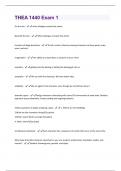
On the line - when dialogue reveals the action Beneath the line - When dialogue conceals the action Function of Stage directions - To tell us who's there by naming characters as they speak, enter, react, and exit. imagination - the ability to create ideas or pictures in your mind empathy - getting into the feeling or letting the feeling get into us sympathy - We are with the character. We have taken sides. antipathy - We are against the character, even though we sometimes deny it. dramatic space - Brings characters interacting with same 3D environment at same time. Readers approach space attentively. Creates setting and ongoing behavior. 4 Basic questions to begin analyzing a play - 1. Where are we? (Setting) 2.What are the characters doing?(Occasion) 3.What's new? What's wrong? (Situation) 4. Who's there?(Character) simultaneous behavior - Each character has a sequence of events that occur at the same time. Why study Dramatic Literature important to you as a student, professional, storyteller, reader, and human? - Student: Knowing eras, periods, and stylesProfessional: Bases for artistic choices Storyteller: To hone skills of dramatic empathy Reader: Offers us many version of what it feels like to be human. Linear play structure - Story arranged chronologically. Aristotle's Unity of Action: Action - Is an individual loop Aristotle's Unity of Action: Event - A series of actions linked to one another Plot - Basic order of events as the author arranges them. Protagonist - Carrier of action Antagonist - Opposer of action Balance - A play is in a stasis until one action triggers a chain of events. Exposition - Tells characters background and past events. What audience MUST know. complication - Outside forces or new twists introduced at opportune moment. central conflict - the main problem in the story Rising action - a series of relevant incidents that create suspense, interest and tension in a story. Reversal - Point where the protagonist fortune changes 180.Climax - Highest point of tension Denouement - Final scenes devoted to tying up loose ends.
Written for
- Institution
- THEA 1440
- Course
- THEA 1440
Document information
- Uploaded on
- May 22, 2024
- Number of pages
- 6
- Written in
- 2023/2024
- Type
- Exam (elaborations)
- Contains
- Questions & answers
Subjects

Also available in package deal