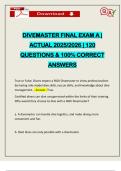
Divemaster Final Exam A 120 Questions 2024 | 2025
Updated
True or False. Divers expect a PADI Divemaster to show professionalism by having role-model dive skills,
rescue skills, and knowledge about dive management. - Answer -True.
Certified divers can dive unsupervised within the limits of their training. Why would they choose to dive
with a PADI Divemaster?
a. A divemaster can handle dive logistics, and make diving more convenient and fun.
b. Boat dives are only possible with a divemaster.
c. Divemaster take care of every detail of individual divers' plans.
d. All of the above. - Answer -a. A divemaster can handle dive logistics, and make diving more convenient
and fun.
Acting as a good role model:
a. Provides divers with a behavior pattern of responsible dive practices and habits of follow.
b. Helps students by watching.
c. Gives you credibility and encourages divers to consider your suggestions.
d. All of the above. - Answer -d. All of the above.
The PADI Membership Commitment __________________, found in your PADI Instructor Manual,
explains the professional and ethical behavior expected of you as a PADI Member.
,a. License Agreement
b. Liability Release
c. Code of Practice
d. Active Status - Answer -c. Code of Practice
True or False. As a PADI Divemaster, you earn a credential that allows you to potentially work as a dive
professional by assisting with PADI diver courses or conducting some PADI programs independently. -
Answer -True
True or False. Experts easily solve problems that non experts because they have a large knowledge and
experience base to draw on. - Answer -True.
Your role in dive planning for a group of certified divers is to:
a. relieve everyone in the group of all responsibility for dive planning.
b. assess the equipment needs for each individual in the group.
c. provide broad planning information that divers use to plan their individual dives.
d. All of the above. - Answer -c. provide broad planning information that divers use to plan their
individual dives.
General factors to consider when evaluating dive conditions include:
a. weather - wind, rain and temperature.
b. tides and currents
c. visibility
,d. All of the above. - Answer -d. All of the above.
One effective way to plan a dive is to:
a. Ask an instructor to provide dive details.
b. think through the dive from start to finish.
c. always follow the same dive plan for every dive.
d. None of the above. - Answer -b. think through the dive from start to finish.
A diver who takes a really long time to prepare personal equipment for a dive might be:
a. exited about the dive.
b. busy taking care of equipment for a buddy or other divers.
c. stressed or have concerns about the dive.
d. tired or too hot. - Answer -c. stressed or have concerns about the dive.
True or False. If a diver has concerns about a dive, make it clear that if the diver doesn't feel up to the
dive for any reason, it's okay not to dive. - Answer -True.
What is an advantage of inwater supervision?
a. You are closer to divers to respond to problems.
, b. It's an effective way to supervise multiple groups at once.
c. Buddy teams have more individual options in where they dive.
d. You are closer to emergency related equipment. - Answer -a. You are closer to divers to respond to
problems
What is a disadvantage of out of water supervision?
a. You can't remind divers to follow appropriate dive procedures.
b. You are closer to emergency-related equipment.
c. Buddy teams have fewer individual options.
d. You can only watch one group. - Answer -a. You can't remind divers to follow appropriate dive
procedures.
The primary purpose of diver accounting procedures is to:
a. obtain information needed to plan repetitive dives.
b. track divers in and out of the water - making sure all divers have returned after a dive.
c. make certain that all divers have a buddy.
d. check whether each diver has the proper equipment for a dive. - Answer -b. track divers in and out of
the water - making sure all divers have returned after a dive.
What individual differences in divers do you need to recognize and accommodate?
Updated
True or False. Divers expect a PADI Divemaster to show professionalism by having role-model dive skills,
rescue skills, and knowledge about dive management. - Answer -True.
Certified divers can dive unsupervised within the limits of their training. Why would they choose to dive
with a PADI Divemaster?
a. A divemaster can handle dive logistics, and make diving more convenient and fun.
b. Boat dives are only possible with a divemaster.
c. Divemaster take care of every detail of individual divers' plans.
d. All of the above. - Answer -a. A divemaster can handle dive logistics, and make diving more convenient
and fun.
Acting as a good role model:
a. Provides divers with a behavior pattern of responsible dive practices and habits of follow.
b. Helps students by watching.
c. Gives you credibility and encourages divers to consider your suggestions.
d. All of the above. - Answer -d. All of the above.
The PADI Membership Commitment __________________, found in your PADI Instructor Manual,
explains the professional and ethical behavior expected of you as a PADI Member.
,a. License Agreement
b. Liability Release
c. Code of Practice
d. Active Status - Answer -c. Code of Practice
True or False. As a PADI Divemaster, you earn a credential that allows you to potentially work as a dive
professional by assisting with PADI diver courses or conducting some PADI programs independently. -
Answer -True
True or False. Experts easily solve problems that non experts because they have a large knowledge and
experience base to draw on. - Answer -True.
Your role in dive planning for a group of certified divers is to:
a. relieve everyone in the group of all responsibility for dive planning.
b. assess the equipment needs for each individual in the group.
c. provide broad planning information that divers use to plan their individual dives.
d. All of the above. - Answer -c. provide broad planning information that divers use to plan their
individual dives.
General factors to consider when evaluating dive conditions include:
a. weather - wind, rain and temperature.
b. tides and currents
c. visibility
,d. All of the above. - Answer -d. All of the above.
One effective way to plan a dive is to:
a. Ask an instructor to provide dive details.
b. think through the dive from start to finish.
c. always follow the same dive plan for every dive.
d. None of the above. - Answer -b. think through the dive from start to finish.
A diver who takes a really long time to prepare personal equipment for a dive might be:
a. exited about the dive.
b. busy taking care of equipment for a buddy or other divers.
c. stressed or have concerns about the dive.
d. tired or too hot. - Answer -c. stressed or have concerns about the dive.
True or False. If a diver has concerns about a dive, make it clear that if the diver doesn't feel up to the
dive for any reason, it's okay not to dive. - Answer -True.
What is an advantage of inwater supervision?
a. You are closer to divers to respond to problems.
, b. It's an effective way to supervise multiple groups at once.
c. Buddy teams have more individual options in where they dive.
d. You are closer to emergency related equipment. - Answer -a. You are closer to divers to respond to
problems
What is a disadvantage of out of water supervision?
a. You can't remind divers to follow appropriate dive procedures.
b. You are closer to emergency-related equipment.
c. Buddy teams have fewer individual options.
d. You can only watch one group. - Answer -a. You can't remind divers to follow appropriate dive
procedures.
The primary purpose of diver accounting procedures is to:
a. obtain information needed to plan repetitive dives.
b. track divers in and out of the water - making sure all divers have returned after a dive.
c. make certain that all divers have a buddy.
d. check whether each diver has the proper equipment for a dive. - Answer -b. track divers in and out of
the water - making sure all divers have returned after a dive.
What individual differences in divers do you need to recognize and accommodate?