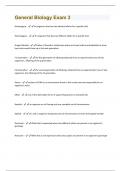
General Biology Exam 3 Homozygous - An organism that has two identical alleles for a specific trait Heterozygous - An organism that has two different alleles for a specific trait. Gregor Mendel - Father of Genetics, studied pea plants and used math and probability to show how traits would show up in the next generation F1 Generation - the first generation of offspring obtained from an experimental cross of two organisms., offspring of the p generation F2 Generation - the second generation of offspring, obtained from an experimental cross of two organisms; the offspring of the F1 generation Genes - sections of DNA on a chromosome found in the nucleus and are responsible for an organism's traits. Allele - one of the alternative forms of a gene that governs a characteristic Haploid - an organism or cell having only one complete set of chromosomes Diploid - of a cell or organism having two sets of chromosomes or twice the haploid number Dominant - Allele that is expressed when two different alleles are present in an organism's genotype Recessive - Allele that is not expressed unless two copies are present in an organism's genotype Zygote - The cell that results from the union of sperm and ovum Law of Independent Assortment - alleles are all passed on to offspring independently. There is no linking of traits or package transference, each allele segregates independently Law of Segregation - An individual has 2 alleles for a trait. When gametes are produced, each gamete receives only one copy of the allele for a trait Genotype - the genetic makeup of an organism or group of organisms with reference to a single trait or set of traits. Phenotype - The physical traits that appear in an individual. Probability - the likelihood of an event occurring. Monohybrid cross - Cross, or mating, between organisms that involves only one pair of contrasting traits Dihybrid cross - Cross, or mating, between organisms involving two pairs of contrasting traits Walter Sutton - introduced the chromosomal theory of inheritance Codominance - Both alleles for a gene are expressed equally. incomplete dominance - creates a blended phenotype; one allele is not completely dominant over the other. ex. white and red snapdragons make pink. Epistasis - when the effect of one gene depends on the presence of one or more 'modifier genes' homologous - chromosomes that have the same sequence of genes and the same structure
Exam (elaborations)
General Biology Exam 3 Questions & Answers Already Passed!!
Rating
Sold
-
Pages
5
Grade
A+
Uploaded on
21-05-2024
Written in
2023/2024
Homozygous - An organism that has two identical alleles for a specific trait Heterozygous - An organism that has two different alleles for a specific trait. Gregor Mendel - Father of Genetics, studied pea plants and used math and probability to show how traits would show up in the next generation F1 Generation - the first generation of offspring obtained from an experimental cross of two organisms., offspring of the p generation F2 Generation - the second generation of offspring, obtained from an experimental cross of two organisms; the offspring of the F1 generation Genes - sections of DNA on a chromosome found in the nucleus and are responsible for an organism's traits. Allele - one of the alternative forms of a gene that governs a characteristic Haploid - an organism or cell having only one complete set of chromosomes Diploid - of a cell or organism having two sets of chromosomes or twice the haploid number Dominant - Allele that is expressed when two different alleles are present in an organism's genotype Recessive - Allele that is not expressed unless two copies are present in an organism's genotypeZygote - The cell that results from the union of sperm and ovum Law of Independent Assortment - alleles are all passed on to offspring independently. There is no linking of traits or package transference, each allele segregates independently Law of Segregation - An individual has 2 alleles for a trait. When gametes are produced, each gamete receives only one copy of the allele for a trait Genotype - the genetic makeup of an organism or group of organisms with reference to a single trait or set of traits. Phenotype - The physical traits that appear in an individual. Probability - the likelihood of an event occurring. Monohybrid cross - Cross, or mating, between organisms that involves only one pair of contrasting traits Dihybrid cross - Cross, or mating, between organisms involving two pairs of contrasting traits Walter Sutton - introduced the chromosomal theory of inheritance Codominance - Both alleles for a gene are expressed equally. incomplete dominance - creates a blended phenotype; one allele is not completely dominant over the other. ex. white and red snapdragons make pink. Epistasis - when the effect of one gene depends on the presence of one or more 'modifier genes' homologous - chromosomes that have the same sequence of genes and the same structurelocus - is the specific location of a gene or DNA sequence on a chromosome. chromosomal theory of inheritance - The unifying theory stating that inheritance patterns may be generally explained by assuming that genes are located in specific sites on chromosomes polygenic inheritance - More than one gene affects a trait and the different genes work together to produce these traits. Pleiotropy - one gene influences multiple, seemingly unrelated phenotypic traits, an example being phenylketonuria Recombination frequency - The proportion of gametes that receive recombinant chromosomes. If the recombination frequency of two particular traits is high, then it can be inferred that they lie far apart on the same chromosome. Linkage - Genes located on the same chromosome are said to be linked Sex-linked trait - a trait that is determined by a gene found on one of the sex chromosomes, such as the X chromosome or the Y chromosome in humans SRY gene - sex determining region of the Y chromosome
Show more
Read less
Institution
General Biology
Course
General Biology
Whoops! We can’t load your doc right now. Try again or contact support.
Written for
- Institution
- General Biology
- Course
- General Biology
Document information
- Uploaded on
- May 21, 2024
- Number of pages
- 5
- Written in
- 2023/2024
- Type
- Exam (elaborations)
- Contains
- Questions & answers
Subjects
Content preview
$7.39
Get access to the full document:
100% satisfaction guarantee
Immediately available after payment
Both online and in PDF
No strings attached

Also available in package deal
Package deal
General Biology bundled exams with complete solution
11
2024
$ 79.69
More info