Week 7
Cascades and opinion dynamics, epidemics
EK Ch
Di usion of innovation
Why
• Informational e ects - indirect information is gathered from neighbours decisions, leading to a
change in your behaviour
• Direct-bene t e ects - you change your behaviour because a neighbours decision makes it
pro table
• Determinants of di usion
◦ Complexity of use and understanding of innovation
◦ Ease of observability
◦ Trial ability to mitigate adoption risks
◦ Compatibility with usage, expectations or values within the network
Modelling
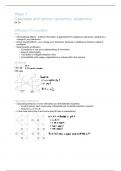
B B ab o
Alaal10,01 U i'spairwiseinteractions
t10,0 bb
rule
Threshold
Ptofi's A
neighboursplay
1ptplayB
BR A
if Pdib
Cascading behaviour
• Cascading behaviour is how networks can shift between equilibria
◦ In each period, each node uses a threshold rule to decide whether to switch
◦ Assume sᵢ= A if A~B
• In the case some play A and some play B there is coexistence
a 3 b2 Sthreshold is p0.4
I Si B ti
a VandWadoptA
s tandr adoptA
sanduadoptA
Theset vw atthreshold 90.4
induces acompletecascade
, • Increasing the payo a from 3 to 4 means the
threshold drops from 0.4 to ⅓ and there is a
complete cascade
• If threshold cannot be changed (ie. your
technology cannot be improved), target the right
entry points
◦ After the rst round of switches, bringing 12
or 13 onboard su ce to win the bottom part
of the network
Clusters
A cluster of density p is a set of nodes such that each node has at least a fraction p of neighbours in
the set
Given a set of initial adopters for A, let q be the adoption threshold for A in the remaining network
• If the remaining network has a cluster of density > 1-q, there will not be a complete cascade
• If a set of initial adopters does not induce a complete cascade with threshold q, the remaining
network must contain a cluster of density greater than 1-q (only clusters stop cascades)
Di usion and weak ties
Awareness must precede adoption
• The strength of weak ties means that you are more likely to learn something new from weak ties,
as strong ties are likely similar to you
Individual thresholds
Cascades and opinion dynamics, epidemics
EK Ch
Di usion of innovation
Why
• Informational e ects - indirect information is gathered from neighbours decisions, leading to a
change in your behaviour
• Direct-bene t e ects - you change your behaviour because a neighbours decision makes it
pro table
• Determinants of di usion
◦ Complexity of use and understanding of innovation
◦ Ease of observability
◦ Trial ability to mitigate adoption risks
◦ Compatibility with usage, expectations or values within the network
Modelling
B B ab o
Alaal10,01 U i'spairwiseinteractions
t10,0 bb
rule
Threshold
Ptofi's A
neighboursplay
1ptplayB
BR A
if Pdib
Cascading behaviour
• Cascading behaviour is how networks can shift between equilibria
◦ In each period, each node uses a threshold rule to decide whether to switch
◦ Assume sᵢ= A if A~B
• In the case some play A and some play B there is coexistence
a 3 b2 Sthreshold is p0.4
I Si B ti
a VandWadoptA
s tandr adoptA
sanduadoptA
Theset vw atthreshold 90.4
induces acompletecascade
, • Increasing the payo a from 3 to 4 means the
threshold drops from 0.4 to ⅓ and there is a
complete cascade
• If threshold cannot be changed (ie. your
technology cannot be improved), target the right
entry points
◦ After the rst round of switches, bringing 12
or 13 onboard su ce to win the bottom part
of the network
Clusters
A cluster of density p is a set of nodes such that each node has at least a fraction p of neighbours in
the set
Given a set of initial adopters for A, let q be the adoption threshold for A in the remaining network
• If the remaining network has a cluster of density > 1-q, there will not be a complete cascade
• If a set of initial adopters does not induce a complete cascade with threshold q, the remaining
network must contain a cluster of density greater than 1-q (only clusters stop cascades)
Di usion and weak ties
Awareness must precede adoption
• The strength of weak ties means that you are more likely to learn something new from weak ties,
as strong ties are likely similar to you
Individual thresholds