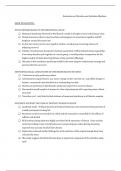
Evaluation on Ultradian and Infradian Rhythms
MAIN EVALUATION:
EVOLUTIONARY BASIS OF THE MENSTRUAL CYCLE -
❏ Menstrual synchrony observed in McClintock’s study is thought to have evolutionary value
❏ Female Ancestors where it may have been advantageous to menstruate together and fall
pregnant around the same time
❏ So that new-borns can be cared together within a social group increasing chances of
offspring survival
❏ Validity of evolutionary perspective has been questioned. Jeffrey Schank (2004) argued that
if too many females cycle together in a social group, it would produce competition for the
highest quality of males (lowering fitness of any potential offspring)
❏ His point is that avoidance synchrony would be the most adaptive evolutionary strategy and
natural selection can occur.
METHODOLOGICAL LIMITATIONS IN SYNCHRONISATION STUDIES -
❏ Criticisms at early synchrony studies.
❏ Commentators argued factors e.g. stress, change in diet, exercise etc. may affect change in
women’ s menstrual cycle therefore be a confounding variable
❏ Patterns in synchrony in McClintock’s study were expected to occur by chance
❏ Also involves small samples of women & relies of participants self-reporting onset of their
own cycle
❏ Trevathan et al . 1993 failed to find evidence of menstrual synchrony in all female-samples
EVIDENCE SUPPORT THE IDEA OF DISTINCT STAGES IN SLEEP -
❏ Landmark study - William Dement & Nathaniel Keitman (1957) monitored sleep patterns of
9 adult participants in sleep lab
❏ Brainwave activity was recorded on a EEG and the researchers controlled for the effects of
caffeine and alcohol
❏ REM activity during sleep was highly correlated with experience of dream . brain activity
carried according to how vivid dreams were and participants woken during dreaming
reported very accurate recall of their dreams
❏ Replications showed similar findings but with small size of the original sample have been
criticized by some.
❏ This study suggests that REM (dream) sleep is important component of the ultradian sleep
cycle
MAIN EVALUATION:
EVOLUTIONARY BASIS OF THE MENSTRUAL CYCLE -
❏ Menstrual synchrony observed in McClintock’s study is thought to have evolutionary value
❏ Female Ancestors where it may have been advantageous to menstruate together and fall
pregnant around the same time
❏ So that new-borns can be cared together within a social group increasing chances of
offspring survival
❏ Validity of evolutionary perspective has been questioned. Jeffrey Schank (2004) argued that
if too many females cycle together in a social group, it would produce competition for the
highest quality of males (lowering fitness of any potential offspring)
❏ His point is that avoidance synchrony would be the most adaptive evolutionary strategy and
natural selection can occur.
METHODOLOGICAL LIMITATIONS IN SYNCHRONISATION STUDIES -
❏ Criticisms at early synchrony studies.
❏ Commentators argued factors e.g. stress, change in diet, exercise etc. may affect change in
women’ s menstrual cycle therefore be a confounding variable
❏ Patterns in synchrony in McClintock’s study were expected to occur by chance
❏ Also involves small samples of women & relies of participants self-reporting onset of their
own cycle
❏ Trevathan et al . 1993 failed to find evidence of menstrual synchrony in all female-samples
EVIDENCE SUPPORT THE IDEA OF DISTINCT STAGES IN SLEEP -
❏ Landmark study - William Dement & Nathaniel Keitman (1957) monitored sleep patterns of
9 adult participants in sleep lab
❏ Brainwave activity was recorded on a EEG and the researchers controlled for the effects of
caffeine and alcohol
❏ REM activity during sleep was highly correlated with experience of dream . brain activity
carried according to how vivid dreams were and participants woken during dreaming
reported very accurate recall of their dreams
❏ Replications showed similar findings but with small size of the original sample have been
criticized by some.
❏ This study suggests that REM (dream) sleep is important component of the ultradian sleep
cycle