Professional School Counselor PRAXIS II Exam Study Guide Graded A 2024
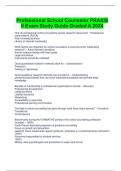
How do professional school counselors access research resources? - Professional organizations (ASCA) Peer-reviewed journals Library or Internet (cautiously) What factors are important for school counselors to examine when interpreting research? - Asks important questions Sound research design with clear goals Legal and ethical Instruments should be validated Good quantitative research methods allow for: - Generalization Prediction Testing of hypothesis Good qualitative research methods can provide for: - Understanding phenomena/processes that can serve exploratory purposes and provide deep knowledge Benefits of membership in professional organizations include: - Advocacy Professional development Lobbying efforts Liability insurance Networking Accessibility to resources Professional learning communities The field of school counseling has gone through what three major periods? - Formative Transitional Contemporary Benchmarks during the FORMATIVE period of the school counseling profession included: - 1900's Frank Parson becomes proponent of guidance counseling Focus on growth and prevention Jessie B. Davis implements regular guidance, emphasis on vocational/career instruction 1930's Personnel responsible for student services 1940's Military uses psychologists and counselors to select and recruit Benchmarks during the TRANSITIONAL period of the school counseling profession included: - 1950's Carl Rogers moves field away from educational guidance and toward client-centered counseling 1953 American School Counseling Association formed 1958 National Defense of Education Act passed allowing for more funding 1960's Dinkmeyer, Myrick, and Gysbers focused on developmentally appropriate, evidence-based school counseling structure Benchmarks during the CONTEMPORARY period of the school counseling profession included: - 1975 Education for All Handicapped Children Act increases services Leads to Individualized Education Plans (IEPs) 1997 ASCA National Standards developed with holistic point of view 2003 ASCA National Framework developed to provide guidelines on an effective school counseling program Trends in the educational system - Positive behavior support Professional learning communities ASCA National Model ensures - 1. Equitable access to education 2. Specific knowledge and skills will be gained by K-12 students 3. School counseling services delivered to all systematically 4. School counseling services are data-driven 5. School counseling services are provided by state-credentialed counselor ASCA Recommendations - Ratio 1:250 80% of time spent in direct or indirect services to students ASCA National Model is made of three parts: - FOUNDATION- Component that drive school counseling program MANAGEMENT- Assessments and tools that manage a school counseling program DELIVERY- Method of delivering programming ACCOUNTABILITY- Helps professional school counselors analyze data ASCA National Model FOUNDATION - Program focus- Mission statement and goals Student competencies- Academic, career, and personal/social development Professional competencies- Knowledge, attitudes, and skills of good counseling
Written for
- Institution
- PRAXIS II
- Course
- PRAXIS II
Document information
- Uploaded on
- May 21, 2024
- Number of pages
- 11
- Written in
- 2023/2024
- Type
- Exam (elaborations)
- Contains
- Questions & answers
Subjects
- praxis ii exam
-
professional school counselor praxis ii exam
-
professional school counselor praxis ii
-
professional school counselor

Also available in package deal