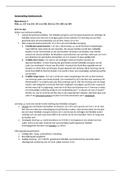
Creighton University Bio 201 Unit 2 Test review Questions With 100% Correct Answers.
What is Fick's Law? What influences diffusion - Answer-The molar flux due to diffusion is proportional to the concentration gradient F=kA((c1-c2)/d)) - Answer-F is rate of diffusion K is diffusion constant A is surface area for diffusion D id distance for diffusion (ex: membrane thickness) C1-C2 is difference in concentration How does the diffusion of uncharged and charged particles differ? - Answer-Uncharged particles diffuse irrespective of the concentration of each other. Charged particles have both a concentration and electrical gradient that must be accounted for. For charged particles, need to keep in mind what charge is attracted or repelled Osmosis - Answer-the process of the natural diffusion of water across a semipermeable membrane due to a difference in solute concentration. From low to high concentration. Osmolarity - Answer-sum of concentration of solutes in the water. Measured in osmoles per liter Osmolarity is determined by the combined concentration of all solutes in a solution osmotic vs. hydrostatic pressure - Answer-Osmotic pressure is the amount of pressure required to PREVENT solvent from passing through Hydrostatic pressure is the difference of water pressure between two regions Type of charges and size for molecules passing though lipid bilayer, along with how easy or hard it is. - Answer-Smaller and uncharged substances diffuse across lipid bilayers easier than larger polar substances small , nonpolar molecules diffuse the easiestSmall polar Large molecules very hard Charged particles impossible Fats pass through very easily due to being very hydrophobic. How are channel and carrier proteins involved in movement across membranes? - Answer-Channel protein (Permeation) uses an open passageway Carrier proteins (Facilitated Diffusion) can move against concentration gradient What are the forms of transportation? - Answer-Active: requires use of ATP Passive: No ATP involved Primary vs Secondary active transport - Answer-Primary active transport: uses uniport pump-carrier protein with ATP to go against concentration gradient Secondary active transport: Secondary Active transport does not take ATP directly . Movement across membranes How do surface area to volume ratios and diffusion distance change with size? - Answer-increases areas for diffusion, distance from center to surface surface area : volume decreases harder for cells to reach center permeation - Answer-penetration through something facilitated diffusion - Answer-process of spontaneous passive transport of molecules or ions across a cell's membrane via specific transmembrane integral proteins. Hyposmotic - Answer-low concentration compared to other concentration
Written for
- Institution
- Creighton University Bio 201 Unit 2
- Course
- Creighton University Bio 201 Unit 2
Document information
- Uploaded on
- May 21, 2024
- Number of pages
- 10
- Written in
- 2023/2024
- Type
- Exam (elaborations)
- Contains
- Questions & answers
Subjects
-
creighton university bio 201 unit 2

Also available in package deal