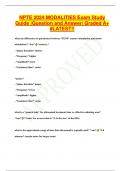
NPTE 2024 MODALITIES Exam Study Guide |Question and Answer| Graded A+ #LATEST!!
NPTE 2024 MODALITIES Exam Study Guide |Question and Answer| Graded A+ #LATEST!! what are differences in parameters between *TENS* sensory stimulation and motor stimulation? *Ans* *sensory:* - *phase duration* shorter - *frequency* higher - *amplitude* lower - *treatment time* varies *motor:* - *phase duration* longer - *frequency* lower - *amplitude* higher - *treatment time* varies what is a *general rule* for ultrasound treatment time re: effective radiating area? *Ans* *5 min* for an area that is *2-3x the size* of the ERA what is the approximate range of time that ultrasound is typically used? *Ans* *5-8 minutes* (maybe more for larger areas) which *2* parameters should be changed in order to change the *thermal effects* of ultrasound? what would you use for *non-thermal* tx? *Ans* 1) *duty cycle* (ratio of on time: total time) - *20% or lower duty cycle* allows heat produced during the on time to be dispersed more during off time no net increase in temperature 2) *intensity* - usually 0.5-2.0 W/cm2 *thermal* - 0.5-0.75 W/cm2 at 20% duty cycle for *non-thermal* what is the parameter that affects *depth of penetration* when using *ultrasound*? which kinds of tissues have a low rate of absorption? which have high rate of absorption? what amount is used for deeper tissue heating? how deep does it go? what amount is used for superficial tissue heating? how deep? *Ans* *frequency* - high water content tissues (e.g, blood and plasma) = *low* rate of absorption - high protein content tissues (e.g., bone) = *high* rate of absorption - lower frequency (*1 MHz*) is used for deeper tissues (up to *5 cm*) - higher frequency (*3 MHz*) is used for superficial tissues (*1-2 cm*) what is *iontophoresis*? which theory is it based on? what are the components needed? *Ans* the process by which ions are introduced into the body through skin via *continuous direct current e-stim* based on theory that like charges repel - negative ions will move away from the *negative pole (cathode)* and into body - positive ions will move away from the *positive pole (anode)* and into the body *active electrode* = the electrode containing the *ion solution* placed at the treatment site *dispersive electrode* = the electrode placed away from the active electrode what are *11 indications* for *iontophores
Written for
- Institution
- NPTE
- Course
- NPTE
Document information
- Uploaded on
- May 20, 2024
- Number of pages
- 45
- Written in
- 2023/2024
- Type
- Exam (elaborations)
- Contains
- Questions & answers
Subjects
-
npte 2024 modalities exam study guide question a

Also available in package deal