L02 language and structure devices
Language:
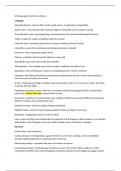
Adverbial phrases- used to affect verbs usually end in –ly (gloomily, energetically)
Active verbs- verbs that describe what the subject is doing (the waves crashed, swung)
Personification- give a non-living thing a human feature (the wind danced through the trees)
Pathos- makes the reader sympathise with the narrator
Collective noun- something that refers to a group of things (a flock of sheep)
Intensifiers- words that emphasise something (extremely, intensely)
Oxymoron- direct opposites (angelic devil)
Plosives- created by hard constants (dead as a doornail)
Empathetic lang- makes the reader feel empathy
Monosyllabic- a one syllable word used to create a rhythmic tone/effect (cat)
Superlative- the best thing over anyone or anything (funniest, richest, smartest)
Metaphor- describing something by referring to something else that has similar characteristics (a
heart of stone, the mind is an ocean)
Simile- comparing one thing to another using words such as ‘like’ & ‘as’ (as fast as a tiger, she walks
in beauty, like the night)
Parenthetical phrases- used to add info to a sentence without disrupting the flow/ cohesion (the
man’s face, twisted with rage, contorted into a snarl
Assonance- similarity in sounds between two syllables with the same vowels/different constants or
different vowels/ same constants (hit, hat)
Dissonant sounds- sounds sounding strange/unpleasant
Pathetic Fallacy- words that give human qualities/ feelings to objects (cruel sea)
Hyperbole- exaggeration used to create an effect
Irony- when one thing was intended but the opposite of that happens- allows readers to re evaluate
and question their thoughts on the text while creating a sense of humour/ suspense
Structure
Syntax- long/ short sentences
Cyclical structure- the beginning is again referred to at the end- creating a sense of repetition
perhaps making emphasis on a particular part of the text
Rhetorical question- a question that does not require an answer
Foreboding narrative- foreshadowing of whats to come in the extract allows readers to make
connections and their own critical thoughts and opinions about the text, helping to engage readers
Language:
Adverbial phrases- used to affect verbs usually end in –ly (gloomily, energetically)
Active verbs- verbs that describe what the subject is doing (the waves crashed, swung)
Personification- give a non-living thing a human feature (the wind danced through the trees)
Pathos- makes the reader sympathise with the narrator
Collective noun- something that refers to a group of things (a flock of sheep)
Intensifiers- words that emphasise something (extremely, intensely)
Oxymoron- direct opposites (angelic devil)
Plosives- created by hard constants (dead as a doornail)
Empathetic lang- makes the reader feel empathy
Monosyllabic- a one syllable word used to create a rhythmic tone/effect (cat)
Superlative- the best thing over anyone or anything (funniest, richest, smartest)
Metaphor- describing something by referring to something else that has similar characteristics (a
heart of stone, the mind is an ocean)
Simile- comparing one thing to another using words such as ‘like’ & ‘as’ (as fast as a tiger, she walks
in beauty, like the night)
Parenthetical phrases- used to add info to a sentence without disrupting the flow/ cohesion (the
man’s face, twisted with rage, contorted into a snarl
Assonance- similarity in sounds between two syllables with the same vowels/different constants or
different vowels/ same constants (hit, hat)
Dissonant sounds- sounds sounding strange/unpleasant
Pathetic Fallacy- words that give human qualities/ feelings to objects (cruel sea)
Hyperbole- exaggeration used to create an effect
Irony- when one thing was intended but the opposite of that happens- allows readers to re evaluate
and question their thoughts on the text while creating a sense of humour/ suspense
Structure
Syntax- long/ short sentences
Cyclical structure- the beginning is again referred to at the end- creating a sense of repetition
perhaps making emphasis on a particular part of the text
Rhetorical question- a question that does not require an answer
Foreboding narrative- foreshadowing of whats to come in the extract allows readers to make
connections and their own critical thoughts and opinions about the text, helping to engage readers