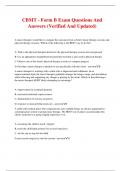
CBMT - Form B Exam Questions And Answers (Verified And Updated)
CBMT - Form B Exam Questions And Answers (Verified And Updated) A music therapist would like to compare the outcomes from a client's music therapy sessions and physical therapy sessions. Which of the following is the BEST way to do this? A. Talk to the physical therapist about how the physical therapy sessions have progressed B. Use an appropriate standardized measurement tool that is also used in physical therapy C. Observe one of the client's physical therapy sessions to compare progress D. Develop a music therapy evaluation to use specifically with this client - answerB A music therapist is working with a client who is depressed and withdrawn. In an improvisational dyad, the music therapist gradually changes the tempo, range, and articulation, while reflecting and supporting any change in playing by the client. Which of the following is the music therapist MOST likely attempting to encourage? A. improvement in sustained attention B. increased emotional expressiveness C. demonstration of sensory awareness D. response to musical behavioral cues - answerB A child with cerebral palsy who communicates non-verbally brings an electric augmentative communication system to group music therapy. The BEST way to plan to accommodate this client's inclusion in a group singing experience is to: A. encourage the child to touch "stop/go" B. teach the child hand gestures for several song lyrics C. ask the star to sing for the child D. pre-record song lyrics onto the system - answerD When playing a song for a group of clients, the music therapist is reminded of feelings of love for a romantic interest. The therapist should: A. continue working and internally acknowledge these feelings B. block these feelings out and focus on the clients' needs C. share these feelings with the clients when the song is over D. play this song in future sessions only when feeling uninspired - answerA A client with Autism Spectrum Disorder claps to musical accompaniments, clapping when the music plays and stopping when the music stops. The music therapist uses these responses to assess which of the following areas of functioning? A. vibroacoustic B. vestibular C. proprioceptive D. sensorimotor - answerD Determining a client's musical background and skills is an important task during which phase of the music therapy plan? A. evaluation B. termination C. implementation D. assessment - answerD A music therapist is working with a patient who has suffered a stroke on the left side of the brain and exhibits significant language comprehension issues. It is MOST effective to provide ongoing acknowledgment and reflection of the client's responses through: A. detailed instructions which create context B. exaggerated verbal and nonverbal prompts C. simple singing of directions through a song D. simple non-verbal cues and gestures - answerD A music therapist works in a remote area where the field is not prominent and there are no other practicing music therapists. The music therapist is feeling isolated. Several clients at the hospital where he works are challenging, and he feels that he could really benefit from another person to "bounce ideas off of." Which of the following is the MOST effective way to address the music therapists's immediate need? A. seek peer supervision through an online community of music therapists B. connect with a non-music therapy co-worker who can listen and offer feedback C. find a therapeutic outlet by playing recreationally with local musicians D. attend a conference session that focuses on the music therapist's concerns - answerA A child with ASD starts pacing during a music therapy session. Which of the following is the music therapist's MOST effective response to redirect the child? A. tap on the chair B. chant a rhythmic pattern "it's okay" C. play sol-do on the xylophone D. sing a melodic phrase "sit down" - answerD A music therapist in a private school setting conducts a weekly social skills group for students with high-functioning ASD. Goals include controlling impulses, turn-taking, and reciprocity. Data indicates three of the four students are making progress towards their goals, but one student expresses "music is stupid" and records indicate he participates less than 5% of the time. Which of the following is the music therapist's BEST action? A. refer the student to a non-musical social skills group B. ignore the student and focus on the remaining group members C. position the student in a leadership position D. dismiss the student form the group until he can demonstrate cooperation - answerA A music therapist is completing an initial assessment of an adult client in a hospital setting. The therapist reviews the patient chart beforehand to gather information about demographics, clinical history, and personal resources. During a brief interview with the patient, the therapist gathers information regarding cultural and spiritual background, family dynamics, and support systems. Which of the following additional information should the music therapist obtain that may affect the music therapy session with the client?
Written for
- Institution
- CBMT
- Course
- CBMT
Document information
- Uploaded on
- May 19, 2024
- Number of pages
- 37
- Written in
- 2023/2024
- Type
- Exam (elaborations)
- Contains
- Questions & answers
Subjects
-
cbmt form b exam questions and answers verified

Also available in package deal