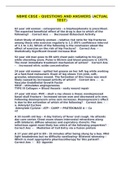
CBMT Exam 2 Questions And Answers (Verified And Updated)
CBMT Exam 2 Questions And Answers (Verified And Updated) During initial assessment, a patient answers questions about her spirituality and states, "I am very spiritual and religious." How should the music therapist interpret this information? A. Recognize that spiritual music is specific to each region of the United States and provide music accordingly. B. Since the music therapist is also spiritual and religious, she can assume that the patient shares the same spiritual belief system. There is no need to further explore the patient's perspective. C. Explore what the patient means by "spiritual and religious" and openly discuss the patient's point of view. D. Determine what the patient means by "spiritual and religious" and initiate a discussion about the merits of each spiritual belief system. - answerC. Explore what the patient means by "spiritual and religious" and openly discuss the patient's point of view. A music therapist is working in a choral ensemble with a group of adults who have developmental disabilities. The group's long term goal is to perform in the community. Which of the following will MOST likely affect the group's success? A. simplifying parts to meet individual group members' abilities B. choosing music that is highly preferred by the group C. choosing music with which each group member is familiar D. arranging the ensemble participants based on musical ability - answerA. simplifying parts to meet individual group members' abilities A 7 year old girl with a severe developmental disability is receiving music therapy in a residential setting. She is nonverbal and prone to be fearful and anxious in new situations. When brought into the therapy room for her first session, she actively resists and begins to cry. The music therapist, working in an improvisational model, might do which of the following? 1. Meet the child by playing music to express the intensity of her crying. 2. Reflect the child's sound and breathing with careful musical phrasing. 3. Comfort the child by holding and rocking her while singing soothing lyrics. 4. Sing without words so the child hears another voice that corresponds to how she is feeling. A. 1, 2, and 3 only B. 1, 2, and 4 only C. 1, 3, and 4 only D. 2, 3, and 4 only - answerB. 1, 2, and 4 only A client who only knows guitar chords in first position wants to learn a song with the tablature for the following chords: E, B7, A, c#, and f#. Which of the following transpositions BEST ensures successful playing of the song? A. F, C7, Bb, d, g B. D, A7, G, b, e C. A, E7, D, f#, b D. G, D7, C, e, a - answerD. G, D7, C, e, a A client is referred to music therapy to increase on-task behavior and to encourage social interaction. After three months of weekly sessions, the client has not met the on-task objective, but social interaction has improved. The music therapist's BEST response would be to A: change the criteria of the on-task objective to challenge the client. B: identify new goals the client may be more successful at completing. C: refer the client to a social skills group. . D: re-evaluate the strategies and expected outcomes of the on-task objective. - answerD: re- evaluate the strategies and expected outcomes of the on-task objective. A music therapist is working with a stroke patient who demonstrates left neglect and difficulty crossing midline. In order to address both needs through instrumental playing, the therapist should position a drum A: to the patient's right side and place a mallet in each hand. B: to the patient's right side and pace a mallet in the right hand. C: to the patient's left side and place a mallet in the right hand. D: directly in front of the patient and place a mallet in the right hand. - answerC: to the patient's left side and place a mallet in the right hand. An adult with severe, chronic asthma receives individual music therapy in an outpatient rehabilitation clinic. Treatment goals include increasing breath support and developing intercostal muscle strength to improve voice quality. When selecting song material, which of the following is the MOST crucial aspect to consider? A: client preference B: phrase length C: tessitura D: song duration - answerB: phrase length A music therapist is assisting a terminally ill client who is preparing for his impending death. The BEST choice of music for the patient's final hours is music that has been A: selected by the client B: designed to elicit relaxation C: selected previously by the family or significant others. D: designed for spiritual transformation - answerA: selected by the client In a residential facility, which of the following is the MOST reliable method for determining whether a client's progress has generalized? A: Evaluate target behaviors of the client outside of the therapy setting. B: Consult with direct care workers who are in contact with the client in the residential setting. C: Consult progress notes written by other members of the client's multidisciplinary team. D: Evaluate whether the client's behavior outside of therapy is appropriate to the context of the residential setting. - answerA: Evaluate target behaviors of the client outside of the therapy setting. Which of the following examples illustrate professional development? A: Document treatment plans, collaborate with other colleagues, and expand music repertoire. B: Conduct or assist with research, participate in continuing education, and engage in collaboration with other colleagues. C: Participate in research, set professional goals, and maintain client confidentiality. D: Participate in continuing education, comply with safety protocols, and review current research literature. - answerB: Conduct or assist with research, participate in continuing education, and engage in collaboration with other colleagues. A 52 year old woman hospitalized for ovarian cancer requests music therapy to help her relax and sleep. During the initial session conducted at bedtime, the patient shares her fears and life story before the use of any music intervention. After validating the patient's feelings, the BEST direction for the music therapist to take is to A: discuss favorite songs important to the patient's life. B: improvise soft guitar music to help the patient go to sleep. C: compose a song together reflecting the patient's disclosure. D: close the session and bring the patient's favorite music to follow-up visits. - answerB: improvise soft guitar music to help the patient go to sleep. During a session on an adolescent psychiatric unit, one of the clients play his guitar to preferred music continuously, not allowing the other clients to suggest songs. Another client, playing electric keyboard, turns up the volume of his instrument and begins to play different songs. The guitar player reacts by playing his instrument louder and faster. The music therapist should A: take the instruments away from the two clients and confront them about the behavior. B: end the group and report the behavior to the counselors. C: suggest the two clients leave the group and allow the others to continue. D: stop the music and process the disruption. - answerD: stop the music and process the disruption. Which of the following types of recording procedure is being employed when a music therapist uses a stopwatch to time how long a child marches to music? A: event B: duration
Written for
- Institution
- CBMT
- Course
- CBMT
Document information
- Uploaded on
- May 19, 2024
- Number of pages
- 38
- Written in
- 2023/2024
- Type
- Exam (elaborations)
- Contains
- Questions & answers
Subjects
-
cbmt exam 2 questions and answers verified and up

Also available in package deal