WGU Organizational Behavior C715 with 100% correct answers already graded A+
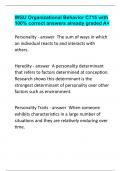
Personality The sum of ways in which an individual reacts to and interacts with others. Heredity A personality determinant that refers to factors determined at conception. Research shows this determinant is the strongest determinant of personality over other factors such as environment. Personality Traits When someone exhibits characteristics in a large number of situations and they are relatively enduring over time. Myers-Briggs Type Indicator (MBTI) The most widely used personality-assessment instrument in the world. It is 100 questions that ask how people feel or act in situations. Respondents are classified as (E) Extroverted or (I) Introverted, (S) Sensing or (N) Intuitive, (T) Thinking or (F) Feeling, and (J) Judging or (P) Perceptive MBTI: Extroverted vs Introverted Extroverted individuals are outgoing, sociable, and assertive. Introverts are quiet and shy. MBTI: Sensing vs Intuitive Sensing types are practical and prefer routine and order, and they focus on details. Intuitives rely on unconscious processes and look at the "big picture." MBTI: Thinking vs Feeling Thinking types use reason and logic to handle problems. Feeling types rely on their personal values and emotions. MBTI: Judging vs Perceiving Judging types want control and prefer order and structure. Perceiving types are flexible and spontaneous. Cons of Using MBTI Model Cons - Forces a person into one type or another and there is no in-between. When people retake the assessment, they often receive different results. Interpreting the results requires training that can leave room for error. Results can also be unrelated to job performance. Big Five Model Proposes that five basic dimensions underlie all others and encompass most of the significant variation in human personality. Factors are Conscientiousness, Emotional Stability, Extraversion, Openness to Experience, and Agreeableness. Big Five Model: Conscientiousness Measures reliability. It is the best predictor of job performance. A highly conscientious person is responsible, organized, dependable, and persistent. Lower scoring individuals are easily distracted, disorganized, and unreliable. Big Five Model: Emotional Stability Measures a person's ability to withstand stress. High scoring individuals tend to be calm, self-confident, and secure. They are likely to be positive, optimistic, and experience few negative emotions. They are likely to have the most job satisfaction. Low scorers (opposite end of the spectrum known as having high neuroticism) are hypervigilant and vulnerable to the physical and psychological effects of stress. They tend to be nervous, anxious, depressed, and insecure. Big Five Model: Extraversion Measures our comfort level with relationships. High scorers tend to be gregarious, assertive, and sociable. They are generally happier and often ambitious. Low scorers (introverts) tend to be more thoughtful, reserved, timid, and quiet. Big Five Model: Openness to Experience Measures to range of interests and fascination with novelty. High scorers are creative, curious, and artistically sensitive. Low scorers are conventional and find comfort in the familiar. Big Five Model: Agreeableness Measures an individuals propensity to defer to others. High scorers are cooperative, warm, and trusting. Low scorers are cold and antagonistic. Big Five Traits - Why Relevant - What Does It Affect (Chart) Dark Triad Three other socially undesirable traits which we all have in varying degrees. They are Machiavellianism, Narcissism, and Psychopathy Machiavellianism High scorers are pragmatic, maintain emotional distance, and believe ends can justify the means. Tend to be manipulative, persuasive, aggressive, and not well liked. Narcissism High scorers are people with a grandiose sense of self-importance, they require excessive admiration, and are arrogant. They often have fantasies of grand success, a tendency to exploit situations and people, a sense of entitlement, and a lack of empathy. Psychopathy In organizational behavior, this does not connote clinical mental illness. In OB context, it is defined as a lack of concern for others, and a lack of guilt or remorse when actions cause harm. Core Self-Evaluations (CSEs) Bottom-line conclusions individuals have about their capabilities, competence, and worth as a person. People with positive CSEs see themselves as effective and in control of their environment. People with negative CSEs tend to dislike themselves, question their capabilities, and view themselves as powerless over their environment. Self-Monitoring Describes an individual's ability to adjust behavior to external, situational factors. High self-motivators show considerable adaptability in adjusting their behavior to external situational factors. Low self-motivators display their true dispositions and attitudes in every situation. Proactive Personality Identify opportunities, show initiative, take action, and persevere until meaningful change occurs, compared to others who generally react to situations. Situation Strength Theory Proposes that the way personality translates into behavior depends on the strength of the situation. Situation strength means the degree to which norms, cues, or standards dictate appropriate behavior. Clarity (Relating to Situation Strength) The degree to which cues about work duties and responsibilities are available and clear. High clarity produces strong situations because individuals can readily determine what to do. Consistency (Relating to Situation Strength) The extent to which cues regarding work duties and responsibilities are compatible with one another. High consistency jobs represent strong situations because all the cues point toward the same desired behavior. Constraints (Relating to Situation Strength) The extent to which individuals' freedom to decide or act is limited by forces outside their control. Many constraints represent strong situations because an individual has limited individual discretion. Consequences (Relating to Situation Strength) The degree to which decisions or actions have important implications for the organization or its members, clients, supplies, and so on. Important consequences represent strong situations because the environment is probably heavily structured to guard against mistakes. Trait Activation Theory (TAT) Predicts that some situations, events, or interventions "activate" a trait more than others. Values Represent basic convictions that "a specific
Written for
- Institution
- Wgu C715 Organizational Behavior
- Course
- Wgu C715 Organizational Behavior
Document information
- Uploaded on
- May 19, 2024
- Number of pages
- 43
- Written in
- 2023/2024
- Type
- Exam (elaborations)
- Contains
- Questions & answers
Subjects
-
wgu organizational behavior c715

Also available in package deal