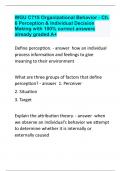
WGU C715 Organizational Behavior - Ch. 6 Perception & Individual Decision Making with 100% correct answers already graded A+
Define perception. how an individual process information and feelings to give meaning to their environment What are three groups of factors that define perception? 1. Perceiver 2. Situation 3. Target Explain the attribution theory. when we observe an individual's behavior we attempt to determine whether it is internally or externally caused Name 3 determinants of attribution. 1. distinctiveness 2. consensus 3. consistency Identify shortcuts people use to make judgments about others. 1. selective perception 2. halo effect 3. constrast effect 4. stereotyping anchoring bias tendency to fixate on initial information, from which one then fails to adequately adjust for subsequent information Explain how individual differences and organizational constraints affect decision making. Contrast the three ethical decision criteria Define creativity and discuss the three-component model of creativity. Name 3 situational factors. 1. time 2. work setting 3. social setting Name 7 factors in the target. 1. novelty 2. motion 3. sounds 4. size 5. background 6. proximity 7. simliarity Name 5 factors of the perceiver. 1. attitudes 2. motives 3. experiences 4. expectations 5. interests distinctiveness does the person behave different in different situations? consensus if everyone faced with the same situation responds the same way consistency does the person respond the same way over a period of time making it a regular habit? fundamental attribution error overestimating internal factors and underestimating external factors when making judgments about an individual's behavior self-serving bias overestimating external factors and underestimating internal factors selective perception interpret what one sees on the basis of one's interests, background, experience, and attitudes halo effect tendency to draw a general impression about an individual on the basis of a single characteristic. constrast effect comparing a person with others of lesser or greater skill levels stereotyping judging someone based on the group they belong to rational decision-making model how a person should behave to achieve an outcome What are the 6 steps to the rational decision-making model? 1. Define the problem. 2. Identify the decision criteria. 3. Allocate weights to the criteria. 4. Develop the alternatives. 5. Evaluate the alternatives. 6. Select the best alternative bounded rationality using the criteria to make decisions until you find the first acceptable solution (not the optimal one) intuitive decision making engages emotions; based on experience rather than facts overconfidence bias being too optimistic about our judgments confirmation bias we tend to seek out information that affirms our past choices and reject that which doesn't availability bias we base our judgments on the information that is readily available escalation of commitment staying with a decision even though there is clear evidence that it is wrong randomness error believing that you can predict the outcome of random events risk aversion prefer sure gain over risky outcome, even if it would have had a greater payoff hindsight bias believing (after looking back) that you could have predicted that outcome having known what you know Identify the 3 ethical decision criteria. 1. utilitarianism 2. whistle blowers 3. Justice utilitarianism criteria decisions are made to provide the greatest good to the greatest number of people whistle blower criteria those who report their unethical company practices to outsiders Justice criteria impose and enforce rules fairly and impartially to ensure justice or an equitable distribution of benefits and costs creativity The ability to produce novel and useful ideas 3 component model of creativity individual creativity requires expertise, creative thinking skills, and intrinsic task motivation expertise knowledge, proficiency, and abilities in a particular area creative thinking skills the ability to use analogies, and the talent to see the familiar in a different light intrinsic task motivation desire to work on something because it's interesting, involving, exciting, satisfying, or personally challenging Add or remove terms Flashcards Learn Test Ma
Written for
- Institution
- Wgu C715 Organizational Behavior
- Course
- Wgu C715 Organizational Behavior
Document information
- Uploaded on
- May 19, 2024
- Number of pages
- 11
- Written in
- 2023/2024
- Type
- Exam (elaborations)
- Contains
- Questions & answers
Subjects
-
wgu c715 organizational behavior ch 6

Also available in package deal