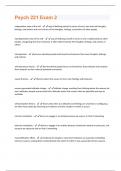
Psych 221 Exam 2 Questions & Answers Correctly Answered.
independent view of the self - way of defining oneself in terms of one's own internal thoughts, feelings, and actions and not in terms of the thoughts, feelings, and actions of other people interdependent view of the self - way of defining oneself in terms of one's relationships to other people, recognizing that one's behavior is often determined by the thoughts, feelings, and actions of others introspection - process whereby people look inward and examine their own thoughts, feelings, and motives self-awareness theory - idea that when people focus on themselves, they evaluate and compare their behavior to their internal standards and values causal theories - theories about the causes of one's own feelings and behaviors reasons-generated attitude change - attitude change resulting from thinking about the reasons for one's attitudes; people assume that their attitudes match the reasons that are plausible and easy to verbalize self-perception theory - theory that when our attitudes and feelings are uncertain or ambiguous, we infer these states by observing our behavior and the situation in which it occurs intrinsic motivation - desire to engage in an activity because we enjoy it or find it interesting extrinsic motivation - desire to engage in an activity because of external rewards or pressures, not because we enjoy the task or find it interesting overjustification effect - tendency for people to view their behaviors as caused by compelling extrinsic reasons, making them underestimate the extent to which it was caused by intrinsic reasonstask-contingent rewards - rewards that are given for performing a task, regardless of how well the task is done performance-contingent rewards - rewards that are based on how well we perform a task two-factor theory of emotion - idea that emotional experience is the result of a two-step selfperception process in which people first experience physiological arousal and then seek an appropriate explanation for it misattribution of arousal - process whereby people make mistaken inferences about what is causing them to feel the way they do fixed mindset - idea that we have a set amount of an ability that cannot change growth mindset - idea that our own abilities are malleable qualities that we can cultivate and grow upward social comparison - comparing ourselves to people who are better than we are with regards to a particular trait downward social comparison - comparing ourselves to people who are worse than we are with regards to a particular trait or ability social tuning - process whereby people adopt another person's attitudes impression management - attempt by people to get others to see them as they want to be seen ingratiation - process whereby people flatter, praise, and generally try to make themselves likable to another person, often of higher social statusself-handicapping - strategy whereby people create obstacles and excuses for themselves so that if they do poorly on a task, they can avoid blaming themselves self-esteem - people's evaluations of their own self-worth-- extent to which they view themselves as good, competent, and decent terror management theory - theory that self-esteem serves as a buffer, protecting people from terrifying thoughts about their own mortality narcissism - combination of excessive self-love and a lack of empathy toward others cognitive dissonance - drive or feeling of discomfort, originally defined as being caused by holding 2 or more inconsistent cognitions and subsequently defined as being caused by performing an action that is discrepant from one's customary, typically positive self-conception self-affirmation - way of reducing dissonance by reminding oneself of one or more of one's positive attributes impact bias - tendency to overestimate the intensity and duration of one's emotional reactions to future events post-decision dissonance - dissonance aroused after making a decision, typically reduced by enhancing the attractiveness of the chosen alternative and devaluating the rejected alternatives lowballing - a salesperson induces a customer to agree to purchase a product at a low cost, subsequently claims it was an error, and then raises the price; frequently, the customer will agree to make the purchase at the inflated price justification of effort - tendency for individuals to increase their liking for something they have worked hard to attainexternal justification - reason or explanation for dissonant personal behavior that resides outside the individual (in order to receive a large reward or avoid a severe punishment) internal justification - reduction of dissonance by changing something about oneself counterattitudinal advocacy - stating an opinion or attitude that runs counter to one's private belief or attitude insufficient punishment - dissonance aroused when individuals lack sufficient external justification for having resisted a desired activity or object, usually resulting in individuals devaluing the forbidden activity or object self-persuasion - long-lasting form of an attitude change that results from attempts at selfjustification hypocrisy induction - arousal of dissonance by having individuals make statements that run counter to their behaviors and then reminding them of the inconsistency between what they advocated and their behavior attitudes - evaluations of people, objects, and ideas cognitively based attitude - attitude based primarily on people's feelings and values than on the properties of an attitude object affectively based attitude - attitude based more on people's feelings and values than on their beliefs about the nature of an attitude object classical conditioning - stimulus that elicits an emotional response is repeatedly paired with a neutral stimulus that does not, until the neutral stimulus takes on the emotional properties of the first stimulusoperant conditioning - behaviors we freely choose to perform become more or less frequent, depending on whether they are followed by a reward or punishment behaviorally based attitude - attitude based on observations of how one behaves toward an object explicit attitudes - attitudes that we consciously endorse and can easily report implicit attitudes - attitudes that are involuntary, uncontrollable, and at times unconscious persuasive communications - communication advocating a particular side of an issue Yale Attitude Change Approach - study of the conditions under which people are most likely to change their attitudes in response to persuasive messages, focusing on the source of the communication, the nature of the communication, and the nature of the audience elaboration likelihood model - model explaining the 2 ways in which persuasive communication can cause attitude change: centrally, when people are motivated and have the ability to pay attention to the arguments in the communication, and peripherally, when people don't pay attention to the arguments but are instead swayed by surface characteristics central route to persuasion - case in which people elaborate on a persuasive communication, listening carefully to and thinking about the arguments, which occurs when people have both the ability and the motivation to listen carefully to a communication peripheral route to communication - case in which people do not elaborate on the arguments in a persuasive communication but are instead swayed by peripheral cues need for cognition - personality variable reflecting the extent to which people engage in and enjoy effortful cognitive abilitiesfear-arousing communication - persuasive message that attempts to change people's attitudes by arousing their fears heuristic-systematic model of persuasion - explanation of the 2 ways in which persuasive communications can cause attitude change: either systematically processing the merits of the arguments or using mental shortcuts attitude inoculation - making people immune to attempts to change their attitude by initially exposing them to small doses of the arguments against their position
Written for
- Institution
- Psych 221
- Course
- Psych 221
Document information
- Uploaded on
- May 19, 2024
- Number of pages
- 6
- Written in
- 2023/2024
- Type
- Exam (elaborations)
- Contains
- Questions & answers
Subjects

Also available in package deal