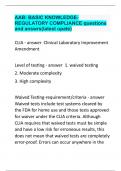
AAB: BASIC KNOWLEDGE- REGULATORY COMPLIANCE questions and answrs(latest upate)
CLIA Clinical Laboratory Improvement Amendment Level of testing 1. waived testing 2. Moderate complexity 3. High complexity Waived Testing-requirement/criteria Waived tests include test systems cleared by the FDA for home use and those tests approved for waiver under the CLIA criteria. Although CLIA requires that waived tests must be simple and have a low risk for erroneous results, this does not mean that waived tests are completely error-proof. Errors can occur anywhere in the testing process, particularly when the manufacturer's instructions are not followed and when testing personnel are not familiar with all aspects of the test system. Certificate of Waiver (CW) The CW permits a laboratory to perform only waived tests. Waived tests are so simple and accurate that little risk of error exists when done correctly. Examples of waived tests include: ■ Certain testing methods for glucose and cholesterol; ■ Fecal occult blood tests; ■ Pregnancy tests; and ■ Some urine tests. Health and human services (HHS) responsibilities for waived test HHS will determine whether a laboratory test meets the criteria for a waived test. Revisions to the list of waived tests approved by HHS will be published in the Federal Register. Laboratories eligible for a certificate of waiver must follow instructions given by manufacturers and producers. Moderate complexity Non waived testing is the term used to refer collectively to moderate and high complexity testing. Laboratories or sites that perform these tests need to have a CLIA certificate, be inspected, and must meet the CLIA quality standards. This includes the subcategory of Provider Performed Microscopy (PPM). Criteria for categorization: knowledge, training and experience, reagents and materials preparation, characteristics of operational steps,calibrations,quality control, and proficiency testing materials, test system troubleshooting and equipment maintenance, and interpretation and judgement. Scoring of complexity Score 1 indicates the lowest level of complexity. Score 2 will be assigned to a criteria heading when the characteristics for a particular test are intermediate between scores of 1 and 3. Score 3 indicates the highest level of complexity. Scores will be totaled Scores <12 = moderate complexity Scores >12 = High complexity Provider-Performed Microscopy (PPM) A subset of the moderate complexity tests, PPMs receive a unique classification and certification. A laboratory where a physician, mid-level practitioner, or dentist performs only certain microscopy procedures and waived tests may receive this certificate. Routine on-site surveys are not required for a Certificate for PPM. A laboratory may be surveyed as part of a routine survey for non-waived tests or if there is a complaint. Moderate complexity requirements apply Provider-Performed Microscopy examinations A microscopy procedure is moderately complex using a microscope (for example, urine microscopic or potassium hydroxide [KOH] smear). Pin worm examinations Fern test Postcoital direct, qualitative examinations of vaginal or cervical mucus urine sediment examinations and Nasal smears for granulocytes, fecal leukocyte examination, qualitative semen analysis. High Complexity Non waived testing is the term used to refer collectively to moderate and high complexity testing. Laboratories or sites that perform these tests need to have a CLIA certificate, be inspected, and must meet the CLIA quality standards Inspections: roles and responsibilities of HHS in inspection HHS may conduct inspections of any laboratory during its hours of operation to asses compliance with the requirements in order to: Determine if testing is performed without any serious risk to public health. Evaluate complaints from the public. Lab is certified for the testing which they performed. Lab is performing the test in accordance with the manufacture's or producer's instructions. Inspection: roles and responsibilities of laboratory in inspection Permit HHS or its designee to interview all employees of the laboratory concerning the laboratory's compliance with the applicable requirements. Permit HHS or its designee to access all areas of laboratory which includes; specimen procurement and processing areas, storage facilities for specimens, reagents, supplies, records, and reports, testing and reporting areas. Permits employees to be observed performing tests, data analysis, and reporting. Also provide copies to HHS or its designee of all records and data that agency requires under this regulations proficiency testing Proficiency testing or PT is the testing of unknown samples sent to a laboratory by a CMS approved PT program. Most sets of PT samples are sent to participating laboratories three times per year. After testing the PT samples in the same manner as its patient specimens, the laboratory reports its sample results back to their PT program. The program grades the results using the CLIA grading criteria and sends the laboratory scores reflecting how accurately it performed the testing. CMS and accreditation organizations routinely monitor their laboratories' performance. Importance of PT PT is important because it is a tool the laboratory can use to verify the accuracy and reliability of its testing. Routine reviews of PT reports by the laboratory staff and director will alert them to areas of testing that are not performing as expected and also indicate subtle shifts and trends that, over time, would affect their patient results. Performance standard for testing of Proficiency Testing samples 1.Proficiency testing samples are received by laboratories are provided from the proficiency testing program in the same manner as patient specimen. 2.The sample must be tested with other laboratory samples by the laboratory personnel by using the routine laboratory methods. 3.The laboratory test samples the same number of times that it routinely tests patient sample. atories are not allowed to discuss the results of proficiency testing sample until they report the result to the program for the testing event in which the samples were sent. in case of multiple locations of the laboratories, should not participate in any communications or discussions about the proficiency sample result until the result sent out to the program. 5.The laboratory must not send PT samples or portions of samples to any other laboratory for any other analysis which it is certified to perform in its own laboratory. If any laboratory intentionally sending its PT sample s to other laboratory for testing will have its certification revoked at least for a year. Any laboratory that receives PT samples from another lab must notify CMS of the receipt of those samples. Split sample testing Split sample testing is an alternative performance assessment system for determining the reliability of analytical testing.Alternate proficiency testing is required for tests in which an approved PT is not available. Alternate proficiency methods include: 1. Split sample testing with reference or other laboratories 2. Split samples with an established in-house methods, assayed material, or regional pool 3. Clinical validation by chart review or other suitable and documented means 4. Participation in ungraded/educational proficiency testing program Patient Test Management If laboratory is performing moderate or high complexity testing, or any combination of these test must maintain and provide proper patient preparation; proper specimen collection; identification; preservation; transportation; processing and accurate result reporting. this whole process must assure optimum patient specimen integrity and positive identification throughout the pre-testing, testing and post testing processes and also meet the standard of the test performed. Pre-analytical(pre-testing): Laboratory Requisition Test must be perform when requested in written or electronic form by authorized person Oral request can be accepted if the lab subsequently request written authorization for
Written for
- Institution
- AAB MT
- Course
- AAB MT
Document information
- Uploaded on
- May 19, 2024
- Number of pages
- 63
- Written in
- 2023/2024
- Type
- Exam (elaborations)
- Contains
- Questions & answers
Subjects
-
aab basic knowledge regulatory compliance

Also available in package deal