HNF 150 EXAM 1 Objectives All Possible Questions and Answers with complete solution
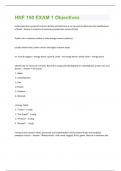
Understand the concept of nutrient density and state how it can be used to determine the healthfulness of foods - Answer-A measure of nutrients provided per calorie of food Foods rich in nutrients relative to their energy content (calories) usually whole foods; lower calroies and higher nutrient foods ex: fruits & veggies = energy dense; spam & candy - not energy dense; whole foods = energy dense Identify the six classes of nutrients. Recall the energy yield (kcal/gram) for carbohydrate, protein, fat, and alcohol. - Answer-• Six Classes 1. Water 2. Carbohydrates 3. Fats 4.Protein 5. Vitamins 6. Minerals • Energy Yields 1. *Carbs* - 4 cal/g 2. *Fat (Lipid)* - 9 cal/g 3. *Protein* - 4 cal/g 4. *Alcohol* - 7 cal/g Compare and contrast whole, processed, enriched/fortified, and functional foods and recognize examples of each. - Answer--*Whole foods*: milk, meat, veggies, fruits, grains. Basis of a nutritious diet.-*Processed foods*: foods subjected to any process, such as milling, alteration of texture, addition of additives, cooking, or others. Depending on the starting material and the process, a processed food may or may not be nutritious. -*Enriched/fortified food*: nutrients are added to the food, it's a concentrated form of sugar or fat (ex: enriched flour) -*Functional food*: general term for foods with beneficial physiological or psychological effects beyond providing essential nutrients ---(EX: "enhance mood," "promote relaxation and good karma," "increase alertness," and "improve memory") Recognize cues within nutrition information that could be misleading in advertising and media. - Answer- -News media often sensationalize single study findings and are not always trustworthy sources of nutrition information. -Too good to be true, suspicions about food supply, testimonials, false credentials, unpublished studies, persecution claims, authority not cited, motive: personal gain, advertisement, latest innovation/timetested Identify credible sources and credentials of experts in the field of nutrition who provide reliable nutrition information. - Answer--Professional health organizations (American Dietetic Association), government health agencies (FTC), certain consumer watchdog agencies (National Council against Health Fraud), reputable consumer groups (Better Business Bureau) -Scientific study published in a peer review journal, News report that describes research methods, Report should define study subjects Identify the steps of the scientific method - Answer-1. Ask a question/Observation 2. Conduct research 3. Hypothesis 4. Experiment 5. Data/analysis6. Conclusion Describe and recognize an example of the major types of research studies discussed in class. - Answer-1. *Case Studies*: study of individuals 2. *Epidemiological Studies*: studies of populations (ex: migration studies that follow populations who move from one food environment to another); usually reveal association, not causation (A is associated with B) a. *Cross-sectional*: measuring disease/condition at one time point between two or more groups b. *Case-control*: identifying cases (those with disease/condition) and comparing to controls (those without disease/condition) c. *Cohort*: following healthy population to see how many develop disease/condition 3. *Interventional Studies (Controlled/Clinical Trial)*: Researchers actively intervene in one group of the population (experimental group) and compare to a group that does not receive the intervention (control group) ---Ex: People were recruited for a study and divided into 2 groups. One at a plant based diet and the other did not. Those who had the plant based diet had lower cholesterol than those who ate regular diet 4. *Laboratory Studies*: studies performed under tightly controlled situations (often involve animals) Discuss strengths and weaknesses of the types of diet and nutrition measures discussed in class - Answer-1. *Anthropometric Methods* -measure various aspects of the body (ht, wt, body circumference,skinfold thickness) --strength: easy to obtain and generally reliable --weakness: no info about chemical/bodily issues, just measurements, may not give us full picture2. *Clinical Examination*: search for physical signs associated with severe vitamin or mineral deficiencies (diet-related diseases--high BP, skin conditions)--give dietary & environ. assessment Weakness: many signs/symptoms of deficiencies are not very specific & can take a long time for them to develop & a long time may elapse btwn the initial devlopment of poor nutritional health and first clinical evidence of problem 3. *Diet Questionnaires*: (ex: nutrition knowledge, attitudes, and behavior) -*24-Hour Recall*: record all food and fluid intake for previous 24 hours; best practice is to take average of 3 random 24-hour recalls (participants don't know when they will be measured) --Strengths: pretty accurate, easier to remember within 24-hours --Weaknesses: recall issues -*Food Frequency*: measures usual amounts of foods commonly eaten over a time period --Strengths: food/nutrient specific or general diet --Weaknesses: because time frame is much longer than one day, may be even harder for participants to remember or estimate portion 4. *Biomarkers*: measure nutrients or metabolites in bio-fluids (blood, urine, saliva) or tissues (hair, nails, skin, etc.)—(ex: urinary nitrogen, protein intake, sugar intake, plasma, Vitamin C) --Strengths: accurate, reliable, direct observation List the 5 characteristics scientists evaluate when weighing the totality of evidence about a specific nutrition question. - Answer-1. Consistent 2. Strong Correlations 3. Specific 4. Dose-Dependent 5. Biologically Plausible - come from mechanism studies (animal studies, cell studies, etc.) List the health properties of garlic, and which compounds are responsible for the health benefits and odor. - Answer--Contains *sulfur compounds* that are released when garlic is crushed or cut (*Responsible for odor and healing properties*)-Garlic is anti-microbial, anti-fungal, and anti-thrombic (prevents blood clots) -Rich in calcium, phosphorus, iron, thiamin and Vitamin C -Garlic and onions enhance the absorption of iron and zinc bound up by phytate in whole grains State reasons for the obesity and diabetes epidemic, and according to Dr. Alaimo, a better way to characterize it. - Answer--More calories available in the food supply, more total caloric sweetener, healthier food is more expensive, convenience, etc. -Trends toward supersizes -Daily Travels -A better way to characterize it is as the poor nutrition and physical inactivity epidemic State how the DRI's (RDA and EER) for energy and other nutrients are established. - Answer--Established by *DRI committee* by finding out how much of a nutrient a healthy individual needs (DRIs set by the Food and Nutrition Board, National Academy of Sciences, Washington DC) -RDA is calculated to meet the needs of 97-98% of the population -EER is set for energy, same as the EAR, goes straight down the middle of a bell curve --Review scientific studies of deficiencies, how much your body stores of the nutrient, what can cause depletion of the nutrient, and what other factors influence these factors --One type of study = *Balance Studies*---Test different levels of intake of the nutrient ---Measure excretion of the nutrient (urine, sweat, feces) ---Find out how much intake = excretion Identify the purposes and differences in the nutrient standards: Dietary Reference Intakes (DRI)- Estimated Average Requirements (EAR), Recommended Dietary Allowances (RDA), Adequate Intakes (AI), Tolerable Upper Intake Levels (UL), Daily Value (DV) and Acceptable Macronutrient Distribution Ranges (AMDR). - Answer-1. DRI - setting recommended intake levels 2. EAR - population-wide average nutrient requirements; use in nutrition research and policymaking; form the basis for the RDAs 3. RDA - nutrient intake goals for individuals (age & gender specific) 4. AI - nutrient intake goals for individuals; set when scientific data are insufficient to establish RDA 5. UL - identifies potentially toxic levels of nutrient intake; intakes above UL are likely to cause illness from toxicity 6. DV - nutrient standards printed on food labels and on grocery store & restaurant signs; based on nutrient and energy recommendations for a general 2000 calorie diet, allow consumers to compare foods with regard to nutrients 7. AMDR - provide adequate total energy and nutrients while preventing chronic diseases (ex: carbs, protein, fats) For the following nutrition labeling terms, *state the definition, who sets, how, why and/or for whom*: the *DRI's & Nutrition Facts Labels* - Answer-1. DRI -*Definition*: general term for a set of reference values used to plan and assess nutrition intakes of healthy people -*Who Sets*: DRI Committee -*How*: Developed and published by the Institution of Medicine-*Why*: To plan and assess nutrient intakes of healthy people -*For Whom*: Healthy persons ONLY 2. Nutrition Facts Labels -*Definition*: a label required on most packaged food -*Who Sets*: FDA -*How*: Published the final rules in the Federal Register -*Why*: Makes it easier to make better informed food choices -*For Whom*: Consumers For the following nutrition labeling terms, *state the definition, who sets, how, why and/or for whom*: *DV & RDA* - Answer-1. DV -*Definition*: nutrient standards used on food labels, in grocery stores, and on some restaurant menus -*Who Sets*: FDA -*How*: Labels of dietary supplements and foods -*Why*: To help consumers determine the levels of various nutrients in a standard serving of food in relation to their approx. requirement for it -*For Whom*: Consumers 2. RDA -*Definition*: nutrient intake goals for individuals -*Who Sets*: DRI -*How*: careful assessments of the amount of nutrient required to prevent a deficiency -*Why*: To meet the known nutrient needs of practically all healthy persons -*For Whom*: Healthy individuals For the following nutrition labeling terms, *state the definition, who sets, how, why and/or for whom*: *AI & EAR* - Answer-1. AI -*Definition*: nutrient intake goals for individuals set instead of RDA if there's insufficient evidence for EAR-*Who Sets*: DRI -*How*: based on experimentally derived intake levels or approximations of observed mean nutrient intakes by a group (or groups) of apparently healthy people -*Why*: goal for the nutrient intake of individuals; If sufficient scientific evidence is not available to establish an EAR and set an RDA, an AI is derived instead -*For Whom*: Healthy individuals 2. EAR -*Definition*: population-wide average nutrient requirements -*Who Sets*: DRI -*How*: derived from a group estimate -*Why*: nutrition research and policy making -*For Whom*: population-wide For the following nutrition labeling terms, *state the definition, who sets, how, why and/or for whom*: *UL & nutrient and health claims* - Answer-1. UL -*Definition*: suggested upper limit for potentially toxic nutrients -*Who Sets*: DRI -*How*: intakes above UL are likely to cause illness from toxicity; top of the DRI intake value (Safety zone) -*Why*: establish safety guidelines -*For Whom*: 2. Nutrient and Health Claims -*Definition*: voluntary statements made by food businesses on labels and in advertising about a food; for food packages only -*Who Sets*: regulated by FDA -*How*: only allowed when safe and supported by scientific evidence -*Why*: to inform -*For Whom*: ConsumersIdentify which foods the DRAFT 2015 Dietary Guidelines classify a healthy dietary pattern as being HIGHER in and which foods a healthy dietary pattern is LOWER in - Answer--*HIGHER* in vegetables, fruits, whole grains, low- or non-fat dairy, seafood, legumes, and nuts; moderate in alcohol (among adults) -*LOWER* in red and processed meats; sugar-sweetened foods and drinks; and refined grains Which foods do the DRAFT 2015 Dietary Guidelines state is associated with less environmental impact than the current U.S. diet? - Answer-Plant-based foods Non-animal based foods
Written for
- Institution
- HNF 150
- Course
- HNF 150
Document information
- Uploaded on
- May 18, 2024
- Number of pages
- 30
- Written in
- 2023/2024
- Type
- Exam (elaborations)
- Contains
- Questions & answers
Subjects

Also available in package deal