

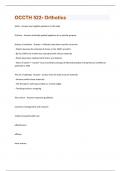
OCCTH 522- Orthotics Questions & Answers Already Graded A +
Splint - Answer-any tangible appliance to the body Orthosis - Answer-medically applied appliance for a specific purpose History of orthotics - Answer-- Orthotics have been used for centuries - Plastics became the material of choice in the 1930's and 40's - By the 1990's the market was saturated with various materials - Rivets have been replaced with Velcro as a fastener - Velcro ("velvet"/ "crochet") was invented by George de Mestral (Swedish entrepreneur) in1948 and patented in 1955 The art of splinting - Answer-- Comes from the wide array of materials - Variance within these materials - The therapist's technique (rolled vs. smooth edge) - Finishing touches: strapping The science - Answer-treatment guidelines outcomes management and research evidence-based health care effectiveness efficacy basic sciencetheory clinical expertise, patient values, clinic setting (all arrows pointing here) Rules of splinting - Answer-- you control the material, the material does NOT control you - splinting does not require brut force - when in doubt, begin again Goals of splting - Answer-1. To prevent dysfunction: - Protect weak muscle: Prevent contractures, Prevent stretching of unopposed muscles limiting functional recovery - Protect newly repaired structures: Conservative management of injuries, Post-operative management Goals of splinting - Answer-2. To maintain function - supporting joints, arches and other tissues in the presence of weak muscles or pathological state Goals of splinting - Answer-3. to restore function - maintain joint alignment - eliminate pain - restore normal mechanics of the hand Kinds of splints- Static - Answer-- Have no moveable parts - whenever possible the joints should be positioned in a "functional" position -wrist 20-30 degrees ext -MCP's 45-50 degrees flex - IP's 45 degrees flex -Thumb palmar abduction, full opposition- There are other sub-categories (e.g. Static progressive)- mobilization splint (splinting module) Kinds of Splints- Dynamic - Answer-- Splints-applies a force to a moveable part (active splinting) Splints Should: - Answer-1. Fulfill the physiological needs of the client 2. Be created as simply as possible 3. Not create dysfunction 4. Be cosmetically acceptable Why OTs? - Answer-Form follows function Client- centered Client independence Form of your splint is going to fit the function of your splint In your assessment you need to know what it is you are going to do in your life and how can I help you do that Education- can't forget- can't just give someone a splint and not educate them 4 phases of hand function - Answer-- 1st phase: Reach: you need good proximal stability for distal function - Prehension patterns: pinch (lateral, tripod, tip to tip) and grasp (cylindrical, ball, hook) - carry - release The therapists role - Answer-1. Understand the normal mechanics of the hand 2. Understand the pathology 3. Thorough examination 4. Define the function of the splint 5. Know the mechanics of splinting6. know how to design and construct a plint 7. Know the properties of the materials 8. Re-evaluate: does the splint meet all the criteria 9. Provide educaion 10. Document ex: Carpel tunnel- compression of the median nerve- increased volume in their from swelling (what causes this- repetitive moving, previous injury) Decompression of the nerve- 10 degrees of the wrist Define the function- splint is there to prevent the repetitive movement of your wrist, etc. Know the mechanicsThe architecture of the hand - Answer-the mobile unit 1. the 1st metacarpal 2. the phalanges 3. the 4th and 5th metacarpals: stabilizers with different size objects 4. the fixed of stabilizing unit: - the carpal bones - the 2nd and 4rd metacarpals
Document information
- Uploaded on
- May 18, 2024
- Number of pages
- 14
- Written in
- 2023/2024
- Type
- Exam (elaborations)
- Contains
- Questions & answers


