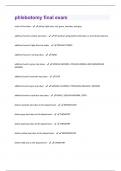
phlebotomy final exam Questions & Answers Already Graded A+
order of the draw - yellow, light blue, red, green, lavender, and grey additives found in yellow top tubes - SPS (sodium polyanethol sulfonate), or acid citrate dextrose additives found in light blue top tubes - SODIUM CITRATE additives found in red top tubes - NONE additive found in green top tubes - SODIUM HEPARIN, LITHIUM HEPARIN, AND AMMONIUM HEPARIN additive found in lavender top tubes - EDTA additive found in grey top tubes - SODIUM FLUORIDE / POTASSIUM OXALATE / HEPARIN additive found in royal blue top tubes - NONE / SODIUM HEPARIN / EDTA deliver lavender top tubes to this department - HEMATOLOGY deliver grey top tubes to this department - CHEMISTRY deliver gold top tubes to this department - CHEMISTRY deliver yellow top tubes to this department - MICROBIOLOGY deliver CBG test to this department - CHEMISTRYfilling tubes in the wrong order can result in - CONTAMINATION OF A SPECIMEN DUE TO ADDITIVE CARRYOVER standard needle gauge for venipuncture - 21g coagulation dept runs these tests - PT / APTT / PTT time needed for blood clotting in a tube containing no additive - 30 - 60 mins veins are anchored in order to - prevent the vein from rolling royal blue top tubes are used to collect - toxicology and traced metal specimens 21g - 22g needles are used for - routine venipuncture the proper order of vein selection - MEDIAN CUBITAL / CEPHALIC / BASILIC reasons to allow alcohol to dry completely before needle insertion - puncture will sting less, hemolysis is less likely to occur, evaporation process helps destroy microbes improper cleaning of venipuncture site can cause - INFECTION second choice vein, more visible on obesse patients - CEPHALIC VEIN tourniquets should never - tied over open sores (causes infection) / tied too tightly (cuases petechiae) / left on longer than one minute (causes hemoconcentration) to properl anchor a vein - pull the skin taut with your thumb, below the tube holderbutterfly and syringe needles may be used - on small frail veins such as those in children and geriatric patients types of needles used for phlebotomy - hypodermic needle / multisample needle / winged infusion (butterfly) yellow top tubes are used to collect - Blood culture specimens during venipuncture the needle is inserted at - a 15 - 30 degree angle with the bevel up lavender top tubes are used to collect - CBC specimens when identifying a patient in the hospital seeting always - check the patients ID band / ask the nurse the patients name / ask the patient to state his or her name after venipuncture pressure should be applied - for at least 5 mins prior to bandaging phlebotomist should avoid the basilic vein because - it lies near a major nerve and near the brachial artery and is more painful when punctured glucose tesst are collected in - grey top tubes types of anticoagulants include - sodium citrate, EDTA, sodium heparin, lithium heparin and ammonium heparin thixotropic gel found in light green tubes is a - coagulant the easiest veins to anchor - median cubital veinstubes containing anticoagulants - prevent clotting palpataing a vein is useful because it aids in determining - the depth of a vein / the direction of a vein / the size of the vein slanted tip of the needle is known as the - bevel open space inside the needle described by gauge - lumen located where the needl attaches to the syringe - hub when determining needle size remember that - the higher the gauge of the needle, the smaller the lumen the tourniquet should be applied - 3 - 4 inches above the injection site tubes should always be labeled with the following informatiom - patients name (ID #) / date / time of draw / phlebotomist initials / test type and urgency clot activators are designed to - accelerate coagulation the correct order for finishing a phlebotomy procedure - remove the tourniquet / remove the tube / place the gauze / remove the needle / apply pressure / discard needle in a sharps container after the torniquet is applied blood should be drawn - within 1 minute what anticoagulant is found in green top tubes - sodium heparin / lithium heparin / ammonium heparinitems needed for routine venipuncture include - alcohol / mutisample needle / gloves / tourniquet / gauze and tape / tubes and tube holder / bandaids after preforming venipuncture you should - apply pressure and instruct the patient not to bend his or her arm if pressure is applied to the gauze during needle removal - it is painful to the patient / prolongs needle removal / and the needl may cut through the patients skin correct order of the draw - yellow / light blue / red / green / lavender / grey a stat specimen should be collected - IMMEDIATELY when preforming venipuncture the following area should be avoided - areas that are scarred, burned, or sclerotic, and areas that appear edematous
Written for
- Institution
- Phlebotomy
- Course
- Phlebotomy
Document information
- Uploaded on
- May 18, 2024
- Number of pages
- 9
- Written in
- 2023/2024
- Type
- Exam (elaborations)
- Contains
- Questions & answers
Subjects

Also available in package deal