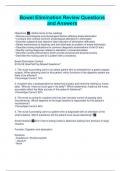
Bowel Elimination Review Questions and Answers
Objectives • Define terms in the readings • Discuss psychological and physiological factors affecting bowel elimination • Compare and contrast common physiological alterations in elimination • Describe subjective and objective data indicative of elimination difficulties • Relate mechanisms of laxatives and anti-diarrheals to problem of bowel elimination • Describe nursing implications for common diagnostic examinations of the GI tract • Identify nursing diagnoses related to alteration in bowel elimination • Describe nursing interventions which provide personal and physical privacy • Describe the nursing care for a patient with a colostomy Bowel Elimination Content EVOLVE SherPathTop Missed Questions * 1. The nurse is providing care to an obese patient who is scheduled for a gastric bypass surgery. When planning care for this patient, which functions of the digestive system are likely to be affected? Percentage Correct: 12% 2. A patient who is postoperative for abdominal surgery and receiving nothing by mouth asks, "Why do I have so much gas in my belly?" Which statements, made by the nurse, accurately reflect the likely sources of this patient's flatulence? Percentage Correct: 32% 3. The nurse is caring for a patient who has lost voluntary control of passing stool (incontinence). Which segment of the large intestine is responsible for this patient's incontinence? Percentage Correct: 46% 4. The nurse is providing care to a patient who is diagnosed with an alteration of the small intestine. Which substance will the patient have issues absorbing? Small Intestine 20-21 feet of tubing coiled in abdomen leading from stomach to large intestine Function: Digestion and absorption Divisions: - Duodenum: Shortest section - Jejunum -Ileum Characteristics: - Interior highly folded with VILLI (fingerlike projections) - Increases Surface Area for absorption Large Intestine - contains Chyme which moves through the small intestine, pass through the ileocecal valve (prevents contents from entering the large intestine prematurely & waste products from returning to small intestine) into the cecum (first part of the large intestine). - *Last 5 feet of the GI tract (not coiled)* - Resident bacteria act on food residue as it passes through; this action produces vitamin K & some B-complex vitamins. - Contents next enter the colon which contains several segments: Ascending colon(cecum toward liver) Hepatic flexure(turn across abdomen) Transverse colon(crosses abdomen right to left) Splenicflexure(turn down from abdomen) Descending colon(downleft side to sigmoid) Sigmoid colon(contains feces-solid waste products ready for excretion) Sigmoid colon empties into the Rectum (last part of large intestine) Chyme waste products of digestion rectum contains *3 transverse folds that temporarily hold on to fecal material* Vertical folds inside each contain an artery & Vein Feces are excreted from this through the anal canal via the anus; once excreted, waste is then called stool Distention of rectal walls is stimulus for defecation (bowel movement) Peristalsis (involuntary) - Contraction of circular & longitudinal muscles of intestine - Mass sweeps 3 to 4 times per day, usually after meals
Written for
- Institution
- GI and Bowel Elimination Fundamentals of Nursing
- Course
- GI and Bowel Elimination Fundamentals of Nursing
Document information
- Uploaded on
- May 17, 2024
- Number of pages
- 12
- Written in
- 2023/2024
- Type
- Exam (elaborations)
- Contains
- Questions & answers
Subjects
-
bowel elimination review questions and answers
-
objectives define terms in the readings disc
-
large intestine contains chyme which moves thro

Also available in package deal